
Dr. Vikas Kikan: Turning Crop Residue into India’s Clean Energy Future
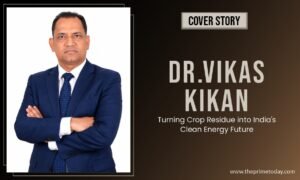
India’s clean energy transition is often discussed through the lens of solar parks, wind corridors, and large infrastructure projects. Yet one of the country’s most promising energy resources has been lying in its fields for decades.
Every harvest season, millions of tonnes of agricultural residue are burned, creating severe air pollution while wasting a resource that can generate energy, create rural income, and reduce dependence on fossil fuels.
Dr. Vikas Kikan saw that possibility long before biomass became a mainstream conversation. Widely known as the “Pellet Man of India,” he left a successful 26-year corporate career to build a business around agricultural residue and clean energy. As the CEO of Beyond Drilling and Exploration Private Limited, he has focused on creating a biomass ecosystem that connects farmers, technology and large energy consumers through scalable, commercially viable solutions.
A Corporate Career Replaced by a Larger Purpose
Dr. Kikan’s move from a successful corporate career to the renewable energy sector was not driven by dissatisfaction with business. It was driven by a growing awareness of a problem that affected both the environment and the economy.
During his years in the corporate world, he became increasingly conscious of crop residue burning and the enormous energy value contained in biomass that was being treated as waste. The question that stayed with him was simple but powerful: could a commercially viable business solve pollution, create value for farmers, and strengthen India’s energy security at the same time?
That question ultimately led him to leave a stable and successful career and enter the emerging biomass industry. The decision was far from easy. The sector was still developing, and the challenges were significant. Technology, quality, logistics, raw material aggregation, and the ability to supply large power plants consistently all required solutions that did not yet exist at scale.
What kept him committed was the opportunity to build something larger than a company. He wanted to create an ecosystem in which agricultural residue could become a recognised energy resource. Today, when crop residue is converted into fuel, farmers receive value from material that was once considered waste, and thermal power plants are able to replace a portion of coal with biomass. That transformation, he believes, validates the decision he made years ago.
The title “Pellet Man of India” represents more than industry recognition. To him, it reflects a mission to make biomass an integral part of India’s energy story and to encourage others in the sector to see their work as a contribution to the nation’s future.
Transforming Agricultural Residue into a National Biomass Ecosystem
Dr. Kikan has always viewed biomass as much more than a fuel. His vision has been to build an ecosystem that connects farmers, technology, and large energy consumers while turning agricultural residue into a reliable source of clean energy.
The starting point was a simple reality. Farmers often have a very short window between harvesting one crop and preparing for the next, and crop residue is frequently treated as a burden rather than a resource. Instead of asking farmers to stop burning residue, he believed the better solution was to create a dependable market where they could collect it, sell it, and earn from it.
That thinking became the foundation of Beyond Drilling and Exploration Private Limited. The company was built to bridge three gaps at once: the lack of economic value attached to agricultural residue, the need for organised collection and aggregation, and the demand for standardised biomass fuel from power plants and industrial users.
Through biomass aggregation, processing, pelletisation, quality control, logistics, and large-scale supply to thermal power plants, the company has worked to transform a fragmented agricultural-residue market into a structured energy ecosystem. Investments in indigenous technology through the TRIO ecosystem have further strengthened that effort by developing solutions suited to Indian agricultural conditions.
The achievement that matters most to Dr. Kikan is not simply business growth or production capacity. It is seeing agricultural residue increasingly recognised as an important energy resource rather than agricultural waste. His larger goal is to help build an industry in which crop residue contributes to farmer income, rural employment, India’s energy security, and a stronger circular bioeconomy.
What began as an effort to address stubble burning has evolved into a broader mission to create a scalable biomass ecosystem that links India’s farms with its clean-energy future.
Leadership Shaped by Decades of Business Experience
Dr. Kikan entered renewable energy after more than three decades in leadership and business development, including 26 years in an Agri-machinery multinational corporate environment. That experience, he says, fundamentally shaped the way he approaches sustainability.
His corporate career taught him that good ideas do not create lasting impact on their own. Strategy, execution, systems, quality, people, and the ability to scale are what transform ideas into industries.
He brought that discipline into biomass by studying the entire value chain. His focus has been on efficient residue collection, reliable technology, consistent fuel quality, optimised logistics, and commercially sustainable business models that work for both farmers and energy consumers.
The standards expected by large industrial customers also influenced his approach. Thermal power plants cannot rely on fuel that is inconsistent or intermittently available, which is why standardisation, quality control, and supply-chain reliability have become central pillars of his business.
Another lesson carried over from his corporate years is the importance of collaboration. Sustainability challenges of this scale cannot be solved by a single company. Farmers, technology providers, equipment manufacturers, transporters, power utilities, policymakers, and financial institutions all have a role to play.
He often reflects that his earlier career gave him business discipline, while biomass gave him a larger purpose. The combination of operational rigour and environmental commitment continues to define his leadership and his belief that sustainability must become a commercially viable and scalable model capable of creating measurable national impact.
A Supply Chain That Could Scale
Among all the challenges involved in biomass pellet manufacturing, Dr. Kikan believes the greatest test of leadership has been building a reliable biomass supply chain at scale. The difficulty was never the lack of agricultural residue. India has an abundance of it. The real challenge was turning that scattered, seasonal, and highly variable resource into a dependable industrial fuel.
Agricultural residue is spread across thousands of villages, differs in moisture and quality, and must be collected within a narrow harvesting window. Manufacturing pellets was only one part of the equation. The larger challenge was creating a system that could consistently bring the right biomass, with the right quality, to the right facility, at the right cost.
He approached the problem by treating the supply chain as the foundation of the business rather than a supporting function. The company worked across farm-level collection, aggregation, machinery deployment, storage, processing, quality control, and transportation. Investment in indigenous technology through the TRIO ecosystem became an important part of that strategy because Indian agricultural conditions require solutions designed specifically for local realities.
Weather fluctuations, changing feedstock prices, quality variations, and logistical disruptions created difficult periods, but each challenge led to stronger systems rather than short-term fixes. Supplier networks were expanded, quality-control mechanisms were strengthened, machinery and technology investments were increased, and long-term relationships with farmers and power-plant customers were prioritised.
One lesson has remained constant throughout the journey. A biomass plant is only one visible part of the business. The real strength of the company lies in the ecosystem that supports it. Reliable feedstock, efficient collection, robust technology, quality assurance, and dependable logistics are what make large-scale biomass possible.
Biomass as the Missing Link in India’s Renewable Energy Future
Dr. Kikan believes India’s clean-energy transition will not be driven by a single technology. Solar, wind, hydro, energy storage, green hydrogen, and biomass each have a role to play, and the country’s long-term energy security will depend on how intelligently these resources are integrated.
What makes biomass unique, in his view, is that it can be collected, stored, transported, and used whenever energy is required. Unlike variable renewable sources, it offers a dependable source of renewable fuel while addressing one of India’s largest agricultural and environmental challenges.
India produces enormous quantities of agricultural residue every year, much of which is still burned or discarded. Dr. Kikan sees this not as waste, but as a vast indigenous energy resource that can reduce fossil-fuel dependence, support thermal power and industrial applications, and strengthen the country’s energy independence.
He also views biomass as the foundation of a broader circular bioeconomy. Agricultural residue can become feedstock for pellets, compressed biogas, bio-CNG, biochar, and other value-added energy products, creating income for farmers and employment across rural supply chains.
His vision is one of complementarity rather than competition. Solar and wind can provide large volumes of clean electricity, energy storage can manage intermittency, and biomass can deliver reliable renewable fuel while solving residue management and creating economic opportunities in rural India.
He hopes that by 2035, the country will increasingly recognise agricultural residue as a strategic national resource and place biomass at the centre of India’s clean-energy and energy-security journey.
Creating the Conditions for Investment
After years of working with industry stakeholders, farmers, utilities, and technology providers, Dr. Kikan has become a strong advocate for building a more complete biomass ecosystem. He believes India has already taken important steps by recognising biomass as part of the clean-energy transition, but the next phase requires creating long-term confidence for investors.
The first priority, in his view, is predictable demand. Investors are more likely to commit capital to pellet plants, machinery, storage facilities, and logistics infrastructure when they know that a stable market exists. Long-term offtake agreements and consistent biomass-utilisation policies can provide the certainty needed for large-scale investment.
Strengthening farm-to-fuel supply chains is another critical area. Organised aggregation centres, better baling and collection infrastructure, scientific storage systems, and greater participation by rural entrepreneurs would significantly improve efficiency across the sector.
Access to finance remains equally important. Biomass plants and related infrastructure require substantial capital investment, and supportive green-financing mechanisms, appropriate lending structures, and accessible credit can accelerate growth.
He also believes that clear national biomass-fuel standards are essential. Consistent specifications for moisture, ash content, calorific value, and fuel dimensions would improve bankability and help biomass become a recognised industrial fuel across multiple sectors.
Carbon markets present another opportunity. Converting agricultural residue into useful energy instead of allowing it to be openly burned creates measurable environmental value, while biochar can contribute to long-term carbon-removal efforts.
The Next Generation of Biomass Innovation
Dr. Kikan believes the future of biomass lies not only in producing more pellets, but in producing better pellets, from a wider range of feedstocks, with greater efficiency and higher value from every tonne of biomass processed.
Advanced feedstock processing and pelletisation technologies are expected to play a major role by allowing manufacturers to handle diverse agricultural residues while maintaining consistent fuel quality and moisture control.
Among the technologies he finds particularly promising is torrefaction. Torrefied biomass is more energy-dense, more resistant to moisture, and more similar to coal in handling characteristics, making it easier to store, transport, and use in high-quality biomass applications. This is an area in which Beyond Drilling has been investing through its ZENERA torrefaction technology.
Automation and digitalisation are also expected to reshape the industry. Sensors, real-time quality monitoring, automated process control, and data analytics can improve consistency, reduce operational costs, and optimise energy consumption across manufacturing facilities.
He is equally convinced that innovation outside the plant is just as important as innovation inside it. Better balers, shredders, bale-breakers, mobile processing systems, GPS-enabled logistics, and digital aggregation platforms can significantly reduce the cost and complexity of moving biomass from farms to processing facilities.
The longer-term opportunity lies in integrated biorefineries capable of producing pellets, compressed biogas, biochar, heat, power, and other value-added products from the same biomass stream. Artificial intelligence can further improve feedstock forecasting, procurement planning, and predictive equipment maintenance.
Technology alone, however, will not transform the sector. Dr. Kikan believes lasting progress will come only when technology, supply chains, policy, and markets evolve together. His ambition is not merely for India to adopt biomass technologies developed elsewhere, but to become a global centre for developing, manufacturing, and exporting the technologies that will power the next generation of the bioenergy economy.
A Vision for 2030 and Beyond
Looking beyond 2030, Dr. Kikan envisions a future in which biomass is no longer regarded as an alternative or supplementary energy source. He wants it to be recognised as a mainstream pillar of India’s clean-energy and circular economy.
His vision extends far beyond pellet manufacturing. He sees a fully developed biomass industry that includes agricultural-residue collection, advanced pelletisation, torrefaction, compressed biogas, bio-CNG, biochar, carbon-removal technologies, biomass-based power generation, and a wide range of value-added bioenergy products.
At the centre of that vision is a simple but transformative idea: agricultural residue should have economic value before it creates environmental cost. Farmers should be able to earn from residue that is currently discarded or burned. Rural entrepreneurs should find opportunities in collection, aggregation, and processing. Industries and power plants should have access to reliable, standardised renewable fuels produced within India.
He also believes India has the potential to become a global leader in biomass technology. Solutions developed for Indian agricultural conditions could be exported to many other countries facing similar residue-management and energy challenges.
His own role, he says, is to help build an industry rather than merely expand a company. Through Beyond Drilling and Exploration and its technology initiatives, he hopes to contribute to manufacturing, feedstock aggregation, quality systems, supply-chain development, and large-scale biomass utilisation.
What he ultimately wants to see is a national movement in which millions of tonnes of agricultural residue are transformed into energy, rural income, and environmental value. If his work helps create a bridge between India’s farms and its energy future, he believes it will have served its purpose.
A Legacy Built on Clean Energy, Rural Growth, and Innovation
Dr. Kikan believes India is entering one of the most important phases of its clean-energy journey, and he sees renewable energy not as a future opportunity, but as one of the country’s defining business opportunities today.
His message to entrepreneurs and investors is rooted in experience. India’s growing energy demand will require innovation across biomass, compressed biogas, biochar, waste-to-energy solutions, equipment manufacturing, logistics and carbon markets. Biomass, he says, should not be viewed as a simple commodity business, but as an ecosystem that requires technology, infrastructure, strong supply chains and long-term commitment.
He believes the entrepreneurs who will shape the future are those who are willing to solve difficult problems rather than wait for the market to become easy. India needs indigenous technologies designed for local agricultural conditions and capable of creating value not only within the country but also in global markets.
At the heart of his philosophy is the belief that profitability and sustainability can grow together. A well-designed biomass ecosystem can generate financial returns while reducing agricultural burning, creating rural employment, strengthening energy security, and lowering dependence on fossil fuels.
Being recognised among India’s leading renewable energy leaders is an honour he accepts with gratitude, but he views it less as a personal achievement and more as recognition of the entire ecosystem of farmers, engineers, technology developers, transporters, power utilities, and teams that have contributed to the biomass movement.
The legacy he hopes to leave is not measured only in pellet production or manufacturing capacity. What matters most to him is changing the way people think about agricultural residue. He wants future generations to see it as a valuable resource rather than waste and to understand that environmental responsibility and business success can reinforce each other.
In the end, Dr. Kikan hopes to be remembered not only as the “Pellet Man of India,” but as someone who helped build a bridge between India’s farms, its energy security, and its green future. If the ecosystem he has worked to create continues to generate value for farmers, cleaner energy for the nation, and opportunities for future sustainability leaders, he believes that will be the most meaningful legacy of all.