
C. Joseph Vijay, Chief Minister of Tamil Nadu, 2026
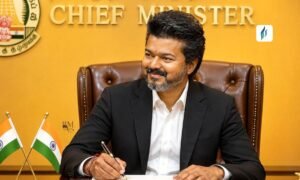
A film star who spent decades commanding massive audiences now sits at the centre of Tamil Nadu’s political power. C. Joseph Vijay became Chief Minister of Tamil Nadu in 2026 after the Tamilaga Vettri Kazhagam (TVK) emerged as the single-largest party in the 2026 Assembly election, and Vijay was sworn in as chief minister on May 10.
His rise is significant because it broke the long-standing pattern of governments led by the DMK or AIADMK. Vijay’s first months in office have therefore been closely watched not only for what his government promises, but for how a political newcomer handles the demands of running one of India’s most politically influential states.
How Did C. Joseph Vijay Become Tamil Nadu Chief Minister?
The 2026 Assembly election became his first major electoral test. TVK won 108 of Tamil Nadu’s 234 Assembly seats, making it the largest single party but leaving it short of the 118 seats required for a simple majority. Congress won five seats, while VCK, IUML and the Left parties provided additional support. The resulting coalition reached 121 seats, allowing Vijay to stake his claim to form the government.
Vijay was sworn in at Chennai’s Jawaharlal Nehru Stadium on May 10, 2026. The ceremony formally transformed a political movement built around a hugely popular actor into the state’s ruling administration.
What Did Vijay Promise After Taking Office?
The early government agenda provides a clearer picture of what C. Joseph Vijay Chief Minister Tamil Nadu 2026 means in practical terms.
According to the TVK government’s published programme, Vijay’s administration placed emphasis on women’s welfare, healthcare, education, employment and farmers. On his first day at the Secretariat, the government announced measures including 200 units of free electricity for every household, a dedicated Women’s Protection Force and specialised anti-drug squads.
These promises are important because election campaigns and government administration operate differently. Once in office, each announcement has to move through budgets, departments, legislation and implementation.
The challenge for Vijay is therefore not simply to introduce popular policies but to demonstrate how those promises can be funded and delivered across the state.
How Is Vijay Handling His Transition From Cinema to Politics?
The transition behind C. Joseph Vijay, Chief Minister of Tamil Nadu in 2026, is unusual because Vijay entered government after an exceptionally long career in Tamil cinema.
His political appeal was built partly through his large fan base, but governing requires a different kind of organisation. A film career revolves around individual performance and public visibility, while a state government depends on ministers, civil servants, legislators, local administration and institutional processes.
That difference is now becoming increasingly important. Vijay has to establish a functioning political organisation while also maintaining control over a coalition government.
His performance will ultimately be judged less by his popularity and more by measurable outcomes in areas such as jobs, public services, education, healthcare, infrastructure and law and order.
What Challenges Does Vijay Face as Chief Minister?
The government began with 121 seats in its supporting coalition, only three above the majority threshold. That makes relationships with alliance partners particularly important. Any disagreement over policy, ministerial responsibilities or the future direction of the coalition could become politically significant.
That issue has already become visible in discussions surrounding the alliance’s future. A meeting scheduled for September 9 is expected to address the formal structure and direction of the TVK-led alliance, with Congress, MDMK and Left parties among the political forces involved in the broader discussions.
Vijay must therefore balance his own political identity with the interests of parties that helped his government reach the majority mark.
Could Vijay Have National Political Ambitions?
The discussion around C. Joseph Vijay, Chief Minister of Tamil Nadu, 2026 has already moved beyond state politics.
Some TVK leaders and supporters have begun promoting Vijay as a possible national opposition figure ahead of the 2029 Lok Sabha election. Congress, however, has publicly pushed back against the idea of replacing Rahul Gandhi as its preferred prime ministerial candidate.
For now, Vijay’s immediate responsibility remains Tamil Nadu. Building a successful state government would be the strongest foundation for any future national ambitions.
The coming years will show whether his political influence can extend beyond the popularity he established through cinema and whether TVK can develop into a durable political organisation.
What Does Vijay’s Rise Mean for Tamil Nadu Politics?
The emergence of C. Joseph Vijay’s Chief Minister of Tamil Nadu in 2026 has changed the political equation in Tamil Nadu almost overnight.
The state now has a government led by a party that did not exist as a major electoral force until recently. Its success has weakened the assumption that Tamil Nadu politics will automatically revolve around the DMK-AIADMK contest.
But winning an election is only the beginning. Vijay now has to build institutions, manage coalition partners, fulfil policy commitments and respond to criticism while proving that his administration can function beyond his personal popularity.
Conclusion
- Joseph Vijay Chief Minister Tamil Nadu 2026 is one of the most significant political developments in the state this year. Vijay has moved from a four-decade film career into the highest elected office in Tamil Nadu after TVK won 108 Assembly seats and formed a government with coalition support.
His first term will ultimately be defined by what happens after the election headlines disappear. If his government can turn its promises into measurable results while maintaining coalition stability, Vijay could establish a lasting political legacy. If not, his remarkable electoral rise may prove easier than the harder task of governing.