
David Wortley: We Keep Making Technology Smarter. What About Us?
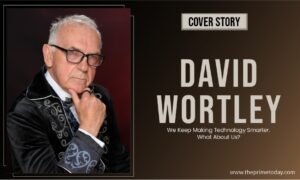
One unexpected discovery in a Leicestershire village led to a three-decade exploration of technology, storytelling and the extraordinary potential people carry within them.
The more technology can do for us, the easier it is to overlook what people can do for themselves. We have become accustomed to asking what the latest device, platform or artificial intelligence can accomplish, while the more interesting question often sits with the person using it: what might they achieve if technology helped them see their own potential more clearly?
David Wortley has spent more than three decades exploring that question. A Fellow of the Royal Society of Arts, motivational speaker, futurologist and advocate for the transformative power of technology in human lives, his career has taken him from high-tech business and community projects to immersive experiences, digital health, gamification and artificial intelligence. The subjects have changed over the years, but the belief underneath them has remained remarkably consistent. Technology has value when it helps people do more with the abilities they already possess.
He first saw the power of that idea in 1998, in a rural village in Leicestershire.
At the time, David was running a small high-tech business and watching the impact of globalisation on communities like his. He had an instinctive feeling that every community contained unseen, under-utilised talent, and he wanted to find a way to surface it. That led him to create ComKnet, the Community Commerce and Knowledge Network, a project that secured £250,000 from a Government award under the Multimedia Demonstrator programme.
As part of the project, he began searching for local talent online, which in those days meant using search engines that predated Google. One search led him to Bigfern, a website that had already done much of what he was trying to build. It was a genuinely impressive piece of work.
There was a moral dilemma as to whether to involve its creator in his project, so David invited the webmaster to visit him one Friday afternoon.
When the man arrived, David thought he recognised him.
He did.
He was his milkman.
The milkman had built the entire website as a part-time hobby on a computer he had constructed himself.
For David, the significance of that discovery went far beyond the surprise of finding that his milkman was also a self-taught web creator. That encounter gave him a lasting view of technology, but it also taught him something about ideas themselves: people need a story before they can see why an idea matters.
An Idea Needs a Story Before It Can Reach People
David calls himself a storyteller at heart because he has seen how easily good ideas can disappear when people cannot connect with them.
To influence and engage people, he believes people need to communicate effectively. Someone can be the best engineer and innovator in the world, but if they cannot tell their story, their ideas go nowhere. The technology is only ever the vehicle. The story is what moves people.
For David, this connection between technology and storytelling runs deeper than presentation or communication skills. He has always believed that the most powerful innovations are the ones that connect with something deeply human. Storytelling becomes part of the technology itself because it determines whether the technical work ever has any impact at all.
That view also shapes his understanding of why some innovations survive while others fade away.
There is no clean formula, he believes. Luck matters. So does effective storytelling, being in the right place at the right time, passion, determination, resilience and an unwavering faith in a product.
People tend to want a cleaner answer. They want a framework or a formula. But the truth is messier and more human than that. The technologies that endure are usually the ones with someone behind them who simply refused to stop believing in them, even when the world had not caught up yet.
David’s own career has been formed by that willingness to keep following an idea, particularly when it concerns the relationship between technology and human behaviour.
The Most Powerful Health Tool May Be the One That Changes Behaviour
In 2013, that relationship became personal.
A combination of circumstances led David, as a healthy but obese 64-year-old, to start using a fitness tracker called the Jawbone UP. Rather than treating it simply as a device for collecting information, he began gamifying his own health. He tracked his steps, his sleep and his calories, and set himself the goal of walking 10,000 steps every day.
Within three months, he had lost 21kg and seen significant improvements in both his physical and mental health. He has walked over five miles every single day since then, and he has never stopped talking about it.
The experience changed the way he thought about healthcare. The most powerful healthcare intervention, he believes, is not always a drug or a procedure. Sometimes it is giving someone the right information about their own body, at the right moment, in a way that motivates them to act. Technology can do that beautifully, when it is designed well.
For business leaders, he sees a practical lesson. The commercial benefits of investing in the lifestyle health of their people are real and measurable. His advice is direct: lead by example.
The reason the Jawbone UP worked so well for him also revealed something important about behaviour itself. The technology gave him information, but the information became useful because it made him want to keep going.
The Difference Between a Reward and a Reason
The best example David can give of gamification genuinely changing behaviour is his own. The health transformation he described was driven entirely by gamification. The Jawbone UP turned his daily health into a game he wanted to keep playing, and the results were profound.
What made it work was intrinsic motivation. The pleasure came from the activity itself: seeing the numbers, hitting the targets, feeling the difference.
Gamification is an essential tool for shaping human behaviour, but it has to deliver intrinsic motivation rather than extrinsic motivation, which has a limited lifespan. Once the external reward disappears, so does the behaviour. Get the intrinsic part right, and the change becomes permanent.
David has seen this replicated by many others since 2013, and it is one of the reasons he remains such a passionate advocate for technology-enabled personal health management.
The principle is simple enough to apply well beyond health. Give people a reason to engage, help them see progress and allow the satisfaction of doing something well to become its own reward. Technology can support that process, but the motivation still belongs to the person.
That distinction becomes increasingly important as immersive technology enters more areas of work and everyday life.
Start With People, Then Reach for the Technology
For leaders in 2026, David believes the important question is what immersive experiences and technologies can and cannot do. The focus, he says, should remain on solutions that are affordable, accessible and attractive.
It sounds simple, but this is where most organisations go wrong.
There is still a tendency to be seduced by the spectacle of immersive tech without asking the harder question: what problem does this actually solve, and for whom?
The leaders who get the most from immersive technology are the ones who start with a human need and work backwards to the tool, not the other way around.
That thinking sits at the heart of 360in360 Immersive Experiences, the platform David leads with a focus on making immersive technology affordable, accessible and meaningful. It is also consistent with the belief that has followed him since the discovery of his milkman’s hidden talent. The technology itself is rarely the whole story. What matters is what becomes possible for the person using it.
His interest in that relationship has continued to take him into new territory. He is also the author of Gadget to God, a book exploring our deepening and often unexamined relationship with technology. More recently, 360in360 has pioneered AI audiobook production, debuting with Gadget to God as its first title.
As the technology changes, David continues to look closely at the human behaviour underneath it.
A Life Built Around Curiosity and Discipline
Keeping pace with so many different frontiers require a particular kind of rhythm. David has developed a daily routine that combines certainty and uncertainty, and he thinks that balance is important.
He wakes up early, drinks water and a protein drink, and works through emails and priority tasks. Then he goes for a morning walk, which is non-negotiable, before stopping for a small breakfast and coffee at a local café around 8:30. He is back home by 10, and he tries to spend the rest of the morning doing creative work. Lunch and dinner are at regular times, and he is in bed by 10:30.
Within that structure there is plenty of room for the unexpected: international travel, speaking at conferences, talks on cruise ships. He always has something to look forward to, and he always tries to be using the latest technologies, because staying current is not optional in the work, he does.
The routine keeps him grounded. The variety keeps him alive.
It is also a useful description of his approach to entrepreneurship. He values direction, but leaves room for discovery. He believes entrepreneurs should focus on their own dreams and aspirations and, paradoxically, help and collaborate with others.
They should find people who share their vision and avoid wasting time on people who do not understand or appreciate their work.
The entrepreneurs who shape the future are the ones clear enough about their own direction that they can stay on course even when the world around them is noisy and uncertain. That clarity is the most valuable asset they can have.
The Future Needs People Who Can Think for Themselves
David has spent his career looking towards what comes next, but his predictions are rarely comfortable.
His book Gadget to God is full of them. Yet one prediction still concerns him most deeply: the relationship with AI is already replacing the relationship with whatever deity people believe in.
People turn to it for answers, for guidance, for comfort, for a sense of what is true. The dependency is there. Most people simply have not named it yet.
David believes this has already happened, but people do not realise the consequences for the future of humanity. That concerns him deeply.
For him, trusting your own vision means being willing to say the uncomfortable thing clearly, even when the world is not ready to hear it.
There is an interesting tension in that view. David has spent his career encouraging people to use technology, embrace new possibilities and stay curious about what is coming next, while also asking them to remain conscious of what technology may be doing to the way they think, behave and make decisions.
That tension may be central to his philosophy. Progress requires curiosity, but curiosity without reflection can become dependence. The more powerful technology becomes, the more important it becomes for people to understand themselves.
The Legacy is About What Other People Discover in Themselves
After more than three decades of work across technology, human potential and societal change, David’s idea of legacy is surprisingly simple.
He wants to feel that, in whatever small way, he has made a positive difference to people’s lives.
He is not looking for fame or fortune. What he is looking for is the quiet satisfaction of knowing that he did what he was able to do, that he at least partially fulfilled his own potential, and that some of the people he encountered along the way fulfilled a little more of theirs because of it.
That brings his career back to where it began, with a man delivering milk to a rural Leicestershire village who had quietly taught himself how to build a website on a computer he had made himself.
David could have simply remembered the encounter as an amusing surprise. Instead, he saw something larger in it: the possibility that technology could bring abilities out into the open, give people a means to express them and perhaps change what they believed they could do.
More than three decades later, that remains the thread running through his work.
The devices will change. The platforms will change. Artificial intelligence will keep changing what technology can do.
The question David keeps returning to is more enduring: what might people become when they have the tools, confidence and opportunity to fulfil a little more of their potential?
For him, that is where the real value of technology begins.