
Dr. Mohamad Abu Ghazaleh-Powered Human Core of Digital Success: Elevating People and Purpose in Global Enterprise
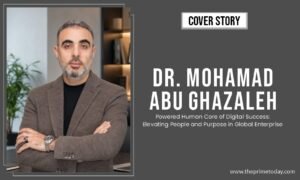
Modern corporate expansions are demanding as well as challenging. They require data systems capable of turning strategic goals into measurable operational results. In that regard, steering major enterprise-wide digital transformation initiatives across multi-billion-dollar organizations for over twenty-five years is Dr. Mohamad Abu Ghazaleh. Encompassing highly complex industrial sectors is his extensive executive leadership. It includes real estate, commercial ports, economic cities, automotive networks, and industrial manufacturing plants. As the Group Chief Information Officer (CIO) at Bayari Investments, he bridges tech capability with commercial performance. On driving business growth, pioneering continuous innovation, and elevating the customer experience through targeted technology deployment is his focus. He introduces advanced enterprise platforms. At the same time, he executes cloud modernization strategies. That way, Dr. Mohamad has been helping diverse business units in discarding outdated legacy systems. So that they are able to adopt high-performance digital models. These are frameworks that ensure sustainable competitive advantage.
Redefining Enterprise Operations Across Diverse Industries
An IDC CIO Excellence Awardee, Dr. Mohamad partners directly with Chief Executive Officers, corporate Boards, and executive leadership teams to accelerate organizational growth and achieve operational excellence. His day-to-day oversight covers enterprise artificial intelligence adoption, modern digital operating models, comprehensive customer relationship management transformations, and robust cybersecurity governance. By aligning data infrastructure with business strategy, he ensures that multi-billion-dollar corporate portfolios can predict market shifts and make data-driven decisions with complete confidence. His unique governance framework protects sensitive corporate assets while giving technical teams the flexibility to experiment with modern automated workflows, drastically reducing go-to-market timelines for new real estate and logistics services.
Bridging Advanced Research with Practical Business Execution
Beyond his corporate duties, Dr. Mohamad combines practical executive leadership with deep academic expertise. As a Part-time Professor in Digital Transformation and AI, he translates complex theoretical research into functional corporate strategy. This dual role allows him to introduce cutting-edge university insights straight into the industrial sector, keeping Bayari Investments ahead of the digital curve. His educational background ensures that his teams understand the underlying mechanics of machine learning and system security, preventing the common pitfalls of superficial technology adoption. Dr. Mohamad meets with his senior technology directors to review an automated supply-chain optimization algorithm, planning how to scale its processing capabilities across the group’s maritime port operations.
The Human Core of Technological Evolution
Throughout his career, peers and colleagues have frequently asked Dr. Mohamad a fundamental question: What is the secret to successful digital transformation? After more than twenty-five years leading enterprise technology across diverse industries, his answer has become surprisingly simple.
- It is not artificial intelligence.
- It is not cloud computing.
- It is not enterprise architecture.
- It is not even technology itself.
The answer is people.
He did not arrive at this conclusion by reading a textbook or attending a corporate seminar. Instead, he learned it by standing in boardrooms where billion-dirham transformation programs were being discussed, sitting with employees who genuinely feared that technology would replace them, celebrating successful implementations that changed entire organizations, and learning from projects that taught him far more through their challenges than their successes ever could.
Moving Beyond Technical Fascination
Like many technology professionals early in his career, Dr. Mohamad was deeply fascinated by innovation. Every new platform represented a world of possibility, every software implementation promised sweeping transformation, and every emerging technology appeared capable of solving the next complex business challenge. He originally believed that if his team selected the right technology and delivered it successfully, organizational transformation would naturally follow.
However, hands-on experience taught him otherwise. One specific meeting early in his leadership journey changed his perspective forever. The executive team spent hours discussing implementation timelines, artificial intelligence capabilities, infrastructure requirements, integration complexity, and project budgets. Every technical detail had been carefully planned. Yet when someone finally asked a simple question, “What business problem are we actually trying to solve?” the entire room became silent.
Starting with Strategy First
That silence became one of the most valuable lessons of his entire career. He realized that the team had invested enormous energy discussing technology while spending almost no time discussing the actual business itself. Since that day, every transformation he has led has started with a completely different conversation.
- Before discussing systems, he and his team discuss strategy.
- Before selecting any technology, they focus heavily on understanding the customers.
- Before defining architecture, they work to fully understand business processes.
- Before introducing artificial intelligence, they explicitly identify the decisions that this intelligence should improve.
Dr. Mohamad sketches out a customer journey map on a whiteboard, ensuring his technical managers align their new automation scripts with real-world user needs.
Technology as a Strategic Vehicle
In his management philosophy, technology should never become the final destination. Instead, it must remain the vehicle that helps organizations reach their true strategic destination. Throughout his career, Dr. Mohamad has been fortunate to lead digital transformation initiatives across remarkably different industries, moving from ports and free zones to industrial cities, real estate, automotive networks, customer services, and complex enterprise operations. At first glance, these industries appear completely different because they serve different customers, operate under different regulations, and rely on distinct business models.
Yet they all share one common challenge. Every organization is ultimately trying to create more value for people. Whether moving cargo across global supply chains, selling homes to families, improving customer experiences, or optimizing heavy industrial operations, technology becomes meaningful only when it directly improves human experiences.
Defining Meaningful Innovation
This realization transformed not only the way he leads technology departments, but also the way he defines modern innovation. To him, innovation is not about introducing the newest technology just for the sake of novelty. True innovation means finding a better way to solve a meaningful problem. Artificial intelligence may become part of that solution, cloud computing may enable it, data analytics may guide it, and enterprise applications may execute it.
But none of these advanced technologies creates value on their own. People create value, and technology simply amplifies their potential. This human-first mindset guides his technical roadmap at Bayari Investments, ensuring every automated platform serves a clear, practical purpose. Dr. Mohamad checks the feedback loop on a freshly launched logistics tracking app, analyzing how quickly warehouse staff can navigate the interface to update incoming shipments.
The Confluence of Boardroom and Classroom
As his career evolved, another unexpected opportunity shaped his thinking even further. Alongside his intensive executive responsibilities, Dr. Mohamad also became a part-time professor. Many people have asked why someone with such demanding executive responsibilities would choose to teach at a university, and his answer has always been exactly the same: teaching has made him a better corporate executive.
Every week, he moves smoothly between two very different worlds. During the day, he sits in high-level executive meetings where decisions directly affect multi-billion-dollar organizations, customers, employees, and shareholders. His team discusses digital strategy, cybersecurity, artificial intelligence, investment priorities, enterprise architecture, operational excellence, and long-term business growth. Later, he walks into a university classroom filled with students preparing to become tomorrow’s leaders. Together, they explore disruptive technologies, digital transformation, supply chain analytics, management science, enterprise systems, and strategic leadership.
Closing the Gap Between Industry and Academia
To many people, these activities look like two entirely separate careers. To him, they have become a single, unified mission. The boardroom teaches him what the classroom should never ignore, while the classroom reminds him what the boardroom should never forget. This continuous exchange of ideas has convinced him that one of the greatest opportunities facing every country is closing the gap between business and academia.
For too long, these two worlds have developed in parallel lines without interacting enough. Dr. Mohamad believes that true innovation accelerates when theoretical research connects directly with practical business execution. He updates his syllabus with actual case studies from his recent port operations, creating an environment where future leaders learn to apply data models to real-world logistics bottlenecks.
Becoming the Bridge Between Worlds
Universities produce brilliant theories, frameworks, and research, yet students sometimes graduate without fully understanding the realities that organizations face every day. On the other hand, businesses solve complex practical challenges, yet they occasionally overlook decades of academic research that could accelerate better decisions. Both sides possess extraordinary knowledge, but neither side is complete without the other. Dr. Mohamad has made it his personal mission to become a bridge between these separate worlds.
Every transformation project he leads in his corporate role eventually becomes a practical case study in his university classroom. At the same time, every academic discussion encourages him to challenge static assumptions inside the organizations he serves. When his students study artificial intelligence, they do not simply learn abstract coding algorithms. Instead, they analyze how AI changes real customer experiences, supports executive decision-making, improves operational efficiency, strengthens corporate governance, and creates measurable business value.
Shared Ownership of Digital Strategy
When his students study enterprise architecture, they do not just memorize rigid theoretical frameworks. They learn exactly how structure enables large organizations to remain resilient while adapting to constant market change. When they discuss digital transformation, they never begin with technology, but always with business strategy. In the real world, successful digital transformation is never owned exclusively by the IT team; it is owned completely by the business.
Technology leaders must therefore become true business leaders, and business leaders must become deeply technology-aware. The future belongs entirely to professionals who can comfortably speak both languages. Today, artificial intelligence dominates almost every single conversation about the corporate future, causing every organization to ask similar questions about job replacement, role elimination, and adoption speed.
The Limitless Nature of Human Potential
Yet Dr. Mohamad believes there is an even more important question to address: how do we ensure technology empowers people and drives genuine business value? Artificial intelligence can analyze millions of data records within seconds, but it cannot replace human empathy. Machine learning can identify complex patterns invisible to humans, but it cannot replace deep wisdom. Automation can eliminate repetitive work, but it cannot replace true leadership. Large language models can generate impressive text answers, but they cannot replace experience earned through years of solving real business challenges.
The organizations that succeed over the next decade will not necessarily own the most advanced technologies. Instead, they will build the strongest internal cultures, develop leaders who continuously learn, encourage curiosity instead of protecting rigid hierarchy, and invest just as much in people as they invest in software platforms. Every technology investment eventually reaches a natural limit, but human potential does not. Dr. Mohamad closes his presentation slides on digital operating models, preparing to engage his executive team in a discussion on human-centric AI workflows.
The Lifelong Learning Journey
He embraces the willingness to admit that leadership itself is a lifelong learning journey that never truly stops. Every year, corporate technology evolves at a rapid pace. Artificial intelligence becomes far more capable, cybersecurity grows increasingly complex, customer expectations continue to rise, and traditional business models are constantly being reinvented. Yet despite all this constant change, one core principle has remained completely constant throughout his career. The organizations that thrive over the long term are those that never stop learning.
That principle applies equally to individuals navigating the modern marketplace. If he could offer one vital piece of advice to every aspiring technology professional, it would be to avoid building a career entirely around a specific technology. Instead, professionals must build their careers around solving meaningful business problems. The specific technologies mastered today will eventually evolve, and some will disappear from the market completely. However, an individual’s ability to think critically, communicate clearly, understand business operations, inspire diverse teams, and create genuine value will remain entirely relevant throughout an entire career.
Cultivating the Next Generation of Leaders
One of the greatest privileges of his career has been watching people grow within the corporate landscape. Dr. Mohamad has seen young graduates become highly respected technology leaders under his guidance. He has watched employees who once fiercely resisted structural change become the strongest champions of corporate innovation. He has even taught university students who later returned as successful executives, leading digital transformation initiatives inside their own independent organizations.
Those moments remind him that leadership is never measured only by the projects completed or the software systems implemented. True leadership is measured by the people developed along the way. If he has learned anything over the past twenty-five years, it is that the greatest responsibility of a corporate leader is not simply delivering financial results. The true responsibility is leaving organizations stronger than they were founded. Achieving this requires far more than technical expertise, demanding deep integrity, humility, continuous learning, and the consistent courage to challenge assumptions.
Developing an Extraordinary Perspective
He encourages rising professionals to read widely beyond their narrow technical specialization. He advises them to understand finance, study human psychology, learn the mechanics of daily operations, explore corporate strategy, and constantly develop strong communication skills. He believes in listening much more than speaking, and asking better questions before searching for fast answers. Because technology alone will never distinguish extraordinary leaders, but a well-rounded business perspective will.
Transformation as a Cultural Journey
To every business leader in the modern market, Dr. Mohamad offers an equally important message: do not view digital transformation as just another isolated corporate project. Instead, view it as a deep cultural journey. Leaders should not ask their technology teams to simply implement systems, but should actively invite them to participate in shaping core business strategy. Likewise, companies must encourage every single business function to become digitally fluent. Innovation should never belong exclusively to one isolated department, but must become a fundamental part of an organization’s cultural DNA.
When business and technology move forward together, transformation naturally accelerates. When business operations and academia collaborate openly, innovation becomes truly sustainable over the long term. When leaders prioritize investing in developing people rather than simply deploying technical platforms, organizations create enduring legacies rather than short-lived technical projects. As he reflects on his own career, he realizes that his most meaningful achievements were never the awards, the corporate titles, or even the massive transformation programs. Instead, they were the precious opportunities to create a lasting impact through people.
The Power of Human Impact
The real highlights of his journey live in the small human milestones: the executive who discovered a completely new way of leading, the employee who found fresh confidence through rapid corporate change, and the student who entered his university classroom seeking basic knowledge and left believing they could shape the future of the industry. Those moments remind him exactly why leadership matters. Technology will continue to evolve long after our individual careers end, artificial intelligence will become vastly more intelligent, organizations will become more tightly connected, and entire industries will continue to transform.
Yet there is one distinct competitive advantage that no computer algorithm will ever replicate: leaders who can successfully unite vision with daily execution, innovation with corporate responsibility, technology with basic humanity, and business operations with education. That is the exact future he believes in. He envisions a world where corporate boardrooms become deep learning environments, classrooms become active innovation laboratories, and leaders never stop being students. The greatest transformation any leader can achieve is not changing the software technology itself, but changing the way people think.
Creating Inspiring Organizations
When that mental shift happens, organizations do not simply improve their daily metrics;
- They inspire,
- They endure, and
- They create true value that extends far beyond corporate balance sheets and static business plans.
If his journey has taught him one enduring lesson, it is that technology may power the transformation, but it is people, clear purpose, and continuous learning that determine whether that transformation leaves a lasting legacy. “When we bridge the separate worlds of business and academia, combine rapid innovation with deep wisdom, and place real people at the heart of every single decision, we create something far more valuable than simple digital success. We create resilient organizations capable of shaping a better future for generations to come.” Dr. Mohamad’s vision for the future is particularly focused on Agentic AI, autonomous enterprises, and responsible AI governance.