
Engineering Superpowers: Nitesh Kankariya’s Enterprise Logic for Human and Artificial Intelligence’s Fusion-Powered Future
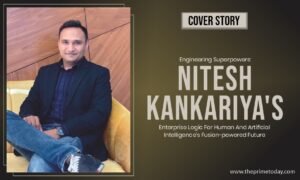
The modern recruitment landscape was in turmoil. Nitesh Kankariya saw the problem: too many candidates, too little time for the human resources department to screen them, and too much cost per hire. He also found out the possible solution: streamlining corporate recruitment logistics through scalable automation. So, as the Founder and Chief Executive Officer (CEO) of Geniehire.ai, by shifting corporate recruitment workflows from manual screening to rapid automated verification, he remodeled the landscape of modern talent acquisition.
Nitesh leverages fifteen years of foundational software engineering expertise, including his previous tenure as an Engineering Leader at Amazon, where he managed development divisions building mission-critical infrastructure for multi-billion-dollar business lines. His technical background features a Master of Science in Computer Science from SUNY Buffalo and a history of stabilizing global banking systems at HSBC. He applies this strict enterprise rigor directly to human resource administration, removing the operational friction that stalls corporate growth during talent shortages.
Nitesh gives human resource departments the tools to handle severe application surges smoothly. He does it by focusing on practical efficiency rather than going for traditional, slow applicant reviews. Every day, before the invention of Geniehire.ai, recruitment teams were used to waste over forty hours. They manually sorted through five hundred applications for a single vacancy. Only to find that ninety-five percent of the candidates lacked the necessary qualifications.
He realized that this administrative lag kept critical positions to remain vacant for months, draining corporate capital and lowering overall productivity. Geniehire.ai addresses this structural bottleneck with an artificial intelligence interview system that evaluates five hundred applicants within one hour, delivering instant and objective talent scores to company decision-makers.
Democratizing Enterprise Intelligence for Global Human Resource Operations
Nitesh expands the boundaries of business-to-business software delivery by making high-capacity evaluation systems affordable for companies of all sizes. At Geniehire.ai, his engineering teams configure automated voice and text evaluation channels that maintain strict operational compliance while removing personal biases from the initial screening round. He emphasizes that the platform does not aim to replace human recruiters but rather seeks to give them technological superpowers that eliminate redundant tasks.
From his operational base in the San Francisco Bay Area, Nitesh studies shifting labor patterns across 2026, checking how faster talent processing influences company revenue streams. His division optimizes cloud infrastructure so that mid-sized enterprises and expanding startups can scale their hiring velocity without increasing their administrative budgets. By reducing overall recruitment expenditure by ninety-five percent, the platform allows management teams to redirect their financial resources toward core product development and market expansion. As international corporate networks encounter rising labor competition and shorter project delivery timelines, the engineering group continues to update its interactive screening algorithms, ensuring that corporate talent acquisition remains predictable, fair, and incredibly fast.
Redesigning the Operating Fabric Through Agentic AI and Ecosystem Engineering
The biggest shift we are witnessing in 2026, says Nitesh, is that businesses no longer want AI as a showcase capability. They want AI that can think contextually, collaborate across systems, and create measurable business continuity. Agentic AI is fundamentally changing how enterprises operate because it moves beyond prediction into decision orchestration, adds Nitesh. But resilience is not built by simply plugging AI into existing workflows. It comes from redesigning the operating fabric of an organization. That is where his focus lies. He works with enterprises to create AI-native business architectures where humans, agents, data systems, and governance layers work together seamlessly. The objective is not speed alone. The objective is adaptability under pressure. Markets are volatile, customer expectations shift overnight, and technology cycles are shrinking dramatically. Companies that survive this era will not necessarily be the largest. They will be the most adaptive. At Geniehire.ai, Nitesh and his teams approach AI transformation through three lenses: intelligence, continuity, and accountability. Every AI solution they design must improve operational intelligence, reduce fragility, and remain explainable to business leaders. That philosophy has helped him move from being a technology implementation partner to becoming a strategic transformation partner for global organizations.
Restoring Execution Focus and Stability During Complex System Transformations
The reality is that many digital transformation projects do not fail because of technology, informs Nitesh. They fail because organizations lose alignment. Priorities shift, teams become overwhelmed, leadership expectations change, and suddenly momentum disappears, he adds.
“Our job is to restore confidence when complexity becomes overwhelming.” The first step is clarity. When projects stall, they simplify the mission. He and his directors identify the business-critical objectives, remove unnecessary noise, and rebuild execution focus. The second step is communication. High-stakes transformation requires continuous alignment between technology teams, operational leaders, and decision-makers. Silence creates confusion, and confusion slows progress.
Most importantly, they cultivate ownership. His teams are encouraged to think like strategic partners, not vendors. When you create that mindset, people naturally step forward to solve problems instead of escalating them endlessly. The pace of technological change today is extraordinary. But calm leadership is still one of the greatest competitive advantages in business. His ability to stay composed, structured, and decisive during difficult transformations is what allows him to close gaps that others cannot.
Balancing Edge Innovation with Core Architectural Governance
In a NAVI world that is nonlinear, accelerated, volatile, and interconnected, Nitesh says that innovation without governance creates instability. Governance without innovation creates irrelevance. The challenge for modern enterprises is finding an equilibrium between the two. He encourages rapid experimentation at the edge while maintaining strong architectural governance at the core. That means teams can innovate quickly, but within clearly defined security, compliance, and ethical boundaries. He also believes governance should enable speed, not block it. Traditional governance models were designed for slower technological cycles. Today, organizations need adaptive governance systems that evolve alongside innovation. They build governance directly into AI architecture rather than treating it as a separate compliance exercise. Another critical factor is interoperability. Businesses today operate in deeply interconnected ecosystems. AI systems cannot function effectively in silos. Structural integrity comes from creating systems that are scalable, observable, and resilient across environments. Ultimately, sustainable innovation is about discipline. The companies that will dominate this decade are not necessarily the fastest innovators. They are the organizations capable of innovating repeatedly without breaking operational trust.
Demanding Traceability and Explaining Black Box Architectures
As AI becomes more autonomous, ‘Black Box’ algorithms are a major concern, cautions Nitesh. Transparency is no longer optional in AI. Enterprises, regulators, and consumers all want to understand how decisions are being made.
They prioritize explainability from the design stage itself. Every AI workflow they engineer includes traceability mechanisms, human intervention checkpoints, and audit visibility. If an AI agent makes a recommendation or triggers an action, stakeholders should be able to understand the reasoning behind it. They also spend significant time on data integrity. Ethical AI cannot exist on biased, poor-quality, or manipulated datasets. Responsible intelligence begins with responsible data practices. The term “Biological Honesty” resonates deeply with Nitesh because it reflects authenticity. Human beings instinctively value fairness, clarity, and trustworthiness. AI systems must reflect those same principles if they are to become sustainable parts of society. Technology is becoming more autonomous, but accountability must always remain human-led. That is a principle he and his company will never compromise on.
Fostering Relational Excellence and Interconnected Mentorship
For him and his company, fostering ‘Relational Excellence’ and mentorship within their teams to ensure that human capability keeps pace with technological capability is paramount. Technology evolves quickly, but human growth requires intentional investment. One of his strongest beliefs is that great companies are built by empowered people, not just advanced systems.
He and his executives encourage senior leaders to actively coach emerging talent, not only in technical skills but also in communication, decision-making, emotional resilience, and leadership thinking.
He adds, “We also promote cross-functional learning because modern innovation rarely happens in isolated departments.” Engineers need a business context. Strategists need technical understanding. Designers need operational awareness. The more interconnected the learning environment becomes, the stronger the organization becomes. Relational excellence is equally important. In high-performance environments, collaboration can either become a strength or a source of friction. He and his directors actively cultivate transparency, empathy, and mutual respect within teams because innovation thrives where psychological safety exists. Nitesh has seen exceptionally talented individuals fail because they could not collaborate effectively. He has also seen teams outperform expectations because they trusted one another completely. Human capability is still the foundation of technological progress.
The Currency of Trust and Long-Term Relationship Thinking
Trust is the only currency that hasn’t been devalued by automation. And Nitesh believes that it is earned through consistency, not presentation. Especially in AI transformation, clients are trusting him and his team with critical systems, sensitive data, operational continuity, and strategic direction. That responsibility cannot be taken lightly. They build trust through transparency and predictability. “Our clients know exactly what they are building, why they are building it, how it will scale, and where the risks exist.” He and his managers avoid exaggerated promises because unrealistic expectations damage long-term relationships. Another important factor is governance maturity. Enterprises today want partners who understand security, compliance, risk management, and ethical accountability at a deep level. AI capability alone is not enough anymore.
“We also prioritize long-term partnership thinking.” Some organizations approach projects transactionally. He and his company approach them relationally. “Our goal is not simply to deploy technology. It is to help clients build future-ready organizations.” In many ways, AI has made human trust even more valuable. As automation increases, authenticity becomes a differentiator.
Managing Mindset Shifts and Overcoming Legacy Organizational Friction
Scaling AI often requires a massive shift in organizational mindset. Especially, Legacy organizations often struggle with AI adoption, not because they lack resources, but because they are structurally conditioned for predictability. AI introduces experimentation, iteration, and continuous evolution, which can feel uncomfortable initially. Nitesh’s strategy begins with alignment at the leadership level. AI transformation cannot succeed if it remains isolated within the technology department. Leadership teams must understand how AI impacts business models, workforce structures, customer experience, and competitive positioning, he adds.
They also focus heavily on practical wins early in the transformation journey. When employees see measurable improvements in efficiency, decision-making, or customer outcomes, resistance naturally decreases. Another critical aspect is education. Fear often comes from uncertainty. Nitesh and his consultants spend considerable time helping organizations understand what AI is, what it is not, and how humans continue to remain central to value creation. Evolutionary growth is not about replacing people with machines. It is about enabling people to operate at higher levels of strategic and creative capability.
Defining Meaningful Innovation and the Architecture of Human Legacy
Technology alone does not create legacy. Impact does. Nitesh wants their legacy to be defined by trust, transformation, and meaningful innovation. “Of course, we take pride in engineering excellence. But code evolves. Platforms evolve. Algorithms evolve. What truly remains is the influence you had on people and organizations.” He says that if they helped businesses become more resilient, empowered professionals to grow alongside technology, and created AI systems that respected human values, then he believes they would have contributed something meaningful to this decade. The future should not feel less human because of technology. It should feel more empowered because of it.
The Non-Negotiable Core Skills for the Future Leaders of 2030
For the young innovators watching his journey in 2026, Nitesh feels that the one ‘non-negotiable’ skill they need to cultivate to become the influential leaders of 2030 is adaptability. Technical skills will continue changing every few years. Tools will evolve. Platforms will evolve.
Entire industries will transform faster than ever before. But the ability to learn continuously, adapt intelligently, and remain emotionally grounded will become priceless. He also believes future leaders must develop interdisciplinary thinking. The next generation of innovators cannot think only like engineers, marketers, or analysts. They must understand systems, people, ethics, psychology, business, and technology simultaneously.
Most importantly, they must stay curious. Curiosity drives innovation. Humility sustains it. The leaders of 2030 will not be the people who simply mastered technology. They will be the people who learned how to combine intelligence with wisdom, speed with responsibility, and ambition with humanity.