
From Data to Dominance: Lisa Warren on Turning AI into a Revenue Engine
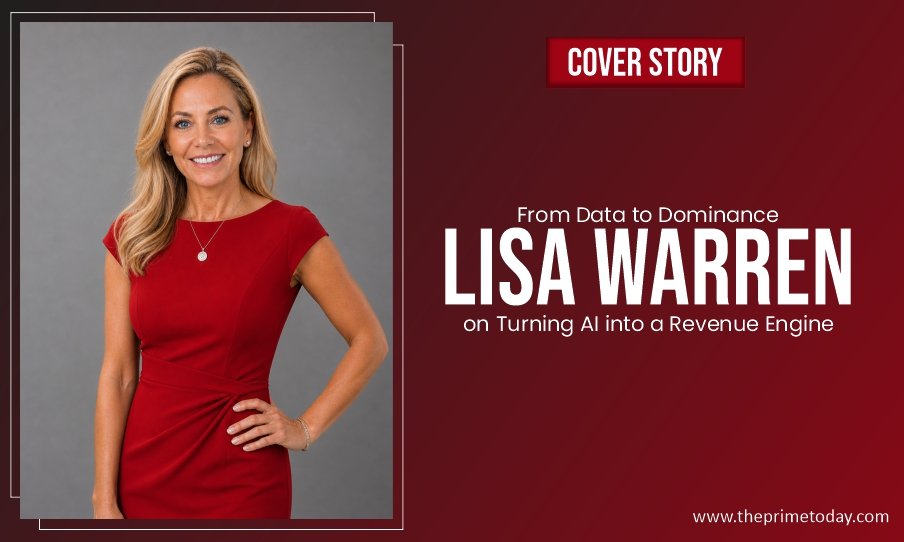
In a market saturated with AI hype, bold promises, and pilot projects that rarely scale, Lisa Warren stands out for a different reason—she doesn’t talk about AI as innovation. She talks about it as execution.
With over two decades of experience spanning FMCG, SaaS, cybersecurity, and financial services, Warren has built her career at the intersection of data, growth, and commercial strategy. Today, as the Founder of Neural Horizons AI, she is challenging how organizations approach artificial intelligence—shifting the conversation from experimentation to revenue, from tools to systems, and from ambition to accountability.
Her perspective is clear: AI is not the future. It’s already here. The real question is whether businesses know how to use it.
The Journey That Began in Trenches
Lisa did not begin her career in the world of labs or algorithms. She started in the trenches of data long before most corporations even recognized its worth. During her early days in FMCG marketing, she was responsible for a loyalty database covering more than two million customers. She spent her days studying exactly how people behaved rather than guessing at their needs. She knew what they ate for breakfast and how their shopping habits changed with the seasons. This deep dive into human behavior allowed her to create personalized promotions that brought in millions in revenue every single quarter.
That experience left a permanent mark on how she views the corporate world. As she transitioned into the fast-paced sectors of digital software and cybersecurity, she noticed a frustrating pattern. Companies were pouring money into new platforms and tools but failing to connect those investments to actual business results. Lisa explains this disconnect simply: “Data isn’t reporting. It’s leverage.” She realized that leadership often confuses having technology with using technology.
Filling the Existing Divide of Lack of Clarity
When she looks at the current state of the industry, she sees a landscape littered with half-finished experiments. This frustration was the spark that led her to found Neural Horizons AI. She saw that leadership teams were being sold high levels of complexity when they actually needed commercial direction. To her, the biggest mistake is treating these systems as fun features rather than the very foundation of a company. “AI doesn’t fail. Execution does. And most businesses are still executing it wrong,” she says.
Lisa believes the gap in the market is not a lack of tools, but a lack of clarity. Too many projects are siloed in different departments, creating internal noise instead of a single system that drives growth. In her view, the companies that will win the next decade are the ones that align their sales, marketing, and leadership around a shared commercial goal. She often tells her clients, “If AI isn’t driving revenue, improving efficiency, or accelerating decisions, it’s just expensive noise.”
The Answers of Accountability and Integration
Her approach is built on accountability. She insists that someone must own the outcome of every technical initiative. In her work with global organizations, she pushes for a shift away from fragmentation. She views the technology as infrastructure that must be embedded and measured just like any other vital part of a business. As she meets with executives across different regions, she continues to challenge the idea that innovation is about having the most advanced toys. For Lisa, it is about the cold, hard reality of the balance sheet.
The conversation at Neural Horizons AI always returns to the same point: integration. Lisa is currently working on new frameworks to help teams move past the pilot phase and into full-scale operation. She remains focused on how these systems can help professionals make faster, better decisions every day. As the market continues to shift, her voice remains a steady reminder that the technology is already here. The challenge is no longer about discovering what is possible, but about having the discipline to make it profitable. Lisa watches the latest industry trends with a critical eye, always looking for the next opportunity to turn raw information into a competitive advantage.
Converting Waste into Commercial Advantage
Lisa believes that the only way to make technology pay for itself is by removing every bit of ambiguity from the start. She does not look for the newest software; she looks for where a company is losing money. When she enters a boardroom, her first questions are about where revenue is leaking, where staff are wasting their hours, and where decisions are taking too long to be made. She argues that starting with a tool is a backward way of working.
“You don’t need more tools. You need better systems,” Lisa explains. She insists that for an investment to work, it must be felt across the entire life of the business. In her view, it should help marketing find customers more cheaply, help sales close deals faster, and help operations run with higher efficiency. Every single step is measured. If a new system does not improve performance, she does not hesitate to have it rebuilt.
The Three Pillars of Organizational Evolution
At Neural Horizons AI, Lisa focuses on the fact that strategy, training, and growth cannot exist in separate silos. She has seen too many companies treat these as different projects, which leads to total failure. For her, an AI strategy is useless if the staff does not know how to use it, and growth is inefficient if it is not supported by modern tech.
She often points out that a leadership team that does not understand the technology eventually becomes a bottleneck for the whole company. To prevent this, she integrates all three areas. “AI strategy without adoption is irrelevant,” she notes. She works to ensure the entire organization evolves at the same time, ensuring that the people and the machines are moving toward the same goals.
Bridging the Gap Between Ambition and Action
Having worked across Europe, Asia, and the Middle East, Lisa has noticed that while the speed of work changes, the mistakes remain the same. She finds Europe to be careful and structured, while Asia moves with an aggressive pace. The Middle East, particularly the UAE and Saudi Arabia, stands out to her for its massive investment and desire to lead the world.
However, she observes a gap in these regions where big dreams often meet old internal ways of working. She believes the opportunity there is huge, but only for those who look deeper than the surface. That creates a gap between ambition and execution. “AI is no longer a tool. It’s infrastructure. The companies that understand that will lead; everyone else will follow,” she states. Her focus is on helping these organizations update their internal structures so they can actually handle the power they are buying. The opportunity in this region is enormous, she insists, but only for those who move beyond surface-level adoption.
Building Culture Through Visible Proof
When it comes to the fear of new technology, Lisa has a very practical view. She does not believe that people are naturally against progress; she thinks they are simply afraid of uncertainty. To solve this, she focuses on extreme clarity. She shows teams exactly what will change in their daily jobs and how the new systems will actually help them do better work.
She pushes for training that is specific to each person’s role rather than general lectures. For Lisa, a culture of innovation is not built through fancy slogans or corporate emails. “Culture doesn’t change through messaging. It changes through proof,” she insists. She looks for quick wins that show immediate results, using that success to build trust across the company. By making the benefits visible and real, she helps teams move past their hesitation and into a mindset of constant improvement.
The Shift to Commercial Intelligence Engines
Lisa views the future of marketing as a radical departure from traditional advertising. She believes that the days of isolated campaigns are over, marketing is no longer just communication, and that it is transforming into a commercial intelligence engine. “We’re moving from campaigns to continuous engagement.” In this new landscape, the focus moves away from just being creative-led to being data-led. She sees a world where marketing and sales are no longer separate departments but a single, integrated force that drives growth through continuous engagement. “From siloed to fully integrated with sales.”
To Lisa, the marketers who thrive in 2026 will be those who master systems as well as they master storytelling. She insists that technology must be the power behind every message. “Marketing is becoming the engine that drives growth, powered by AI,” she notes. By using real-time data, companies can stop guessing what their customers want and start responding to their needs as they happen. This shift allows for a much closer connection between a brand and its audience, making every interaction more relevant and profitable.
Responsible Innovation and the Green Economy
In her role as a Board Member at the Green Economy Partnership, Lisa looks at the intersection of technology and the planet with a critical eye. She recognizes that while these systems have the power to optimize energy and make supply chains far more efficient, they also bring their own set of challenges. She is vocal about the high energy consumption of massive computing clusters and the need for strict governance. For her, responsible innovation is about building transparency into the system from the very first day.
Lisa argues that the goal of technology should be more than just making a company move faster. “AI should not just accelerate growth; it should improve how that growth is achieved,” she says. She advocates for an approach where environmental impact is measured alongside financial gain. By using smart systems to reduce waste and manage resources more effectively, businesses can grow in a way that is sustainable for the long term. She remains committed to ensuring that the rush for progress does not come at the expense of ethical responsibility.
Leadership Through Clarity and Intent
When it comes to leading in a time of rapid change, Lisa prioritizes three specific qualities: adaptability, clarity, and decisiveness. She believes that today’s leaders must be able to operate in a state of constant flux while still being able to simplify complex problems for their teams. In her experience, the most successful leaders are not necessarily the ones who are the most technical. Instead, they are the individuals who can connect a piece of technology to a concrete business outcome and move forward with purpose.
“The leaders who succeed are not the most technical; they’re the ones who connect technology to outcomes and move with intent,” Lisa explains. She encourages executives to stop being intimidated by the complexity of modern tools and start focusing on the commercial direction they provide. By acting quickly and maintaining a clear vision, a leader can turn technical potential into a working reality. As the industry continues to evolve, she remains focused on guiding organizations toward a future where every decision is backed by intelligence and every action is driven by a clear, measurable goal.
The Necessity of Transparent Governance
As technology moves from the sidelines to the heart of business operations, Lisa insists that leaders must prioritize the rules that govern it. She believes that the era of treating technology as a black box is over. For her, if an executive cannot explain how a specific decision was reached, they have effectively lost control of their own company. She pushes for a focus on data integrity and total transparency, ensuring that every automated step is visible and secure.
“Ethics is not separate from strategy; it is part of it,” Lisa says. She argues that accountability is the only thing that keeps a modern organization grounded. By building security and transparency into the system from the start, a company protects itself against the risks of biased or incorrect outcomes. She spends much of her time helping boards understand that good governance is not a hurdle to innovation, but the very thing that makes sustainable growth possible.
Moving Beyond Fragmented Experiments
Lisa sees a future where the scattered nature of current technology projects finally comes to an end. She observes that most organizations today are struggling with a mess of disconnected tools and pilot projects that never quite reach their full potential. To her, this fragmentation is the biggest barrier to real progress. She founded Neural Horizons AI to help businesses move past this stage and toward a model where every system is fully embedded and working in harmony.
“The future is integrated AI, embedded across the entire organization,” she explains. In her long-term vision, the goal is not to have a company that simply uses smart tools, but to have a company that functions as a single, intelligent system. She works with teams to ensure that information flows smoothly from one department to another, removing the walls that typically slow down big corporations. This level of integration is what allows a business to scale without losing its edge.
The Shift from Technology to Execution
Lisa is often asked what will happen once every company has access to the same high-level technology. Her answer is always the same: the tools will stop being the thing that sets a business apart. She believes that we are rapidly approaching a time when having advanced systems will simply be the baseline for entry into the market. When that day comes, the winners will be determined by how well they actually use what they have.
“In the near future, AI won’t be a differentiator. Execution will be,” Lisa states. She is positioning Neural Horizons AI to be the partner that helps companies master this transition. She remains focused on the practical reality of day-to-day operations, ensuring that her clients are not just buying into the hype but are building the muscle memory needed to execute with precision. As the global market grows more crowded, she continues to advocate for a lean, results-driven approach that turns potential into profit.
Embracing the Evolution as the Way of Progress
According to Lisa, marketing was never fluff. And it was never just ‘social media.’ Long before AI became a boardroom buzzword, real marketing was already science.
It was:
→ Buyer psychology
→ Behavioural analysis
→ Data intelligence
→ Search ecosystems
→ Website architecture
→ UX and conversion science
→ Google, SEO, SEM, CRO
→ Brand trust engineering
→ Revenue systems
Marketing has always sat at the intersection of human behaviour, technology, design, and business growth.
The problem? Too many people misunderstood it. “Ah, so you make ads look good?”
No. The best marketers were never just creatives. |We were analysts. Strategists. Technologists. Builders. Growth architects. We learned how people think, how systems connect, how digital ecosystems perform, and how departments should communicate. And that disconnect used to drive me crazy,” recalls Lisa. Marketing. Sales. Operations. Leadership. Tech. Too often, they operated in silos — each department speaking its own language, chasing its own metrics, missing the bigger system. But that era is ending. Because Digital Transformation, Agentic AI, and eventually Quantum Intelligence are changing everything.
Here’s what that really means: Digital Transformation connected businesses. AI is now enabling businesses to think, automate, predict, and act. Agentic AI will move beyond prompts into autonomous systems that can make decisions, execute workflows, and bridge operational gaps across departments. Quantum Computing (as it matures) has the potential to exponentially accelerate complex modelling, optimization, security, and decision-making beyond traditional computational limits.
This is no longer about isolated tools. This is about unified intelligence. The future belongs to organisations that can merge:
Marketing + Sales + Operations + Leadership + AI + Governance. Into one connected system. “That’s why my role has evolved — and why it will continue to.”
From digital marketing strategist…
To transformation architect…
To AI leadership.
As a Stanford AI Leader, Lisa sees this clearly: “We are entering an era where the companies that win will not simply ‘use AI.” They will build the infrastructure, governance, and operating systems that allow AI to unify every moving part of their business. That is exactly why she built Neural Horizons AI. Not as another marketing company. But as a transformation powerhouse. A company designed to bridge the gaps between departments, break down silos, and help businesses build future-ready operational ecosystems from the ground up.
“Through Zonar OS, we are creating foundational systems for companies to:”
→ Diagnose disconnects
→ Align departments
→ Integrate intelligence
→ Build scalable frameworks
→ Transition into Agentic AI readiness
→ Prepare for what comes next
Because innovation without structure creates chaos. But innovation with systems creates transformation. And for those who think Gen AI is ‘new…’ Artificial Intelligence has been evolving since the 1950s. What’s changed is not its existence. What’s changed is its accessibility, scale, and speed. “We are no longer approaching the future. We are building it now. I believe Neural Horizons AI will stand at the forefront of that shift — working with visionaries, innovators, and businesses ready to evolve beyond outdated systems.”
This isn’t about keeping up. This is about building what’s next. Zonar OS. The foundation for connected, intelligent business evolution. “If you’re ready to unite your business, modernise your infrastructure, and prepare for the Agentic AI era — Get in touch,” appeals Lisa.
Navigating the New Standard of Business
Walking through the corridors of a new client’s headquarters, Lisa looks at the rows of servers and the busy teams of developers not as a collection of parts, but as a potential engine for growth. She is already thinking about the next set of challenges, from shifting global regulations to the rising costs of energy in computing. She does not see these as reasons to slow down, but as puzzles to be solved through better design and clearer intent.
The work at Neural Horizons AI continues to expand into new territories, bringing this focus on execution to leaders who are tired of empty promises. Lisa stays grounded in the data, always looking for the measurable outcome that proves a strategy is working. She knows that the path forward is not about finding a magic solution, but about the disciplined, consistent application of intelligence to every part of the business journey.
“AI won’t define the next generation of market leaders—execution will. The difference is no longer who adopts AI, but who knows how to operationalize it at scale,” concludes Lisa Warren, the Founder at Neural Horizons AI.