
Luis Miguel Larriba: How a Fighting Spirit Became a Distinctive Approach to Tax Law
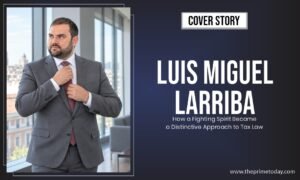
A lifelong instinct to challenge injustice formed Luis Miguel’s journey from corporate lawyer to a trusted voice in tax and legal advisory, where legal insight meets the realities of business.
Most companies think of tax as something to be managed when a filing is due or when an inspection arrives. Yet the decisions that create the greatest tax consequences are often made much earlier, when a business is being reorganised, a family structure is changing, or a company is deciding how it wants to grow.
For Luis Miguel Larriba, this is where the real work of a tax lawyer begins. His career has grown from a simple instinct he has carried since childhood: when something feels unjust, he cannot simply stand by. That fighting spirit led him towards law, while his entrepreneurial drive and constant interest in the business world brought him towards corporate advisory. Tax, where he found the greatest conflict, became his speciality. Over time, these experiences shaped the way he sees his profession and the businesses he advises.
Today, as Socio Director of LRB Tax & Legal, Luis Miguel brings the legal, tax and business perspectives together, seeking to understand the reality behind every decision before determining the right way forward.
The Instinct Which Led Him to Law
Ever since he was a child, Luis Miguel had what he describes as a fighting spirit. Whenever he saw something unjust, or someone taking advantage of a situation, he could not simply stand by.
That instinct eventually led him to become a lawyer, and for him, the profession was always a vocation.
At the same time, his entrepreneurial drive and constant interest in the business world were pulling him towards another direction. Those two interests came together in corporate law. As he began working more closely with businesses, he found that taxation was where some of the greatest conflicts arose.
That discovery led him to specialise in the tax field while retaining the business perspective that, in his view, should inform every decision, including legal ones. This mixture became increasingly important as his career progressed through larger organisations and international firms.
What Large Organisations Taught Him About Strategy
Luis Miguel’s time at Grupo Flexicar and in international law and consulting firms gave him two lessons that continue to determine his work.
The first was that strategy only means something if it survives contact with operational reality. A plan can look elegant on paper while ignoring how a business actually runs. For Luis Miguel, that kind of plan remains theory.
The second lesson came from working within larger and international structures and seeing how risk is managed at scale. It requires methodical processes, clear escalation paths and accountability at every level.
Those experiences gave him a clear idea of the kind of adviser he wanted to become. When he eventually brought those lessons into LRB, he carried the same rigour with him while remaining closely connected to the client’s day-to-day reality.
This balance between technical rigour and practical business needs also shaped his understanding of what the market was missing.
Creating a Boutique Around a Clear Need
LRB Tax & Legal was built as a boutique tax and legal advisory firm headquartered in Madrid, with an additional office in San Sebastián de los Reyes and a delegation at Parc Bit in Palma de Mallorca.
For Luis Miguel, the market had a clear gap. He saw a need for a firm capable of matching the technical depth of large traditional practices while avoiding the bureaucracy, junior-staffed execution and one-size-fits-all pricing that could accompany a larger structure.
Medium-sized companies and high-net-worth families often require senior-level strategic judgement when dealing with FEAC restructurings, holding structures or the Balearic RIB/RIIB regime. They may require deep expertise without wanting to pay for an entire large-firm structure.
LRB was therefore built around direct access to senior expertise, a realistic and business-focused approach, and the flexibility to move at the speed a tax inspection or restructuring genuinely demands.
The model has also attracted some of the largest companies. They may keep their main adviser and the reputation of a major firm while relying on specialist firms such as LRB for support. In Luis Miguel’s view, this happens because specialist advisers can provide practical solutions tailored to how a business actually operates, without the bureaucracy or half-measures of a large firm.
This emphasis on practical solutions carries through to the way Luis Miguel approaches the legal, tax and business considerations behind each client decision.
When Legal, Tax and Business Questions Become One
Luis Miguel frequently sees the same problem appear in different forms. A family holding structure or corporate restructuring may look sound from a purely legal standpoint while creating unnecessary tax exposure. The opposite can happen too: a tax-efficient structure may leave a business legally exposed during a dispute or succession.
For that reason, he believes these questions should never be treated as three separate matters.
In several FEAC-regime restructurings involving clients in the tourism and hospitality sector, his team reviewed the operation simultaneously through the legal, tax and business lens. That approach allowed the structure to be redesigned before filing and helped avoid an inspection risk that could otherwise have surfaced years later.
For Luis Miguel, this is part of what makes a good corporate lawyer. Legal knowledge alone cannot provide the complete answer. The lawyer also needs to understand the business perspective and bring both together when advising the client.
Applying these perspectives together has also helped him recognise recurring weaknesses in how companies and families approach tax planning.
The Structures Which Outlive Their Purpose
One of the most common blind spots Luis Miguel encounters is treating tax planning as an annual, compliance-driven exercise rather than as an ongoing part of business and succession strategy.
He also sees corporate structures that were created for a particular moment in a company’s history, perhaps because of a specific shareholder situation or a particular tax regime, and then left untouched as the business or family circumstances changed.
His approach is to review the full picture regularly rather than waiting for filing deadlines. Every structural decision also needs to be stress-tested against how a tax inspector might read it, alongside the legal assessment.
Large companies can face another difficulty. Executives who make important decisions are often not shareholders themselves, and this can make them cautious when a decision could affect their own position if things do not go as expected.
For Luis Miguel, that personal risk cannot be allowed to limit the growth of a company. The priority has to remain the business structure and its development rather than protecting an executive’s position.
The need to anticipate risks rather than respond to them later becomes especially clear when a company or family faces a tax inspection or appeal.
Holding the Line When the Pressure Rises
During an inspection, an appeal or proceedings before the TEAR, Luis Miguel relies on three principles.
The first is to prepare the documentary record as if litigation were inevitable, because it very often is. The second is to ensure that the client’s emotional urgency does not dictate the legal strategy. The third is to argue from the complete factual and legal record rather than from a partial version of events.
In administrative and judicial proceedings, he believes the side that has organised its evidence and legal arguments coherently from the beginning almost always has an advantage, regardless of how strong the opposing position may look on paper.
His approach to tax inspections also rests heavily on common sense. He prefers to lay out the real facts and the plain logic of a situation rather than leave room for an inspector to construct a different interpretation.
Sometimes, he believes, things are simpler than they appear. Lawyers can become caught up in creating elaborate explanations around a situation when simply telling it as it is, and showing why logic and the correct application of the rule lead to a particular conclusion, can be a stronger argument than citing dozens of rulings from cases that do not match the client’s circumstances.
Making complex matters understandable is also central to another part of Luis Miguel’s professional life: teaching.
The Lesson Which Technical Knowledge Alone Cannot Teach
Luis Miguel teaches at business associations and business schools, and he also speaks at chambers of commerce and other business organisations. Over time, teaching has taught him almost as much as it has taught his students.
The core lesson he tries to pass on is that technical knowledge is necessary, but knowing how to explain things is equally fundamental.
A professional can be among the best in the world at a particular subject, but if the client, inspector or person listening cannot understand that knowledge, it becomes difficult to be an effective lawyer.
He therefore encourages younger professionals to specialise deeply rather than remain generalists. Clients increasingly need advisers with real command of a specific area rather than broad knowledge that remains shallow.
His own education reflects the same emphasis on developing deep expertise while understanding the wider context in which that knowledge must be applied.
Building Knowledge Across Disciplines
Luis Miguel holds degrees in Law, Business Administration and Management, and Equality and Gender Studies, alongside four postgraduate specialisation master’s programmes. He is also accredited as a Perito Judicial, or court-appointed expert, by ASPEJURE.
That range of training has influenced the way he advises clients and leads LRB. It allows him to approach a client’s situation as a business owner might, weighing risk, cost and opportunity, while still applying the discipline of a lawyer.
For Luis Miguel, this combination of legal and business knowledge is at the heart of practical corporate advice. The work cannot stop with understanding the law. The law has to be brought into the reality of the business.
The same principle guides his leadership at LRB, where technical rigour and a genuine understanding of the people and businesses the firm serves are expected to work together.
It is this blend of expertise and practical judgement that underpins one of the clearest rules Luis Miguel has developed throughout his career.
Never Promise What You Do Not Believe
One of Luis Miguel’s defining traits is his refusal to sell a client something he does not believe is achievable.
A client deserves to hear the real situation, together with a genuine assessment of the chances of success. At the same time, that honesty should come with the reassurance that the adviser will do everything possible, and more, to achieve the best outcome.
It is a principle he carries into his advice for younger professionals. Build technical depth in one area before trying to become a generalist, he advises, and learn to be present during the moments that matter most: an inspection, a hearing or a negotiation.
Those are the moments when an adviser earns trust. The client needs someone willing to tell the truth, even when the truth differs from what the client wants to hear.
His career has since received recognition for the amalgamation of technical expertise, professional integrity and practical judgement that defines his approach.
Recognition for a Career Built on Practice
In September 2026, Luis Miguel was named Tax Professional of the Year – Spain and Portugal at the Iberian Lawyer Forty Under 40 Awards 2026.
He regards the recognition as a reflection of LRB’s work as much as his own.
Alongside his legal practice, he also leads ValiTax, LRB’s brand specialising in judicial expert reports. His work therefore extends across tax inspections, corporate reorganisations, business advice, expert reports and education, with each area reinforcing the others.
The underlying principle remains consistent: technical expertise has its greatest value when it can be applied to the actual circumstances of a business or family.
As tax administration and regulation evolve, this ability to combine specialised knowledge with practical judgement is likely to become even more important.
Preparing for What Comes Next
Looking towards the next few years in Spain and Europe, Luis Miguel expects continued digitalisation of tax administration. Verifactu and similar measures, in his view, represent only the beginning. Regulatory complexity is also likely to continue growing at both Spanish and European level.
Artificial intelligence is arriving in the tax and legal sector as it is in many other professions. Luis Miguel sees these tools as useful resources that can help professionals improve the way they work.
There are, however, parts of the profession that depend on human judgement. The ability to argue and negotiate with an inspector, or to understand a company’s culture well enough to make the right decision, requires an understanding that goes beyond technical information.
For leaders in the sector, his answer is therefore rooted in preparation: invest in specialised and up-to-date expertise, understand the business behind the legal question and build advisory relationships with clients that are proactive rather than reactive.
For Luis Miguel, the evolution of tax advisory does not change the principle that brought him into the profession in the first place. The work begins with understanding the problem, but its real value lies in having the knowledge, judgement and determination to stand behind the right solution.