
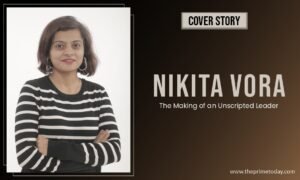
Nikita Vora: The Making of an Unscripted Leader
From a Childhood Idea of Business to a Leadership Built on Experience
Social media agencies are expected to have answers almost instantly. Which idea will work? Which design should go out? What should the campaign say? How will the client respond?
For Nikita Vora, answering those questions became part of learning what it really means to run a business.
Her interest in business began long before social media. Nikita believes she knew she wanted to become a businesswoman as early as Standard 4.
She grew up in a Gujarati business family. Her father, grandfather and uncles were all business owners, and the family had a factory with more than 80 workers. Business was simply part of the world she knew. As a child, she never really thought of taking up a job as a career. To her, business was how people earned their livelihood.
So, when someone asked what she wanted to become, she never gave the usual answers. Doctor, engineer or lawyer did not feature in her plans.
She would simply say, “I want to be a businesswoman.”
Of course, a child has a very different understanding of what running a business means. For Nikita, it meant having signatory authority, making decisions and shaping people’s lives.
Much of that picture came from watching her father. At family and community events, people would turn to him when something needed to be decided, whether it was big or small. He was expected to take risks, call the shots and give direction. Nikita watched that and formed her own idea of what a business leader looked like.
She followed that path deliberately. After Standard 10, she chose commerce, then Business Administration and eventually an MBA. Each step took her closer to something she had wanted since childhood.
The real lesson came when she began running a business herself: Good decisions come from experience.
Nikita founded SMM Unleashed, a social media marketing agency, and soon found herself on the other side of the questions. Employees would come to her with questions about designs, words, visual hierarchy and client strategy.
That was when she understood something her childhood self could never have known: owning a business does not mean having an answer to every question.
“Experience creates clarity,” she says. That idea now forms how she approaches leadership. She believes a leader needs to know what questions to ask, have enough experience to contribute, and offer a counter-perspective that helps the team arrive at a stronger answer.
The girl who once thought being a businesswoman meant making the decisions now sees the role differently. For Nikita, leadership has become less about having all the answers and more about knowing how to help find them. Today, for her, the definition of success has changed along the way. Revenue and growth still matter, but today she measures her work increasingly by a different question: How many women can she help move forward?
Where Did Nikita Vora’s Curiosity About Technology Begin?
Nikita’s relationship with technology began long before digital marketing and AI became part of her professional life.
She was introduced to computers as a child, at a time when the internet was still something people were only beginning to explore. She got her first computer in Standard 5. It was a huge machine, but she loved it.
Then she discovered the internet and felt there was an entire world of possibilities inside it.
She has since watched the internet evolve from the Orkut era to social media, digital marketing and now AI. Even today, she remains fascinated by what technology can make possible.
Whether it is business, fitness, meditation, education or communication, she still finds herself thinking, “Wow, the internet can do this too?”
That curiosity remains part of how she works. She is still learning digital marketing. She is still learning AI. She does not believe there will ever be a point where she can say, “Now I know technology.”
There will always be something new to discover.
How Did Teaching Change the Way Nikita Thinks?
Teaching entered Nikita’s career much later and almost by accident. Around COVID, an opportunity to teach led her into classrooms where she could take ideas she had learned through experience and see how other people responded to them.
Teaching was never part of her original career plan. But she discovered that it gave her something extremely valuable: clarity of thought.
Even today, when she teaches as a visiting faculty member at FLAME or other institutions, much of what she does is pro bono. She does not necessarily teach because she wants to be known as a teacher.
She teaches because it forces her to structure what she knows.
When she takes an idea into a classroom, she gets to see how people react to it. Is it adding value? Is it creating clarity? What perspective might she be missing?
For Nikita, that human interaction is particularly important in an age when technology can provide enormous amounts of information.
AI can give people knowledge. But insights, experiences and perspectives still come from humans.
Teaching gives Nikita a structured environment to interact with people, hear what they really think and refine her own understanding.
Why Did Women Entrepreneurs Become Part of Nikita’s Mission?
Long before Nikita began working with women entrepreneurs, she had already noticed how much a woman’s position could change when she had her own income, knowledge and voice.
Growing up in a Gujarati family, she noticed that women were not always given the same importance when it came to entrepreneurship. She also noticed something else: a woman who earned, had knowledge and had a voice was treated differently.
She craved that respect herself.
She never wanted to be ignored because somebody assumed she did not understand something. She wanted knowledge. She wanted a voice. She wanted to be able to structure her thoughts and speak for herself.
That experience formed her belief in financial independence.
For Nikita, financial independence is closely connected with self-esteem and respect. She realized there were many women who probably felt something similar, and that understanding became one of the reasons her work with women entrepreneurs became so important to her.
If she can help a woman grow her business and earn more independently, she is not just teaching her marketing or technology. She may be changing the way that woman sees herself, and sometimes the way people around her see her.
What Does it Take to Keep Going After Starting a Business?
Working with women entrepreneurs also showed Nikita what happens after the initial excitement of starting a business fades.
Starting requires ambition. Continuing through repeated setbacks requires something else: Mindset.
When someone tells her they have been stuck for months, Nikita wants to understand what is actually happening. Have repeated failures made them want to give up? Has their inner voice become stronger than their determination? Have they stopped fighting for the goal?
For her, determination is visible in what happens after failure.
Someone may fail. They may feel terrible. They may need help. But they come back and try again.
That fighting spirit matters enormously to Nikita.
Very often, she believes, what stops a woman from reaching her goal is not a lack of tools or information. It is the point at which she starts giving up on herself.
Why Does Nikita Believe Entrepreneurs Should Start with the Problem?
The same principle influences how Nikita approaches technology with entrepreneurs.
With new tools appearing constantly, it can be tempting to start with the technology and then look for a reason to use it. She prefers to begin somewhere else.
She does not tell entrepreneurs to learn 100 tools. She tells them to define the challenge first.
What exactly are they trying to solve?
Once they know the challenge, they can find the technology that helps solve it. It does not have to be AI. It does not have to be the newest or fanciest tool.
And they should not operate from FOMO.
Technology is incredibly dynamic. Nobody can permanently stay on top of everything. Her approach is straightforward: solve challenge number one, then move to challenge number two.
“You don’t need to know it all.”
Where Does Nikita Believe AI Actually Belongs?
For Nikita, using technology well also means knowing where it can genuinely make a difference.
AI is extremely useful wherever there is documentation, repetitive work or work that does not require deep human thinking every single time. Those are areas where entrepreneurs can save enormous amounts of time.
But she draws a line when the work requires lived experience, judgment or genuine human connection.
Conversations, experiences, insights, learning, fundamentals and real-world application still need humans.
AI can help people process information. But what they have lived, what they have learnt from it and how they apply that understanding to another human being is different.
For Nikita, the goal is not to replace human thinking with technology. It is to use technology where it genuinely helps.
Why Does Nikita Tell Entrepreneurs to Stop Borrowing Other People’s Goals?
Technology is not the only source of pressure entrepreneurs face. Nikita also sees people constantly comparing their progress with what others show online.
A business owner may begin with one goal and gradually replace it with somebody else’s version of success.
One mistake she repeatedly sees is that entrepreneurs are not fixated enough on their own goals.
Today, they see somebody earning ₹5 lakh per month, and suddenly that becomes their goal. Tomorrow, they see somebody driving a fancy car, and now they want the car. Then somebody has the latest laptop, and their attention shifts again.
The problem is not ambition.
The problem is constantly changing what they are running towards.
Nikita believes entrepreneurs need to become more stubborn about their own goals and work consistently towards them instead of allowing somebody else’s success to keep changing their definition of success.
How Has Nikita’s Definition of Success Changed?
Business growth comes with obvious measures such as revenue, expansion and profitability. Over time, though, Nikita has started looking at another number when she thinks about the value of her work.
For her, meaningful business success is simple: The number of women she is able to impact.
Money and growth matter, but the impact she creates through her work has become a much stronger measure of success for her.
That shift did not happen overnight. It grew from years of working with entrepreneurs and seeing what business can change beyond a balance sheet.
What Does a Business Legacy Look Like to Nikita?
One experience, in particular, has stayed with Nikita because it showed her what entrepreneurship can mean when the reason for building a business goes beyond the business itself.
There is one woman whose journey is particularly close to her heart.
She was around 58 or 59 when she came to Nikita and had been diagnosed with cancer. She wanted to learn digital marketing and AI because she had a very specific goal: she wanted to grow her business enough to create something meaningful that she could eventually pass on to her son.
She was not simply trying to increase sales. She was trying to build a legacy.
Nikita worked with her on that journey and saw her business expand from one country to two and then three countries.
Stories like hers remind Nikita why this work is vital.
When a woman is going through something so difficult personally and still has the determination to learn, grow and build something for the next generation, helping her move closer to that dream feels deeply meaningful.
What Has Entrepreneurship Taught Nikita About Failure?
The journey has also forced Nikita to confront her own difficult periods.
Entrepreneurship has brought successes, but it has also brought failures and moments when continuing felt exhausting. There were times when one failure seemed to follow another. There were days when she thought about giving up and asked herself, “Why am I doing this?”
The toughest lesson entrepreneurship has taught her is simple: she cannot give up.
Another difficult lesson was learning not to chase money all the time.
When she was constantly focused on money, the journey could become emotionally exhausting. When she shifted her attention towards impact, towards what her work was actually changing for another person, the journey became smoother and more meaningful.
The lesson was not that money does not matter. It was that money alone could not be the reason she kept going.
How Does Nikita Define Leadership Today?
Her experiences have fundamentally changed the way she thinks about leadership.
Earlier, she believed leaders were people who had the answers. Today, she sees leadership differently, especially when working with people who are capable of finding their own way with the right support.
A leader, in her view, needs enough experience to contribute towards finding the right answer.
Her leadership style is never, “I am the boss, therefore follow me.”
It is more like:
“I have walked this path. You can walk it too. And if you find a hurdle, come and talk to me. We will find the solution together.”
That is leadership to her today.
It is also the biggest departure from the way she imagined leadership as a child. The businesswoman she once imagined was someone with authority and answers. The leader she has become is someone who helps others find their own answers.
Why Does Nikita Want Women to Become More Visible?
For women who have knowledge but hesitate to put themselves forward, Nikita sees visibility as something worth learning to embrace.
The initial discomfort can be real, especially for women who have spent years being careful about how much space they take.
Her advice is simple and direct: “Get into the spotlight.”
She believes it is a good thing.
A woman may initially hesitate, but once she experiences what it feels like when people recognize her knowledge and respect her work, she may understand why visibility matters.
Nikita does not want women to keep hiding what they know.
“Try the spotlight. You might actually enjoy it.”
How Has Nikita’s Approach to Innovation Changed?
Nikita’s approach to new technology has also matured.
Earlier, whenever she discovered a new technology or tool, she wanted to try it immediately. With the pace of technological change today, she has become much more selective.
Now she first looks at the user profile.
Who is actually using this tool? What are they using it for? Does she relate to that type of user? Is somebody in her field or with similar requirements getting a meaningful result from it?
A founder may create a product with 50 use cases, but that does not mean all 50 are relevant to her.
Technology is moving too quickly to try everything. If she spends all her time experimenting with tools, her actual work will never get done.
For Nikita, innovation therefore also requires restraint. The newest technology is not automatically the most useful technology.
What Qualities Will Future Women Leaders Need?
The more technology takes over repetitive work, the more Nikita believes leadership will depend on qualities that remain deeply human.
For her, empathy is especially important.
As AI takes over more repetitive and menial work, human qualities become even more important. Women leaders need empathy for other women and for people in general.
Personal growth, in her view, should also create room for other people to grow.
If women grow but do not use that growth to create opportunities for other women, Nikita believes they have missed something important.
Leadership should not simply take someone to the top.
It should help other women grow with them.
How Does Nikita Want Women to Build More Sustainable Businesses?
Her focus on helping women grow is ultimately tied to the kind of businesses she wants them to build.
Nikita sees many entrepreneurs working extremely hard while still having businesses that depend on their mood, energy, daily decisions or the next opportunity that comes along.
Everything depends on how they are feeling that day, what needs immediate attention or what opportunity suddenly appears.
She wants women to understand the power of systems and consistency.
Sustainable entrepreneurship cannot depend on motivation every morning.
Her larger vision is to help more women build businesses that do not just start or grow temporarily, but become consistent and stable, businesses that can operate with systems rather than depending entirely on the founder.
Why Does Nikita Want to Make Technology Less Intimidating?
This larger vision brings Nikita back to the relationship with technology that began when she was a child.
She has spent years watching technology change, learning it, teaching it and helping others use it. Now she wants women entrepreneurs to feel the same sense of possibility rather than hesitation.
If there is one thought she would like women entrepreneurs to remember from her journey, it is simple: “Technology is your best friend.”
She does not want women to fear technology or assume it is too complicated for them.
She wants them to learn enough to make it work for them, use it to solve their problems and allow it to create possibilities they may not have seen before.
Technology has fascinated Nikita since she was a child.
Her definition of leadership may have changed, but that curiosity has remained.
The Standard 4 girl who once imagined a businesswoman as someone who made the decisions has grown into a leader who believes something very different: you do not need to know everything to lead. You need the experience to ask better questions, the humility to keep learning and the willingness to help others find their own answers.
If her work can help more women develop that same comfort with technology and use it to build independent, sustainable businesses, that would be a legacy she would be proud of.