
Sophia Kindle: Connecting Enterprise Operations, Technology and People to Drive Transformation
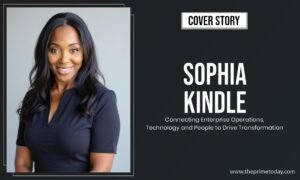
Sophia Kindle: Connecting Enterprise Operations, Technology and People to Drive Transformation
A 20-year journey across operations, HR, technology and programme management shaped her approach to turning strategy into everyday execution.
For leaders trying to modernise a large organisation, one of the hardest questions comes after the strategy is agreed: how does that intention become part of everyday work? A decision can make sense in a boardroom and still take a very different shape across teams, systems and people. For Sophia Kindle, understanding that gap became the thread running through her career.
Sophia spent 20 years at The Boeing Company, working across finance, programme management, global customer operations, human resources and enterprise technology. Moving between these areas gave her a close view of how an organisation works from different sides, and how easily its plans can become separated from the realities of daily operations. She came to describe her role in simple terms. She was an operations executive, a board member and, at heart, a translator.
Her career at Boeing led to two senior leadership positions. She first became Senior Executive Director, Corporate Human Resources, bringing her experience to the people side of the organisation. She then moved into the role of Senior Executive Director, Corporate Information, Digital Technology & Systems, taking on responsibility across another part of the enterprise where people, information and technology had to work together.
After those years at Boeing, Sophia began a new chapter in Portland, Oregon. Her work there has continued to connect leadership with the wider community. She serves on the board of the Women’s Foundation of Oregon and stays active in Wednesday Women and Athena Alliance.
She also spends time with leaders who are trying to modernise their organisations while protecting what makes them work. It is a challenge closely connected to the work she has done throughout her career.
Today, Kindle is stepping into her next executive chapter, and she is choosing it with care. Her experience has given her a clear understanding of what happens when strategy meets people, systems and the everyday realities of an organisation, and that understanding persists to determine the kind of work she wants to take forward.
Where the Numbers Led
Enterprise operations sit in the space between what an organisation intends to achieve and what actually happens in the course of everyday work. It is formed by decisions made across departments, by systems people rely on and by the small points of friction that can gradually affect a much larger outcome. For Sophia, understanding that space began with understanding how an organisation accounted for what it was doing.
Sophia came in through the numbers. Her first role at Boeing was as a financial planning analyst, and what struck her was how often a variance on a spreadsheet was really a story about people: a handoff that did not happen, a system nobody trusted, a team spending its week reconciling instead of improving. Finance explained what happened. It rarely explained why.
That became the problem she wanted to work on. Why did capable people inside large systems work so hard for results that never quite showed up? She did not want to keep reporting on the friction; she wanted to remove it.
Program management gave her first real chance when a subsidiary was being absorbed into Boeing and two different ways of working had to become one. She has been doing some version of that ever since. Operations is where strategy either becomes real or quietly fades, and she has always wanted her hands on that moment.
Working inside an organisation of Boeing’s scale also meant that change could rarely be limited to one team or one process. Some of the most significant opportunities came with the responsibility of building something that had never existed there before.
That brought another question into focus: what does it mean to be the person who goes first?
Being First, Without Being the Last
In any established organisation, new capabilities have to find their place within structures that already exist. The person creating something new therefore has two responsibilities: proving that the idea can work and making sure the work can continue after the original effort has moved on. That becomes particularly meaningful when the person creating the path is a woman entering spaces where there may be few examples to follow.
Sophia has had the privilege of being “the first” a few times: the first business intelligence capability in her business unit, the first Boeing HR program run on SAFe, and the first IT Lean Innovation team. Being first matters, but it is not what she would call iconic. Iconic is making sure you are not the last.
For women reshaping how enterprises operate, the real mark is whether the path gets easier for the person behind them. Did she leave a method others can pick up? Did she build governance that does not depend on her personality?
When they established the Program/Project Management Center of Excellence, the number she cared about most was not the improvement in on-time delivery. It was the 200-plus program and project managers who earned certification and carried that discipline into their own teams.
Recognition like the BEYA Trailblazer Award is deeply humbling, but the lasting version of it is quieter: other people doing great work in a system she helped make fairer.
That way of thinking about lasting impact has also influenced the way she looks at organisational performance. Some measures tell leaders where an organisation has already been. Others can tell them how quickly a problem is making its way towards the people who have the power to address it.
The Metric Which Tells a Bigger Story
Boards and CEOs have no shortage of information in front of them. Financial results, operational reports and customer measures all provide useful signals, yet the distance between what happens on the front line and what reaches the people making decisions can be harder to see. That distance can shape the cost and speed of a response long before it appears in a formal report.
For Sophia, the metric more leaders should pay attention to is simple: How long it takes bad news to travel upward.
Every organisation tracks cost, schedule, and satisfaction. Very few measure the lag between the moment someone on the front line knows something is wrong and the moment a decision-maker hears it. That lag is where money quietly disappears.
Invoice disputes like the ones behind the $2 million in annual savings they recovered when she rebuilt vendor governance rarely come as a surprise to the people closest to the work. They come as a surprise to leadership.
Boards should care because this one measure sits underneath almost everything else. When the lag is short, problems are cheap to fix. When it is long, you are paying for silence, and you usually find out at the worst possible time.
It is also a cultural metric disguised as an operational one: people only carry bad news quickly when they trust what will happen to them after they do.
The relationship between information, trust and decision-making becomes especially important when the decision itself affects people’s work and livelihoods. For Sophia, one of the clearest examples came when the financial needs of the enterprise required her to make a decision that would directly affect teams she knew well.
When the Numbers Affect People
Cost discipline can look simple when viewed through a financial plan. The reality becomes more complicated when the work being reconsidered belongs to people who have built expertise in it over years. Leaders have to hold the business requirement alongside the responsibility of managing what the change means for those carrying the work.
At Boeing, Sophia cut HR operating costs by $15 million annually without losing delivery continuity. The hardest decision was accepting that the right answer for the enterprise meant work her own teams did, and did well, would move to a partner in India. There is no way to make that feel abstract when you know the faces.
What she decided early was that the savings target would not set the pace of the human side. They were honest about what was moving and why. They invested in capturing knowledge properly rather than rushing a handover. And they treated the people staying and the people transitioning as two groups who each deserved a real plan, not a memo.
The $15 million mattered, but continuity of service for a workforce of 160,000 depended on the people who knew the work being willing to teach it. People do not teach generously when they feel discarded.
She learned that the hardest people decisions are not only about who stays. They are about whether you are willing to be honest before it is comfortable. That honesty is what kept delivery steady.
Her experience with large-scale change also brought her closer to another force reshaping enterprise work. Technology was becoming increasingly capable of taking on tasks that had traditionally depended on people, creating a different set of questions around responsibility, control and judgement.
Where AI Belongs
The introduction of AI into an enterprise changes more than the tools people use. It can alter responsibilities, decision-making and the sequence through which work moves from one person or system to another. In regulated environments, those changes carry an additional responsibility because organisations have to be able to explain how important decisions are made.
Sophia believes most leaders are automating the organization they have instead of designing the one they need. They take a process that is already tangled, put AI on top of it, and call it transformation. In a regulated environment, that is especially risky, because now an unclear process is faster and harder to audit.
The second mistake is treating AI as a technology rollout rather than a governance decision. When they deployed two AI-enabled talent acquisition tools in HR, the technology was the easy part. The important questions were who owns the outcome, where a human stays in the decision, and how they confirm the tool is reducing bias rather than hiding it.
Answering those well is why they could cut cycle time to hire by 30% with confidence.
The balance she would urge is simple to say and hard to do: let AI take the repetition, and reinvest the time you get back in your people’s judgment. In regulated work, human judgment is not overhead. It is the control.
That belief in the importance of control runs through her approach to transformation more broadly. It also shaped a governance decision that initially challenged assumptions about where a particular way of working belonged.
The Governance Which Had to Prove Itself
Governance can be difficult to introduce when people already have a familiar way of getting work done. A new framework can feel like an additional demand, especially when the work involves systems that affect something as fundamental as employees receiving their pay correctly. The value of a different approach therefore has to become visible through the work itself.
Sophia ran Boeing’s first HR transformation program on SAFe. At the time, many people saw agile frameworks as something for software teams, not HR. Asking HR, payroll, and benefits professionals to plan together in the open and show working results every few weeks felt like overhead to some and a threat to others.
She understood the resistance. They were onboarding two subsidiaries onto Boeing’s HR, payroll, timekeeping, and benefits platforms, and nobody wanted a methodology experiment in the middle of people’s paychecks.
But payroll is exactly where she believed that discipline was needed: small, visible increments, problems surfaced early, and everyone planning against the same picture.
The program delivered the smoothest deployment and lowest hypercare defect rate in its history, and the model was adopted enterprise-wide for all future HR programs. They later moved Workday stabilization onto the same approach.
The lesson she carries is that unpopular governance is worth it when it protects people from the chaos they would otherwise absorb at the end.
The question of protecting people from operational chaos became even more complicated when she was responsible for teams spread across several parts of the world, each with its own established way of working.
Bringing Seven Locations Together
Global operations can create a tension between consistency and local knowledge. A central model can make it easier to coordinate a large network, while the people closest to each location often understand details that a standardised process can overlook. Changing such a system requires more than choosing one approach over another.
When Sophia led global customer operations for Boeing’s pilot and mechanic training, their seven locations, spanning Seattle, Miami, Brisbane, Singapore, Shanghai, London, and Moscow, ran scheduling on four disconnected legacy platforms.
Each site had built its own way of working, and each one worked well enough day to day. Short-term stability said leave it alone.
But “well enough” had a cost. They could not see capacity across the network, and their teams carried the weight of constant workarounds.
Consolidating into a single enterprise system meant asking every location to give up something it was proud of. She chose the long-term path, and the way she navigated it was to treat each site as a co-designer rather than a recipient, so that their expertise shaped the standard and it became their system too.
It paid off in the numbers, with capacity planning improving and revenue growing by $2 million, $4 million, $4 million, and $6 million year over year from 2015 to 2018.
What she is proudest of, though, is that seven teams started operating as one.
That experience reinforced the importance of hearing from the people who have to work inside a system every day. Her board work would later give that same idea a broader dimension, bringing questions of representation and equity into the way she thinks about operational design.
Who Gets a Voice in the Design?
A process can look perfectly reasonable when it is viewed from a distance. The experience can change once different groups begin using it in their own circumstances. Employees may work different hours, belong to different employment structures or operate in different regions, and those differences can shape how the same decision affects them.
Board work has sharpened one question she now brings to every operational design: who was in the room when this was built, and who has to live with it?
Governance at its best is a disciplined way of making sure the right voices shape a decision before it is made, not after it is implemented.
In operations, that means she treats equity as a design input rather than a separate program. When they map a process, she wants to know which employees experience it differently, such as shift workers and office staff, union-represented and non-represented employees, or one region and another, because a process built for the average often fails at the edges.
People analytics has been central to this for her. The point is always to measure the experience of the people a system serves, not just its throughput.
Board service has also made her a better operator by making her a better listener. On a board, her job is to ask the question that helps others see, not to hold every answer.
That habit of looking at who gets included in important decisions also extends to the opportunities available to women entering enterprise transformation. For Sophia, one of those opportunities sits in an area many people overlook when they think about operations leadership.
Learn the Language of the Contract
Operational leadership involves more than managing people and programmes. Some of the most consequential decisions can sit inside agreements that determine how an organisation buys technology, uses external partners or structures services over several years. Understanding those agreements can therefore change how much influence a leader has over the operating model itself.
For women aiming to lead enterprise transformations in 2026, Sophia believes one capability deserves more attention: commercial fluency, the ability to read, question, and reshape a contract.
Many talented women in operations are steered toward the people and program side of transformation, where they excel. Far fewer are handed the vendor negotiation or the long-term outsourcing agreement nobody else wants to touch.
Yet in 2026, much of an enterprise’s operating model lives inside its contracts with cloud providers, AI platforms, managed services, and offshore partners. If you cannot shape those agreements, you are running an operating model someone else designed.
Her finance background gave her a head start. Restructuring an infrastructure and operations contract to secure $40 million in savings over its ten-year life was not about being the toughest person at the table. It was about understanding the economics well enough to ask better questions.
So, she encourages women to volunteer for the vendor review, sit in on the renegotiation and learn how the pricing works. It is one of the fastest ways to earn a seat where the real trade-offs are made.
Understanding those trade-offs becomes even more important when imagining what an enterprise could look like if its operating model were designed afresh rather than inherited from the past.
Designing the Enterprise from Scratch
Every established operating model carries decisions made by people who were solving the problems of their own time. Some of those decisions remain useful, while others become harder to justify as technology, workforce expectations and regulatory requirements change. Starting again would give a leader the opportunity to decide what deserves a place in the next model.
On AI, Sophia would treat it as part of the workforce plan, not the technology budget. Every AI capability would have a named human owner, a defined scope, and a clear line between what it may decide and what it may only recommend.
That thinking shaped the AI-enabled ITforIT framework her Lean Innovation team built at Boeing: get the operating model ready first, so agentic AI can scale safely later.
On people, she would build career paths around judgment rather than tasks. As routine work moves to automation, an employee’s value lives in problem-solving, context, and trust, and she would hire, develop, and promote for that deliberately.
On risk, she would move from periodic checkpoints to continuous visibility. Regulated industries need controls, but controls that run quietly in the background are stronger than audits that arrive after the damage is done.
What would she leave behind?
Big-bang go-lives that bet everything on a single weekend. Measuring leaders by the size of their org chart. And a heroic culture that rewards people for rescuing projects instead of designing ones that never need rescuing.
The next generation of operating models should be calmer, more transparent, and built for the people.
For Sophia, that thinking brings the different parts of her career into the same frame. She began with numbers, moved towards the reasons behind them, and gradually took on the systems, people, technology and decisions that shaped those outcomes. The work changed in scale and complexity, but the question underneath it remained familiar: how can an organisation make it easier for capable people to do good work?
That is the question she has continued to carry from one role to the next, and it is what gives the story of her career its continuity.