
What Happens If an Earthquake Strikes the Mumbai-Ahmedabad Bullet Train?
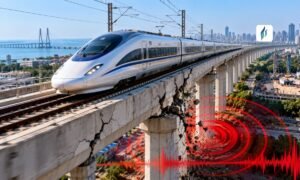
What happens if an earthquake strikes the Mumbai-Ahmedabad bullet train is an important safety question as India prepares to operate its first high-speed rail corridor. The 508-km Mumbai-Ahmedabad bullet train project will use 28 seismometers to detect tremors and trigger protective measures within seconds.
The National High Speed Rail Corporation Limited (NHSRCL) is developing the system using technology based on Japan’s Shinkansen. The corridor has a design speed of 350 kmph and an operational speed of 320 kmph.
The Mumbai-Ahmedabad bullet train earthquake safety system is designed to act automatically when it detects significant seismic activity. Power supply to the affected section will be shut down, and trains will detect the interruption before activating their emergency braking systems.
This means a train travelling through an earthquake-affected area would not depend only on manual instructions from railway staff. The automated response is intended to stop trains before stronger seismic waves reach vulnerable railway infrastructure.
The earthquake detection system will use 22 sensors installed along the high-speed rail alignment at traction substations and switching posts. Eight will cover areas around Mumbai, Thane, Virar and Boisar, while 14 will be positioned across locations including Vapi, Surat, Bharuch, Vadodara and Ahmedabad.
Six additional seismometers will be placed away from the railway line in earthquake-prone areas. Four are planned in Maharashtra at Kheda, Ratnagiri, Latur and Pangri, while Adesar and Old Bhuj in Gujarat will also receive sensors.
These locations were selected after examining earthquakes above magnitude 5.5 recorded near the corridor over the past 100 years. Japanese experts also assessed ground conditions using micro-tremor tests before finalising the sites.
The bullet train emergency brakes form one part of a wider safety chain. Detecting seismic activity away from the track can provide additional warning before stronger waves affect the corridor.
The Mumbai-Ahmedabad bullet train earthquake safety network will become part of the corridor’s operational infrastructure as construction and system installation continue.
The first service is targeted for the 97-km Surat-Vapi section, with the B28 trainset targeted for launch on August 15, 2027. Once operational, the earthquake detection system will provide an automated layer of protection designed specifically for high-speed rail operations in earthquake-prone areas.