
Where Does the World’s Coffee Come From?
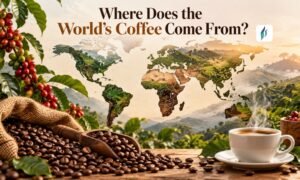
Brazil alone is forecast to produce 63 million 60-kilogram bags of coffee in the 2025/26 marketing year, accounting for about 35% of global production. But if you are asking, “Where Does the World’s Coffee Come From? A Guide to Top Coffee-Producing Countries” reveals a much broader picture.
Coffee is grown across tropical regions in South America, Asia, and Africa, where altitude, rainfall, temperature, and soil conditions shape how the crop develops. The latest USDA data puts global coffee production at 178.83 million 60-kilogram bags for 2025/26. Brazil, Vietnam, Colombia, Indonesia, and Ethiopia are the five largest producers, together accounting for a substantial share of the world’s supply.
Which Countries Produce The Most Coffee?
The leading coffee-producing countries span three major growing regions. For 2025/26, USDA forecasts production of 63 million bags in Brazil, 31.7 million in Vietnam, 12.5 million in Colombia, 12.37 million in Indonesia, and 11.56 million in Ethiopia. Uganda, India, Honduras, Peru and Mexico round out the top 10.
Brazil – 63 million bags
Vietnam – 31.7 million bags
Colombia – 12.5 million bags
Indonesia – 12.37 million bags
Ethiopia – 11.56 million bags
Uganda – 7.1 million bags
India – 6.43 million bags
Honduras – 5.53 million bags
Peru – 4.76 million bags
Mexico – 4.08 million bags
These figures also show why there is no single answer to where coffee comes from. Each origin contributes different varieties, growing conditions, and production systems, while weather can change harvest volumes from one season to another.
Why Is Brazil The Biggest Coffee Producer?
Brazil’s position in world coffee production is largely a story of scale. It grows both Arabica and Robusta, allowing its coffee industry to serve different parts of the global market.
USDA forecasts Brazil’s 2025/26 production at 63 million bags. Arabica output is expected to fall to 38 million bags because drought and high temperatures affected flowering and fruit development in important producing areas such as Minas Gerais and São Paulo. At the same time, Robusta production is forecast to reach a record 25 million bags, helped by favorable rainfall in Espírito Santo and Bahia.
That contrast matters. A difficult Arabica season does not necessarily mean every type of coffee produced in Brazil is experiencing the same conditions.
What Makes Colombian Coffee Different?
Colombia is one of the world’s best-known Arabica origins, with coffee cultivation spread across mountainous areas that offer varied elevations and microclimates.
USDA’s December 2025 forecast puts Colombia’s 2025/26 production at 12.5 million bags. The figure is below the 13.8 million bags projected in the same USDA report’s June estimate, illustrating how production forecasts can change as growing conditions and crop information develop.
Colombia’s importance is not simply its position among the top coffee-producing countries. Its Arabica output gives the global market an origin associated with a broad range of coffees shaped by altitude, climate, variety, and processing methods.
Why Is Ethiopia Important To Coffee’s Story?
Ethiopia occupies a distinctive place among coffee origins because of its historical importance and its growing role in global supply.
USDA forecasts Ethiopia’s 2025/26 production at 11.56 million bags, matching the previous forecast and representing a record level. The increase has been supported by favorable weather, rejuvenation of older coffee trees and the use of higher-yielding seedlings. USDA also reported that more than half of Ethiopia’s cultivated coffee area had been replaced with higher-yielding varieties over the previous three years.
For coffee drinkers, Ethiopia is particularly significant as an Arabica origin with a wide range of regional growing environments.
Is Coffee Production Concentrated In A Few Countries?
Yes. Global coffee supply has become increasingly concentrated among the largest producers.
According to the International Coffee Organization, the 10 largest coffee-producing countries accounted for 76% of world production in 1990. By 2022, that share had increased to 88%.
That concentration helps explain why weather problems in a handful of major origins can have consequences far beyond their borders. A drought, excessive rainfall, or disease outbreak in a major producing country can affect available supply and contribute to changes in international coffee prices.
The ICO’s coffee statistics database tracks production, consumption, trade, inventories and prices across the global coffee sector, providing a broader picture of how individual origins connect to the international market.
What Determines Where Coffee Can Grow?
Coffee needs a particular combination of climate and geography. Temperature, rainfall, soil, elevation, and sunlight all influence the crop, while different coffee species respond differently to growing conditions.
Arabica generally thrives in cooler, higher-altitude environments, while Robusta is better suited to warmer conditions and is widely cultivated in lower-altitude regions. These differences help explain why particular countries have developed strengths in one type of coffee or another.
But geography alone does not determine flavor. Coffee variety, altitude, harvesting, processing, storage, and roasting can all influence the final cup. That is why two coffees from the same country can taste noticeably different.
Why Does Coffee Origin Matter?
Knowing where coffee comes from provides useful context, but the country printed on a coffee bag is only the beginning of the story.
Brazil currently dominates global production by volume, Vietnam is a major source of Robusta, Colombia remains a leading Arabica producer, Ethiopia continues to expand its output, and India contributes both Arabica and Robusta to the international market.
So, where does the world’s coffee come from? It comes from a network of farming regions across South America, Asia and Africa, each shaped by its own climate, geography, varieties and agricultural practices.
The next time you check the origin on a coffee bag, that country represents much more than a name. Behind it are farmers, growing conditions, harvest decisions, processing methods, and a global supply chain that eventually brings those beans to roasters and coffee drinkers around the world.