
Europe charts its AI future as GITEX AI EUROPE opens in Berlin
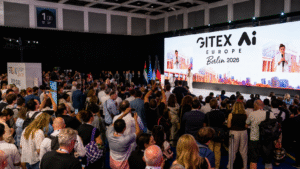
Europe enters a new chapter in digital competitiveness as leaders unite around sovereign compute, trusted AI and the capital needed to build the continent’s next generation of tech champions
Berlin, Germany – 30 June 2026: Europe today entered a defining new chapter in its AI ambitions as GITEX AI EUROPE 2026 opened at Messe Berlin, uniting policymakers, technology leaders, investors and entrepreneurs from more than 80 countries around a shared ambition to build the infrastructure, investment ecosystem and industrial capability needed to lead in the global AI economy.
Organised by inD, the global organiser of GITEX, and supported by the Berlin Senate Department for Economics, Energy and Public Enterprises and Berlin Partner for Business and Technology, the two-day event comes at a pivotal moment for Europe’s digital future. AI leadership is no longer shaped and determined by algorithms alone, but by access to compute, cloud infrastructure, energy, data sovereignty and the ability to scale innovation.
A GITEX AI EUROPE whitepaper, developed in partnership with research firm LUE, underscores the opportunity. Europe’s ICT market has grown to €1.02 trillion, yet AI demand could outpace planned compute capacity over the coming decade. While European data centre capacity is forecast to expand by around 70% by 2030, Germany alone could require up to €60 billion in additional investment to support industrial AI workloads.
Those realities set the tone for GITEX AI EUROPE’s opening day, where leaders from government, industry and investment examined how Europe can transform its engineering excellence into long-term tech leadership by strengthening sovereign compute, trusted cloud infrastructure and growth capital.
The conference programme opened with welcome remarks from Franziska Giffey, Berlin State Senator for Economy, Energy and Enterprise, and Trixie LohMirmand, CEO of GITEX, who positioned Berlin as the meeting point where policy, innovation and investment converge to shape Europe’s intelligence economy.
“Berlin is one of the most innovative places in Europe and one of its leading digital hubs, with more than 6,000 startups and over 100,000 people driving our innovation ecosystem,” said Senator Giffey.
“Through our new Deep Tech Agenda, we are investing in artificial intelligence, biotechnology, quantum technologies, microelectronics and cybersecurity because Europe’s future depends on innovation that strengthens our security, sovereignty and resilience while remaining rooted in international cooperation. GITEX AI EUROPE brings that vision to life by bringing together innovators from around the world to build technologies that make a real difference to people’s lives.”
“GITEX AI EUROPE brings together the world’s technology ecosystem in Berlin to create the partnerships, investment and market access that Europe’s innovators need to grow globally,” noted Trixie LohMirmand, CEO of GITEX. “By connecting international companies, investors and policymakers, we are helping strengthen Europe’s competitiveness while advancing the next chapter of sovereign AI, research collaboration and cross-border innovation.”
Compute has become Europe’s new strategic asset
A clear theme emerged throughout the opening day: in the AI era, compute has become the new strategic asset underpinning economic competitiveness. During a headline conference session, The Gigawatt Guarantee: Engineering Europe’s Industrial AI Supremacy, Germany’s Federal Minister for Digital Transformation and Government Modernisation, Dr. Karsten Wildberger, explored how compute capacity, energy infrastructure and industrial policy have become inseparable in the race to build Europe’s AI economy.
“Berlin is a city that once built the engines, turbines and machines that shaped an industrial century,” said Dr. Wildberger. “The next industrial century will run on a different kind of engine: compute and data. By 2030, we will double Germany’s data centre capacity from three to six gigawatts while expanding AI-specific capacity.
“We are also building the public infrastructure for the next economy through open standards, sovereign cloud services and the Deutschland Stack, while ensuring the state becomes an early customer that helps startups test, scale and connect with industry. Europe does not lack ideas, talent or companies willing to build; the challenge now is turning that potential into scale, industrial strength and long-term competitiveness.”
Digital sovereignty moves from ambition to execution
The conversation then shifted from physical infrastructure to digital independence during a keynote by Willemijn Aerdts, Minister for the Digital Economy and Sovereignty at the Netherlands’ Ministry of Economic Affairs and Climate, who examined how Europe can remain globally connected while maintaining greater control over its digital future.
“Digital sovereignty starts with building our own capabilities while diversifying the dependencies we have,” said Aerdts. “Europe has the talent, the research and the innovative companies to lead, but we need to move fast—we should have started yesterday, not today. Sovereignty is built by working together across Europe, strengthening partnerships around the world and creating the open standards that allow innovation to thrive.”
From experimentation to enterprise AI
With 800-plus exhibitors, the show floor demonstrated how these conversations are already translating into real-world deployments. AWS, the world’s biggest cloud services provider, is showcasing how European organisations can deploy agentic AI at enterprise scale through executive briefings, technical sessions and live demonstrations focused on secure, trusted and sovereign AI innovation.
“European organisations are moving beyond AI experimentation into production-ready transformation,” said Sasha Rubel, Head of AI/Generative AI Policy, EMEA, AWS. “At GITEX AI Europe, we’re sharing how AWS customers are already achieving real business outcomes with agentic AI, and how our continued investment in Europe, including the AWS European Sovereign Cloud, gives organisations the foundation to innovate on their own terms.”
Europe’s next challenge is scale
If compute underpins Europe’s AI future, capital will determine whether that future is built in Europe. While the continent continues to produce world-leading research, engineering talent and breakthrough startups, Europe’s ability to transform those innovations into global tech leaders remains one of its biggest competitive challenges.
According to the whitepaper, the continent attracts only around 5% of global venture capital investment, limiting the ability of many high-growth companies to scale internationally despite strong technical foundations.
Stefan Wintels, CEO of KfW, a German state-owned development bank, said Germany’s €1 billion Growth Fund Germany is already demonstrating how targeted public-private investment can strengthen Europe’s scale-up ecosystem. More than 90% of the fund’s capital has now been committed, helping high-growth companies secure larger funding rounds, create skilled jobs and accelerate commercialisation across AI, cybersecurity, green technologies and industrial software.
“A key policy objective is to retain more scale-ups in Germany and Europe — these are companies working on core technologies that are central to our digital sovereignty,” said Wintels, another headline speaker at GITEX AI EUROPE. “The Growth Fund acts as a catalytic anchor investor, expanding later-stage funding and ensuring that Europe’s most innovative companies have the capital to grow here rather than seek it elsewhere.”
Wintels will continue the discussion on 1 July during his session, Germany’s competitiveness urgency: Investment or Policy? examining how Europe can mobilise significantly larger pools of private capital to support the continent’s next generation of global technology champions.
A defining moment for Europe’s AI future
Running until tomorrow (1 July), GITEX AI EUROPE 2026 convenes more than 800 enterprises and startups, 280 speakers, and 600 investors with $1 trillion in AUM, creating a platform where governments, investors, researchers and technology leaders can collectively shape Europe’s AI future.
Over the next two days, the event will host strategic announcements, cross-border partnerships and high-level discussions spanning AI, cloud, cybersecurity, quantum technologies, digital infrastructure and venture investment — reinforcing a shared message emerging from the opening day: Europe’s AI future will be defined not simply by breakthrough technologies, but by its ability to build sovereign infrastructure, commercialise innovation and scale its own global technology champions.
For more information, please visit www.gitexeurope.com
-ENDS-
Follow GITEX AI EUROPE on social media:
Facebook | Instagram | X | LinkedIn | YouTube
Hashtag: #GITEXAIEUROPE
About GITEX AI EUROPE 2026
GITEX AI EUROPE 2026, Europe’s most comprehensive and cross-industry technology event, returns from 30 June to 1 July 2026 at Messe Berlin. In its second edition in 2026, the event reinforces its role as the defining global platform for Europe’s intelligence economy, uniting the continent’s deep tech, research, and engineering excellence across AI, quantum, data centre, cloud, cybersecurity, circularity tech, among more. With dedicated arenas for Europe’s unicorns, scale-ups, and SMEs, GITEX AI EUROPE continues to accelerate startup growth through North Star Europe, the continental edition of the world’s largest and best-rated startup and investor event.
The show is organised by inD, global organisers of GITEX, and supported by the Berlin Senate Department for Economics, Energy and Public Enterprises, and Berlin Partner for Business and Technology. For more information, please visit: www.gitexeurope.com
Media registration is available here
For Media Registration & Enquiries: media@gitexeurope.com
Media Contact:
Gareth Wright, AVP PR and Communications inD | gareth.wright@dwtc.com