
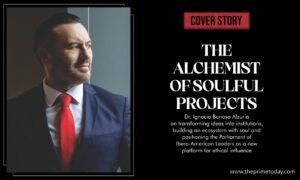
The Alchemist of Soulful Projects Dr. Ignacio Bonasa Alzuria on transforming ideas into institutions, building an ecosystem with soul and positioning the Parliament of Ibero-American Leaders as a new platform for ethical influence
“A project with soul is not born to occupy space. It is born to create meaning, awaken people and leave society better than it found it.”
Some leaders build organizations. Others build ecosystems. Dr. Ignacio Bonasa Alzuria has chosen the second path. Over the last years, his name has become increasingly associated with a singular expression: the alchemist of soulful projects. The phrase is not accidental. It describes a professional journey defined by the capacity to turn experience into vision, pain into purpose, ideas into institutions and leadership into a form of service.
After a distinguished career in banking and executive management, Dr. Bonasa entered a new stage of his life with a question that would become the axis of his work: what would happen if organizations, education, leadership and society recovered their soul? From that question emerged an expanding constellation of initiatives: Liderarte, RESETÉATE, DVT – Dale la Vuelta a la Tortilla (Turn the Table), the University of Happiness and Well-Being, ARTEcoaching, Womentoring, MASVida, The Recipe for Well-Being, Organizations with Soul, BienestART, VitaminARTE, ArtESPACIO Experience and other projects united by a shared purpose.
But one of his most ambitious institutional platforms is the Parliament of Ibero-American Leaders. Conceived as a space for dialogue, values, ethical leadership and shared transformation across the Ibero-American world, the Parliament gives political, cultural, educational and human depth to his broader mission. It is not simply another project in his portfolio. It is a stage where his vision of leadership with soul can become a collective agenda.
In this conversation, Dr. Bonasa reflects on why he creates so many initiatives, what makes a project truly soulful, how the Parliament of Ibero-American Leaders can contribute to the future of the region, and why the leaders of the coming era will need more than power: they will need conscience, culture, humility and purpose.
Dr. Bonasa, people increasingly refer to you as the alchemist of soulful projects. What does that expression mean to you?
I receive that expression with gratitude because it captures something very intimate about my way of working. Alchemy is the art of transformation. It is the capacity to take what appears ordinary, fragmented or even painful and convert it into something meaningful. My life has taught me that ideas only become powerful when they are connected to a purpose greater than personal ambition.
For me, being an alchemist of soulful projects means creating initiatives that are not only useful, but alive. A project with soul must have identity, values, emotional resonance, social contribution and the capacity to mobilize people. I am not interested in projects that simply decorate a curriculum. I am interested in projects that open doors, generate conversations, inspire action and help people or institutions become more human.
Why have you chosen to build an ecosystem instead of focusing on one single institution?
Because human transformation is not linear. People, companies and societies do not change through one channel alone. They need education, culture, leadership, emotional development, well-being, purpose, recognition, social dialogue and institutional frameworks. An ecosystem allows different doors to open for different needs.
Liderarte speaks to organizations through art and talent. RESETÉATE speaks to the personal and professional need to begin again. DVT speaks to resilience and the transformation of pain into purpose. The University of Happiness and Well-Being gives academic and institutional form to the study of well-being. Womentoring focuses on female talent. ARTEcoaching connects art and coaching. MASVida expands the conversation to the mastery of life. The Parliament of Ibero-American Leaders brings the vision to a civic and international level. They are different expressions of the same root.
What is the common root of all these projects?
The common root is soul. But I do not use the word soul in a vague or sentimental way. For me, soul means coherence, dignity, care, truth and purpose. An organization has soul when it treats people as human beings and not only as resources. A leader has soul when ambition is guided by conscience. A project has soul when it generates value without betraying values.
All my projects are connected to that principle. They may have different formats, audiences and languages, but they all ask the same question: how can we build a world where people do not have to lose their humanity in order to succeed? That question is personal, professional, educational, corporate and social. It is also deeply urgent.
Why is the Parliament of Ibero-American Leaders especially important in your ecosystem?
Because the Ibero-American world needs spaces of serious, generous and visionary dialogue. We share language, culture, history, emotional intelligence, creativity and many common challenges. Yet we often lack platforms capable of connecting leaders around values, not only around interests. The Parliament of Ibero-American Leaders can become a meeting point for those who want to think about the future with depth and responsibility.
I see it as a space where business leaders, academics, institutional figures, cultural voices and social actors can reflect on leadership, education, well-being, ethics, cultural identity and human development. Its value is not in reproducing political noise, but in elevating the conversation. The Parliament should help build bridges, not walls; ideas, not slogans; commitments, not mere visibility.
What kind of leadership does Ibero-America need today?
Ibero-America needs leadership with memory and future. Memory, because a region that forgets its cultural depth becomes vulnerable to superficial models. Future, because nostalgia alone cannot solve the challenges of our time. We need leaders who are proud of their roots and brave enough to innovate.
The region needs leaders capable of integrating economic development with dignity, education with values, technology with humanity, and growth with social cohesion. We need leaders who understand that power is not only a position, but a responsibility. The Parliament of Ibero-American Leaders can contribute to that vision by creating a language of leadership that is more ethical, more cultural and more humanistic.
How do your business and social projects connect with the Parliament?
They connect through a shared idea: transformation must operate at different levels. Liderarte works with companies and teams. RESETÉATE works with personal and professional renewal. DVT works with resilience and the capacity to turn adversity into purpose. The University of Happiness and Well-Being works with knowledge and education. The Parliament works with influence, dialogue and institutional projection.
When these levels are connected, the impact becomes stronger. A business program can inspire a leader. A leader can transform a company. A company can influence society. A social movement can give meaning to organizational change. An institution like the Parliament can help articulate all of this into a wider agenda. That is why I speak about an ecosystem, not isolated initiatives.
What role does art play in your wider vision as an alchemist of projects?
Art is one of the great vehicles of transformation because it speaks to the whole human being. It does not only inform; it reveals. It does not only explain; it moves. Art allows us to understand leadership, conflict, trust, vulnerability and purpose in a language that is more profound than corporate jargon.
In Liderarte, Learning Through Art is a methodology. But beyond Liderarte, art is also a philosophy. It teaches that creation requires discipline, listening, emotion, silence, beauty, structure and courage. A society that loses contact with art risks losing contact with its sensitivity. That is why many of my projects include an artistic dimension. Art reminds us that human beings are not machines designed only to produce. We are creators of meaning.
How do you avoid your projects becoming merely promotional brands?
By asking whether each project has a real mission, a real audience and a real contribution. A name is not a project. A logo is not a project. A project begins when there is a need to serve, a problem to address and a methodology capable of generating impact. I am demanding with that distinction.
Of course projects need visibility. In today’s world, what is not communicated often does not exist. But communication must serve substance, not replace it. The soul of a project is tested by its usefulness, its coherence and its capacity to endure beyond the initial excitement. My goal is not to accumulate names. My goal is to build platforms that can grow, collaborate and leave a mark.
Which projects would you identify as central pillars of your current ecosystem?
Liderarte is a foundational pillar because it connects my work with companies, leadership and talent development. DVT – Dale la Vuelta a la Tortilla is another pillar because it expresses my deepest philosophy: the possibility of transforming pain into vitamin for the soul. The University of Happiness and Well-Being is essential because it gives academic legitimacy to well-being as a discipline. The Parliament of Ibero-American Leaders is central because it opens a broader institutional and civic horizon.
Around these pillars there are powerful complementary initiatives: RESETÉATE, ARTEcoaching, Womentoring, MASVida, The Recipe for Well-Being, Organizations with Soul, BienestART, VitaminARTE and ArtESPACIO Experience. Each one addresses a specific dimension of human and organizational transformation. Together, they form what I like to call a universe of projects with soul.
What makes the Parliament of Ibero-American Leaders marketable and attractive for institutions and sponsors?
The Parliament offers something that many institutions and sponsors increasingly seek: purpose with visibility, influence with values and reputation with social meaning. It is not an event without depth. It can become a platform for forums, awards, publications, leadership programs, academic alliances, corporate sponsorships and social impact initiatives.
For companies, supporting the Parliament means associating their brand with ethical leadership, Ibero-American connection, education, culture and human development. For universities, it opens a space for thought leadership. For institutions, it creates bridges. For leaders, it offers belonging to a community with aspiration. The key is to position it not only as a symbolic body, but as a generator of projects, content, encounters and measurable influence.
What is your vision of legacy?
Legacy is not what one says about oneself. Legacy is what remains useful when one is no longer in the room. I would like my work to remain as a set of living platforms that continue helping people, leaders, companies and institutions recover their soul. That would be a beautiful legacy.
I do not want to be remembered only for having created many projects. Quantity is not the point. I would like to be remembered for having insisted that leadership can be stronger when it is more human; that business can be more successful when it respects dignity; that pain can be transformed; that art can educate; and that Ibero-America has a voice capable of contributing something profound to the world.
What message would you give to leaders who want to build projects with soul?
I would tell them to begin with truth. Do not create a project only because the market seems attractive. Create it because something in you recognizes a need that deserves to be served. Then add discipline, structure, alliances, communication and execution. Soul without execution remains a dream. Execution without soul becomes machinery.
A project with soul must be loved, but it must also be managed. It must inspire, but it must also deliver. It must have poetry, but it must also have strategy. The world needs more projects that connect both dimensions. That is the alchemy: turning vision into value, emotion into action, and purpose into institutions that can truly transform lives.
How do you balance personal brand and institutional credibility?
A personal brand without institutions can become fragile, and institutions without a soul can become cold. My challenge has always been to connect both dimensions. The personal brand gives face, voice, narrative and emotional energy to the projects. The institutions give structure, continuity, governance and credibility. One dimension feeds the other.
I do not want my name to be only a label. I want it to represent a standard: projects with purpose, leadership with soul, well-being with rigor and transformation with real impact. The Parliament of Ibero-American Leaders, Liderarte, DVT and the University of Happiness and Well-Being are not ornaments around a personal brand. They are institutional vehicles for a mission that is larger than one person.
What next stage do you imagine for the Parliament of Ibero-American Leaders?
The next stage must be one of consolidation and projection. A Parliament of this kind should not remain only in the symbolic field. It should generate forums, leadership declarations, publications, awards, academic programs, business alliances and social impact projects. It must become a living platform for thought and action.
I imagine it connecting cities, universities, companies, foundations and leaders who share a concern for the future of Ibero-America. The region needs spaces where prestige is not separated from service. If the Parliament can become a place where leaders meet to elevate the conversation and activate projects, it will have a powerful reason to exist.
Why is your ecosystem attractive for international media and partners?
Because it offers a coherent story with many points of entry. Media can speak about leadership, well-being, art, resilience, female talent, education, corporate culture, social movements or Ibero-American dialogue. Partners can connect with specific projects while belonging to a larger vision. That is the strength of an ecosystem: it multiplies relevance.
Internationally, there is a hunger for leadership models that are not purely technical. The world is looking for narratives that combine performance with humanity and visibility with purpose. My ecosystem speaks precisely to that need. It is emotional, but it has structure. It is visionary, but it can be translated into programs, institutions, publications and alliances.