
The AI Scaler of the Main Street – Shadman Zafar: Bringing Artificial Intelligence to the Real Economy
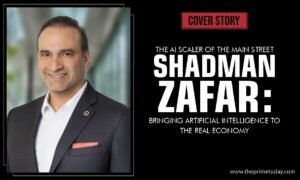
Technology’s true test, for decades, happened far away from all the hype and headlines. A trading floor stressed under daily chaos. A mobile network suddenly spiked at midnight. Or the friction of moving money across borders. Shadman Zafar, in his career, lived all these realities in those exact spaces. He, being an executive at Citi, JPMorgan Chase, Barclays, and Verizon, did much more than just manage systems. He ran the massive digital engines. Engines that power our daily lives. When you scale platforms to serve over 100 million customers, you learn exactly where technology meets reality. You learn that a brilliant idea means nothing if it breaks during peak hours. With those lessons, Shadman turned his learnings into tangible assets. And that way, he earned more than 100 patents. His inventions speak in many industries – finance, telecommunications, entertainment, technology, and design. You have likely relied on a product he helped build whenever you have swiped a card, streamed a video, or used a mobile banking app.
Now, the focus of global conversation is on artificial intelligence. Yet, a massive gap persists between what AI promises in labs and how businesses actually function. As the Chief Executive Officer (CEO) of Vibrant Capital, Shadman addresses this exact friction. Scaling AI on Main Street is the new challenge that he brings his top game as a CIO, Chief Digital Officer, and Chief Product Officer to solve. He never chased abstract tech benchmarks. Instead, his focus has always been on the practical workflows. Processes that power factories, hospitals, and logistics networks. AI has never been an experiment for him, but the new foundation for the real economy. With a recognition as one of the Top Most Visionary Technology CEOs Transforming AI Innovation in 2026, standing at a unique crossroads is Shadman. The tools are ready. The infrastructure exists. And in anticipation are the local businesses. Companies that form the backbone of the economy.
The Operator’s Vantage
Across more than two decades, he held the senior technology seats at Citi, JPMorgan Chase, Barclays, and Verizon, including CIO, Chief Digital Officer, and Chief Product Officer. The teams he led shipped products used worldwide and some reached millions of people daily, from FiOS at Verizon to the UK’s first mobile-payments app at Barclays. But what actually prepared him to run Vibrant Capital wasn’t any single launch. It was a career spent on the receiving end of technology. As the buyer and operator, he was the one accountable when an ambitious promise had to survive real customers, regulators, and a balance sheet, and he learned where transformation tends to break: rarely in the demo, almost always in the unglamorous work of integration, trust, and change. Building across finance, telecom, and media also taught him a kind of pattern recognition, because the same adoption problems keep reappearing in different costumes. That vantage point is the whole premise of Vibrant Capital: it’s built by people who’ve sat in the operator’s chair, for the people still sitting in it.
Scaling AI on Main Street
Vibrant Capital focuses on scaling AI innovation for businesses. When it comes to the mission of the company, Shadman had circled this idea for nearly twenty years. AI generated incredible noise, he says. Yet when you looked at what actually changed for a working business, the honest answer was usually ‘not much.’ Having lived through two AI winters, he knows what it looks like when ambition sprints ahead of delivery. His mission became ensuring effort and capital land on technology that demonstrably improves the real economy—what he calls “scaling AI on Main Street.” Vibrant Capital’s goal is to make AI practical and productive for the operators who run things: banks, insurers, logistics, and healthcare. In practice, that means the company operates as an ecosystem rather than a fund: a nonprofit community where CIOs trade hard-won lessons, a partner arm that vets and scales the companies’ operators genuinely need, and an incubator that pairs founders with enterprise leaders from day one so products are shaped by reality instead of retrofitted to it. Vibrant Capital is the bridge between what’s possible and useful.
Leadership Principles
Having led technology, digital, and AI initiatives at major global organizations, the principle he holds above all: a leader’s finest output is other leaders. Gandhi said it best: a good leader isn’t measured by the number of followers, but by the number of leaders they create. Shadman wants the people he develops to eclipse anything he’s done. Next, relationships over transactions; deals fade from memory, but the bonds you build keep paying dividends in trust and alignment long after the work is finished. Third, humility. Listen more than you speak and share credit freely, because nothing worthwhile is built alone. And fourth, stay a perpetual beginner; the moment you crown yourself an expert, you cap how far you can still climb. Those four have held through every cycle he’s worked—from neural networks no one believed in, to mobile, to today.
Vision and Trust
Visionary leadership in today’s rapidly evolving AI-driven business landscape comes down to agency and trust. He’s drawn to people who believe they can reshape a company’s direction through sheer agency, who refuse to operate inside inherited constraints and instead redraw them. That’s vision in action. The other half is trust, which he treats as a performance multiplier, not a feel-good nicety: a team lighter on resources but heavier on trust beats a bigger, more cautious rival, because decisions come fast and people pull together. There’s a marvelous image of buffalo turning to face a storm; unable to outrun it, they cut their time inside by charging through. The best leaders meet disruption the same way: not waiting it out, not pretending it’s elsewhere, but moving into it with conviction.
Plumbing and Whisperers
AI is transforming industries at an unprecedented pace. The biggest shift, says Shadman, is that AI stops being a destination and becomes plumbing, woven so deeply into how work happens that you stop noticing it. The quiet wins matter more than the headlines: autonomous systems catching fraud, monitoring compliance, rebalancing resources in the background. He’s convinced the winning pattern isn’t one all-powerful model but a coordinated set of capabilities, agent architectures included, each doing what it does best. Simply scaling a model larger doesn’t crack the enterprise problem. Further out, he expects the real prize to move from efficiency to growth: imagine generating hundreds of strategic hypotheses, testing them against simulated customers, and taking only the strongest one or two to market. And one underrated trend: the defining skill is moving from writing code to conversing with these systems precisely. Call it being an AI whisperer. Clear writing and sharp thinking are appreciating assets.
Overcoming Integration Hurdles
When integrating AI into companies’ operations, two challenges dominate. First, clutter. Because a convincing pitch is now trivial to manufacture, the market is awash in thin, me-too products, and leaders burn energy separating the real from the rehearsed. The antidote is peer truth; operators telling each other plainly what they built, what they delivered, what flopped. The deeper problem is that most stuck programs don’t stall on intelligence; they stall on everything around the model: data that arrives late, guardrails so thin humans must babysit every output, glacial approvals, workflows nobody rethought. The fix is rarely a bigger model; it’s a better representation of the enterprise’s own data and a portfolio approach: compact models trained on specific workflows, mid-sized models to coordinate, and frontier models used sparingly to integrate. Treat a rollout as reshaping how work gets done, not installing software. Redesign the process, harden governance, and judge by outcomes, not motion.
Innovation with Discipline
As someone who has helped build large-scale technology platforms serving millions of customers, Shadman anchors on innovation with discipline. Most people see governance and controls as creativity’s enemy; he sees them as the edge, what lets a bold idea hold up and scale in a regulated setting. So he weighs not just an idea’s daring but the rigor to ship it responsibly. Customer obsession keeps that rigor honest. On his teams, a glowing customer survey or strong App Store rating always outranked the size of someone’s office. And he’s fanatical about simplicity: the most sophisticated products are usually the simplest, and that’s incredibly hard to earn. The elegant thing on the surface almost always hides enormous engineering underneath. His reflex is to remove, not add. Every needless decision you push onto a customer is friction, and friction loses people.
Measuring What Matters
Data, automation, and advanced analytics play a foundational role in helping organizations unlock new opportunities and create measurable business value, but only if you measure what matters. Companies love to cite how many staff members finished the training or how often a tool gets opened. That’s faintly interesting and mostly a distraction; it tracks activity, not value. He wants outcome metrics: lower cost, smarter routing, higher productivity, better conversion. A fraudulent transaction flagged before it clears, an underwriting decision returned in minutes instead of days, a support issue resolved without a single human handoff—those are the numbers that move a P&L. In financial services, that maps straight to efficiency, risk handling, onboarding, and compliance. Dependable data flows, clear accountability, and crisp performance measures are what turn an impressive model into a real result. Intelligence produces nothing in a vacuum—it has to be stitched into actual workflows and decisions. Skip that, and even a brilliant system is just a costly science project.
Cultivating Renaissance Talent
To foster a culture of innovation and continuous learning within his organization, especially in a rapidly changing technological environment, Shadman builds around “renaissance employees,” people who possess a wide variety of transferable skill sets and yet continue to seek constant growth.
He prizes the fresh eyes a subject-matter beginner brings. He believes in a daily reading habit, too; a modest number of pages each day quietly compounds into shelves of books a year. Just as vital is making failure safe. He admires that Finland devotes a day each year to destigmatizing it, since our hardest experiences teach the most. So he leans hard on candor: teams with real trust move faster because people name what’s broken instead of hiding it. And collaborating from day one is, in business, just good leadership.
Advice for CEOs
His advice to CEOs and business leaders who are looking to accelerate their AI transformation journey but are uncertain where to begin is straightforward: Begin with the pain, not the buzz. Don’t open with ‘what can AI do?’ Open with a sharply defined problem that your operators already feel. Fall in love with the problem, not the solution. When several operators independently request the same capability, that’s demand validated before you’ve spent a cent. Second, respect how far enterprise reality sits from a slick demo; things that sparkle in a controlled setting buckle under real requirements for scale and governance, so fund the unglamorous foundations early—data quality, controls, measurement. Third, don’t bet everything on one colossal model; assemble a portfolio of capabilities sized to each job. And if you’re getting hands-on personally, don’t be timid: ask again, ask five times, ask the model to interrogate you first. These systems aren’t deterministic, and learning to talk to them well is a competitive skill in its own right.
Setting the Standard
Looking ahead, Shadman says their near-term focus is standard-setting, in other words, handing operators the instruments to own their transformation. They’re working on two efforts. One is a CIO Readiness Index that captures, concretely, what enterprise technology leaders need to see before putting something into production. The other is a reference enterprise architecture for the post-AI world, mapping how the architecture must change as intelligence threads through every layer of the stack. They’re formalizing both so no company walks that gauntlet alone, and reinforcing them through their CIO community, where those standards get pressure-tested by people who actually run enterprises. In a moment flooded with machine-generated everything, standing in their community is earned through operator endorsement, never bought. He counts Vibrant Capital among those determined to keep the next AI winter from arriving.
Message to Innovators
Being recognized among the ‘Top 10 Most Visionary Technology CEOs Transforming AI Innovation in 2026,’ his message to aspiring technology leaders and innovators around the world is this: ‘Chase the ideas that genuinely light you up.’ In college, a professor warned him that studying AI would never make him rich or popular, and for years, he was right. He stuck with it through the winters anyway, purely because it captivated him, and decades on, the discipline nobody wanted is remaking every industry there is. ‘You rarely grasp the worth of your daily work while you’re in it.’ He thinks often of Ramanujan, whose theorems looked like curiosities in his lifetime and still inspire mathematicians today. ‘So apply the full force of your creativity, stay humble enough to keep learning, invest in people rather than transactions, and treat whatever you build next as the most important thing you’ve ever done. The value compounds in ways you won’t see until much later.’