
A People-Centric Leadership Legend – Markus Dinslacken: Creating a Legacy Defined by Consistency, Clarity, and Humanity
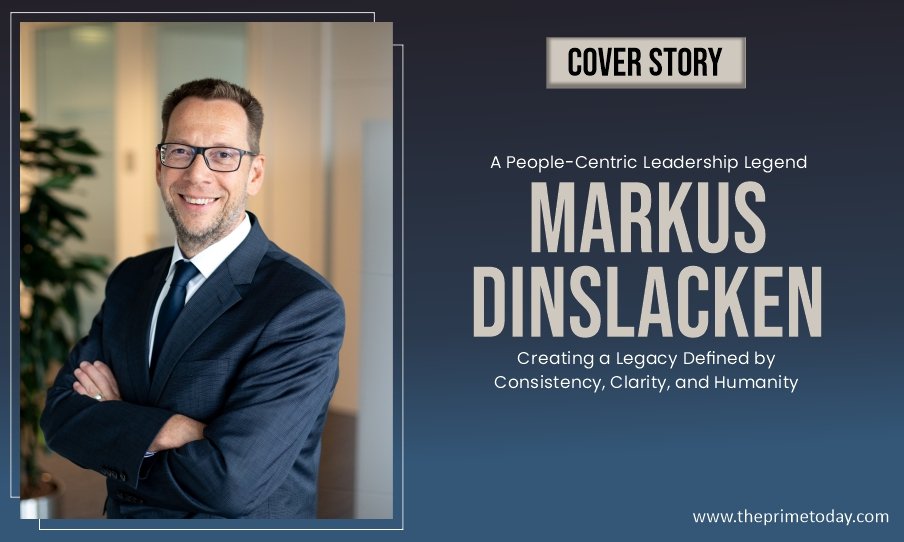
More than stability, transitions shape a leader’s journey with far richer experiences. Experiences that teach them how to handle unexpected challenges, unprecedented situations, and most importantly, expectations of people from different stratums of the business. Especially for a leader in human resources, these learnings are crucial. Markus Dinslacken calls himself fortunate due to that same situation happening to him. During his career spanning 25 years of leadership across FMCG, Pharma, MedTech, and Automotive, he has had the most formative experiences in organizations that faced transitions. Whether integrating new units, reshaping global structures, or steering cultural shifts, he realized how outcomes depend on clarity, communication, and trust. “Working across industries taught me that while business models differ, people’s fundamental needs do not: they want direction, purpose, and credibility from leadership,” says Markus, who learned that strategy only becomes reality when leaders translate it into behaviours, decisions, and priorities that people can understand and follow.
The challenging environments of MedTech and Automotive taught him the importance of discipline and resilience; FMCG and Pharma reinforced the need for speed, simplicity, and cross-functional alignment. Together, these experiences shaped Markus’s perspective, which is grounded in transparency, empowerment, and consistency. He believes that leadership must reduce complexity, create psychological safety, and ensure that people feel connected to the broader purpose. “In every transformation I’ve led, human alignment was the decisive factor.”
Principled in Trust and Fairness
All these transformations have made Markus one of the most influential Chief Human Resources Officers; he, today, is recognized as. Today, being the Head of People & Culture and Managing Director at BASF Coatings, Markus’s leadership philosophy is based on the core values of trust and fairness. They guide how he works, makes decisions, and builds relationships across teams and organizations. He insists that leaders must be transparent and clear, but nothing is wrong with being kind to each other – kindness and clarity reinforce one another. This balance of clarity and empathy has shaped his approach to transformation, talent development, and organizational leadership. Markus adds, “It underpins my belief that people can only contribute meaningfully when they feel respected, informed, and supported.” With this foundation, all his reflections outline how his experiences across industries – and now at BASF Coatings – have shaped his thinking as a CHRO and his perspective on the future of work.
A Strategic Value-Driver
At BASF Coatings, Markus focuses on positioning HR – “Or as we call it, People & Culture – as a driver of strategic value rather than a reactive service function.” This began with simplifying processes, making roles clearer, and building stronger interfaces with the business. His aim is to anticipate business needs, not to wait for them. He explains, “We concentrate on strategic workforce planning, leadership effectiveness, capability building, and data-driven decision support.” And especially now, as he and his team build entirely new functions and organizational capabilities, People & Culture plays a critical role in identifying and attracting the right talent for positions that are being created for the first time. Ensuring that they can fill these future-oriented roles with the right people is one of the most decisive levers for long-term success. By strengthening these pillars, HR becomes an impactful partner in transformation initiatives, claims Markus. “We also enhance our shared services and digital tools so that administrative tasks can be handled more efficiently, freeing our teams to focus on leadership development, culture, and organizational effectiveness.”
A Transparent Approach
Markus always followed some core principles when driving organizational change at a global transformational and large-scale level. His approach centres on co-creation, disciplined execution, and transparent governance. Co-creation ensures that transformation is not something ‘done to’ the organization but something built with it. People support what they help to shape, and this principle has proven invaluable across all changes he’s led. Disciplined execution breaks down complexity into clear, manageable phases, building momentum through early wins, and keeping teams focused on what really matters. Transparent governance ensures everyone knows who decides what, why, and by when. In addition, Markus emphasizes the role of leadership behaviour as a success multiplier: change progresses at the speed of leadership alignment. When leaders model new ways of working, communicate consistently, and hold each other accountable, transformation moves faster and becomes self-sustaining. “For me, successful transformation combines a structured approach with empathy, honest communication, and a focus on impact,” he says.
A People-Centric Culture Powers Efficiency
Also, there is a necessity of balancing operational efficiency with maintaining a strong, people-centric culture in complex, global organizations. Yet, Markus says he does not see efficiency and a people-centric culture as opposites – they strengthen each other. Clear, streamlined processes reduce friction, enable faster decision-making, and give employees time for meaningful work. A strong culture makes teams more resilient, innovative, and engaged. The balance comes from designing systems that are simple and scalable while ensuring that leadership remains empathetic and connected. He puts emphasis on psychological safety, trust, and open communication as cultural anchors; these elements allow efficiency efforts to land positively instead of being perceived as purely cost-driven. Leaders play a key role by combining operational discipline with genuine care for their teams. In global settings, consistent leadership expectations and values help create alignment across regions and functions. When people know what is expected of them, feel respected and supported, efficiency measures enhance performance rather than undermine culture, he feels.
The Architect of the Workforce Ecosystem
The role of the CHRO is evolving, especially in the context of digitalization and workforce transformation. Markus, too, believes that the CHRO is becoming more and more the architect of the workforce ecosystem. Digitalization enables HR to generate insights at a depth and speed that were unthinkable a decade ago. As AI continues to evolve, it will change many jobs, and within that change lies a significant opportunity: to redesign work, elevate skills, and help people grow into roles that did not exist before. At the same time, workforce expectations are shifting dramatically. Employees seek flexibility, purpose, and development, and organizations must respond to remain competitive. As CHRO, Markus adds that he is expected to bridge strategy, technology, and human behaviour. That means shaping future capabilities, creating modern learning environments, simplifying structures, and designing employee experiences that balance digital efficiency with human connection. The CHRO role increasingly requires comfort with data, fluency in change management, and the ability to translate business strategy into leadership and culture. It is no longer enough to run HR operations well; the CHRO must influence how the entire organization adapts, learns, and evolves – ensuring that technological advances become a catalyst for human development.
Building Resilience
Every successful CHRO needs strategies that are most effective in building resilient and future-ready organizations. For Markus, to build resilience, he focuses on enabling organizations to learn and adapt quickly and confidently. This starts with clarity – people need to understand where the organization is heading and why. He also encourages a mindset that views challenges as opportunities for learning rather than disruptions. In parallel, it’s important to simplify governance and increase transparency so that teams feel equipped to act decisively. When leaders demonstrate authenticity, take time to explain the rationale behind decisions, and invite constructive debate, they create environments where resilience becomes a shared habit. Ultimately, future-ready organizations are those that combine direction with flexibility and accountability with psychological safety.
The Authentic and Empathetic Leadership
Markus emphasizes authentic and empathetic leadership. When asked how these qualities translate into measurable business outcomes, he answers that authentic and empathetic leadership improves performance. When leaders communicate honestly and show interest in their teams, they build trust – and trust accelerates collaboration, decision-making, and alignment. Empathy creates psychological safety, which encourages people to raise concerns early, share ideas openly, and take ownership of outcomes. This leads to fewer errors, quicker escalation of risks, and better-quality decisions. Engagement metrics consistently show that teams led by empathetic leaders have higher productivity, stronger retention, and better customer satisfaction results. Authentic leadership also strengthens accountability because people are more willing to follow leaders who act with integrity and consistency. “In my experience, empathy and authenticity are strategic levers that drive measurable results across quality, safety, innovation, and team performance. They turn leadership from a formal role into a lived relationship – and that is what moves the business.”
Three Pillars of the Talent Management
In a rapidly shifting global workforce landscape, Markus’s approach to talent management is built on three principles: skills-first thinking, internal mobility, and transparency. In a fast-changing world, static job descriptions are becoming less relevant. What matters more is the ability to adapt, learn, and apply capabilities across different contexts. He therefore focuses on understanding critical skills, developing them proactively, and creating opportunities for employees to apply them in meaningful ways. Internal mobility plays a decisive role because it accelerates development, strengthens engagement, and helps the organization deploy talent where it’s needed most. Transparency is equally important – people need to know what skills matter, what opportunities exist, and how they can progress. Markus also pays attention to succession pipelines for critical roles and strikes a balance between promoting internal talent and bringing in external expertise. “Effective talent management, in my view, is about enabling people to grow and helping the organization stay competitive at the same time.”
Data and Analytics-Powered Decision-Making
Moreover, data and analytics enable him to make decisions that are both faster and more objective. They help identify trends in workforce dynamics, highlight capability gaps, assess the impact of development initiatives, and uncover risks before they become critical. “Through predictive analytics, we gain insights into retention, engagement, and leadership, allowing us to respond proactively.” However, data only becomes valuable when paired with context and judgment. Markus ensures that analytics inform decisions rather than dictate them. Behind every data point is a human story, and it is essential to interpret numbers in a way that honours that. When used responsibly, analytics improve fairness, increase transparency, and strengthen the credibility of HR. They support targeted investments in talent, consistent performance management, and strategic workforce planning – all of which contribute to organizational success.
Fostering a Culture of Continuous Improvements
Markus fosters a culture of continuous improvement by encouraging his HR teams to think like product owners who create value for their users – “Our employees and leaders.” This means being curious, seeking feedback proactively, and iterating quickly. He promotes experimentation by creating safe spaces for trying new ideas and by recognizing successful innovations and valuable learnings from failed attempts. Simplification is another core element: “We systematically review processes, eliminate unnecessary steps, and leverage digital tools to automate administrative tasks.” This frees up time for more strategic work. Cross-functional collaboration and external benchmarking help broaden perspectives and bring fresh ideas into the organization. Above all, Markus nurtures a mindset where improvement is not a project but a habit. When HR teams see themselves as enablers of business performance and cultural strength, innovation becomes part of their identity, he emphasizes.
A Three-Dimensional Advice
To emerging HR leaders aspiring to take on global CHRO roles, Markus’s advice is to develop fluency in three dimensions: business, people, and data. Understand how value is created, build strong relationships across functions, and learn to interpret data in ways that drive meaningful decisions. Seek out diverse experiences – new regions, new teams, new challenges – because global leadership requires adaptability and cultural awareness. Cultivate the courage to communicate openly, challenge constructively, and simplify complexity. Stay close to the business but equally close to your people.
Most importantly, lead with empathy and authenticity. In global roles, trust is your currency. The combination of strategic clarity, emotional intelligence, and operational discipline will prepare emerging leaders well for future CHRO responsibilities.
Transforming Tomorrow with Purpose and Integrity
Amid a pivotal phase of transformation, BASF Coatings is currently positioned between signing and closing of its acquisition by The Carlyle Group—a transition that underscores the organization’s strategic evolution and sets the stage for its next chapter of growth.
Looking ahead, Markus envisions leaving behind a legacy rooted in consistency, clarity, and humanity. His ambition is to shape leadership systems that are not merely documented frameworks but are actively practiced—simple, meaningful, and embedded into the everyday fabric of the organization. He is committed to fostering cultures where individuals feel genuinely valued, empowered, and equipped to grow.
As he reflects on long-term impact, Markus emphasizes the importance of building enduring leadership expectations, robust learning environments, and sustainable talent mechanisms. For him, true success lies in creating systems that outlast individual tenures and continue to drive progress.
Ultimately, Markus aspires to contribute to an organization where leadership serves as a true catalyst for both performance and well-being—where people thrive amid change, and where HR plays a central, strategic role in enabling transformation with purpose, integrity, and lasting impact.