
The Remarkable Evolution And Future Horizons Of Ambitious Indian Space Missions 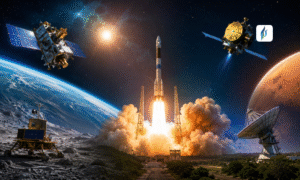
From a small team firing basic rockets off a seaside town, India’s space effort grew quietly but fast. Not money-heavy, yet sharp in spending, it pulled off missions others thought too hard for its budget. ISRO missions once limited to watching weather and land slowly reached farther – way beyond Earth. Now probes circle Mars, craft scout the Moon, even venture where few have gone before. Step by step, without noise or show, goals shifted from machines alone to carrying people among stars. What began as experiments now shapes how nations view what is possible far above through ISRO missions. Each leap forward rests on past wins, each next move points beyond orbit – to stay, not just visit. The path so far tells more than progress – it shows quiet persistence building tomorrow through groundbreaking ISRO missions.
The Key Moments That Changed Moon Exploration Forever
One small step for India became a giant leap when its moon missions took a bold new turn. Not just orbiting, but actually circling the Moon brought early proof – water locked in the soil, hints of life-giving chemistry. Then came the daring plunge toward the icy edge of the south pole, where shadows stretch endlessly across crater floors. Landing there, steady and precise amid jagged terrain, placed the country among only a few who’ve touched those distant plains through historic ISRO missions.
Success here wasn’t about fame. Hidden zones of the Moon, frozen in eternal dark, gave up secrets only now seen. Touching down through danger, then rolling out a robot to study untouched ground – this showed skill can beat spending. Tiny tools, sharp planning, did what once took vaults of money. The world watches differently now when aiming for planets, seeing cleverness where they once saw only need for cash because of advanced ISRO missions.
Expanding Cosmic Sight to the Fiery Sun and Neighboring Venus
Beyond the silver sands of the Moon, Indian scientists have steadily directed their instruments toward the ultimate powerhouse of our solar system. The successful deployment of a dedicated solar observatory at the stable Lagrangian Point L1 has allowed humanity to track solar winds, coronal mass ejections, and the volatile dynamics of the sun without atmospheric interference. This strategic vantage point provides continuous, unobstructed monitoring, delivering vital space weather alerts that protect global satellite networks and terrestrial power grids from unexpected solar radiation storms through innovative ISRO missions.
Simultaneously, the agency has finalized blueprints for an upcoming voyage to our mysterious neighbor, Venus. The Venus Orbiter Mission is uniquely configured to peel back the dense, toxic shroud of sulfuric acid clouds that envelop the planet. Equipped with advanced synthetic aperture radar and hyperspectral imaging cameras, the spacecraft aims to map the scorching topography, analyze subsurface structural anomalies, and hunt for active volcanic hotspots. By studying the extreme greenhouse effect prevalent on Venus, the mission hopes to uncover crucial lessons about planetary atmospheric evolution and the long-term climate vulnerabilities of Earth. These ambitious goals further strengthen the legacy of ISRO missions.
Transitioning From Robotic Observers to Safe Human Spaceflight
The most technically demanding frontier currently underway is the highly anticipated human spaceflight program, known officially as the Gaganyaan initiative. This monumental project marks a fundamental pivot from launching automated hardware to sustaining human life in the unforgiving vacuum of low Earth orbit. The engineering teams have spent years systematically retrofitting existing launch vehicles to meet stringent human-rated safety standards, developing robust environmental control systems, and perfecting complex emergency crew escape mechanisms under future-focused ISRO missions.
A series of rigorous, uncrewed orbital test flights are structured to meticulously validate the integrity of the crew module, the thermal re-entry shields, and the naval recovery operations upon splashing back down into the ocean. These preliminary uncrewed demonstrations ensure that every single life-support parameter performs flawlessly under intense gravitational pressures before Indian astronauts, or Vyomanauts, are permitted to launch. The long-term vision extends far beyond a singular orbital journey; it serves as the essential stepping stone toward establishing an independent, permanently inhabited space station by the next decade and eventually landing an indigenous astronaut on the Moon through visionary ISRO missions.
International Synergy and the Expanding Commercial Horizon
The modern era of cosmic pursuit is built on a foundation of collaborative alliance rather than isolation. A prime example of this cooperative philosophy is the upcoming joint earth-observing project developed alongside Western international partners. This state-of-the-art satellite utilizes dual-frequency synthetic aperture radar to monitor the subtle deformations of the crust of our planet with unprecedented accuracy. The data gathered will prove instrumental in tracking moving glaciers, measuring agricultural yield dynamics, mapping deforestation patterns, and providing early warnings for natural disasters like earthquakes and tsunamis powered by evolving ISRO missions.
Concurrently, the creation of dedicated commercial arms has streamlined the process of launching foreign payloads into precise orbits. By offering the highly reliable Polar Satellite Launch Vehicle and the heavy-lift launch options to private international clients, the country has captured a significant share of the global small-satellite launch market. These commercial ventures generate substantial revenue that is directly funneled back into funding deep-space research, ensuring that the domestic space ecosystem remains financially sustainable while driving localized technological innovation.
From studying microscopic soil grains on the lunar south pole to preparing for the complex realities of human orbital flight, the expansive catalog of missions represents a masterclass in strategic growth. By balancing practical terrestrial applications like communication and weather forecasting with audacious deep-space exploration, the Indian space program continues to prove that the sky is no longer a limit, but a starting line for future ISRO missions.