
A Radically Transparent Leader – Abhinav Pande: Building Meta’s Foundational Infrastructure for the Next Generation of Connected Experiences
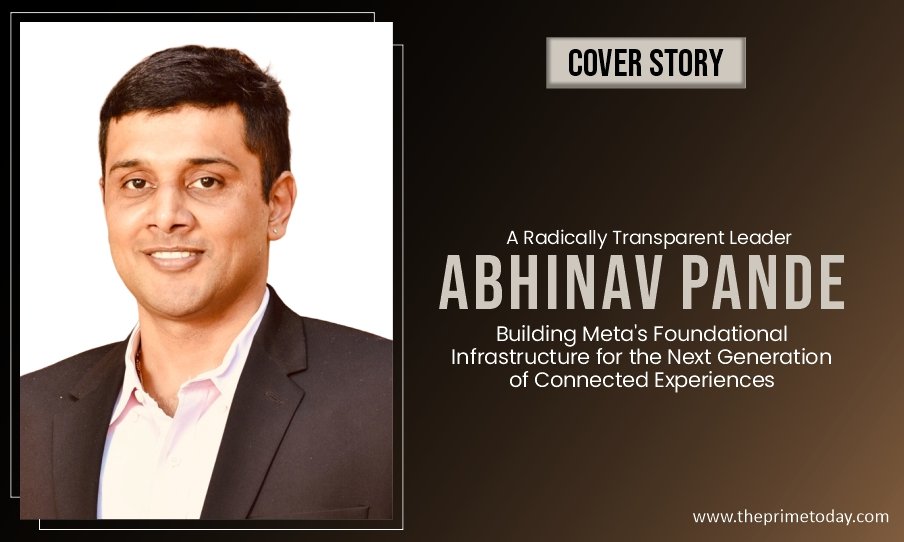
Architecting the Future: A Story of AI Infrastructure, Leadership, and Purpose
In this unbelievable age of artificial intelligence, the most trustworthy, influential leaders shaping the future of the business world are those who possess the rarest quality of radical transparency. Meet Abhinav Pande, a seasoned Technical Program Manager at Meta, who with his 17 years of engineering, program management, and organizational leadership experience across companies including Netflix and Kaiser Permanente, brings an unusual combination of deep technical expertise and business acumen — anchored by an MBA from UCLA Anderson School of Management and a portfolio of certifications including PMP, Oracle PL/SQL Developer Certified Associate, Certified ScrumMaster, and Microsoft Azure Data Fundamentals.
In leading high-stakes programs at the intersection of multiple AI infrastructure teams and business units, Abhinav Pande is guided by a few core principles that he returns to consistently, regardless of the scale or complexity of the challenge at hand.
First and foremost is the principle of radical transparency. In a complex and fast-moving environment, it is crucial that all stakeholders — from individual contributors to senior executives — have a clear and accurate understanding of the program’s status, risks, and dependencies, he insists. “Transparency is not always comfortable, particularly when the news is difficult, but it is the foundation of trust. It enables us to address challenges proactively rather than reactively, and it creates a culture where problems are surfaced and solved rather than hidden and compounded.”
Second, Abhinav Pande believes deeply in the power of data-driven decision-making. His MBA training reinforced the importance of grounding strategic decisions in rigorous analysis rather than intuition alone. “In the context of AI infrastructure, this means leveraging data to inform our roadmap, prioritize initiatives, and measure the impact of our work with precision. This approach allows us to make choices that are both strategically sound and technically robust, and it provides a common language through which technical and business teams can communicate effectively.”
Finally, Abhinav Pande is a firm believer in the principle of customer-centricity. Even in a deeply technical domain like AI infrastructure, it is essential to maintain a clear line of sight to the end-user, he says, while constantly challenging his teams to think about how their work will ultimately impact the user experience — whether it is by enabling new product features, improving performance, or enhancing reliability. “This customer-centric mindset ensures that we are not building technology for technology’s sake, but rather creating genuine value for the people who use our products every day.”
A Journey of a Deep-Seated Fascination
Currently leading strategic initiatives within Meta’s futuristic AI infrastructure, Abhinav’s journey into this sector was driven by a deep-seated fascination with the transformative power of technology. From his early days as an engineer, he was captivated by the challenge of building systems that could solve complex problems at scale. Over the past 17 years, this passion has evolved from a focus on individual technical contributions to a desire to orchestrate large-scale programs that have a broad and meaningful impact on people’s lives.
The AI infrastructure sector, in particular, represents the frontier of this challenge. It is the bedrock upon which future innovations are built — the invisible yet indispensable foundation that powers the experiences of billions of users worldwide. The opportunity to contribute to this foundational layer, to help shape the systems that will define the next era of human-computer interaction, is what motivates me every day. “I am also deeply motivated by the people I work with. At Meta, I have the privilege of collaborating with some of the most brilliant and passionate engineers and product leaders in the world, and that collective energy is an extraordinary source of inspiration.”
During all these years, Abhinav Pande’s leadership philosophy has been shaped by a journey that began with a deep focus on technical execution and has since broadened to encompass strategic orchestration and team empowerment. In his early years as an engineer, Abhinav’s focus was on the craftsmanship of building robust and scalable systems. He believed that leadership was fundamentally about being the most proficient technical expert in the room — the person with the deepest knowledge and the sharpest instincts.
However, as he transitioned into technical program management, particularly at a company with the scale and complexity of Meta, Abhinav’s perspective underwent a significant and humbling evolution. He quickly learned that leadership in this context is less about having all the answers and more about asking the right questions. It is about creating a framework for collaboration that enables brilliant minds from diverse teams to come together and solve problems that no single individual could tackle alone. His role shifted from being a primary contributor to being a facilitator and a force multiplier.
Building the Future Infra
Abhinav Pande further informs that at Meta, where they are building the foundational infrastructure for the next generation of connected experiences, this has meant fostering a culture of shared ownership and collective success. His focus is now on empowering teams, removing roadblocks, and ensuring that their collective efforts are aligned with the broader strategic vision of the company. He has come to believe that the highest form of technical leadership is not the ability to write the best code, but the ability to create the conditions in which the best code — and the best ideas — can emerge.
Sharing a project at Meta that fundamentally changed Abhinav Pande’s understanding of how AI infrastructure forms user experience is when they undertook a project to optimize the delivery of personalized content within their products. The project involved a deep collaboration between Abhinav’s team, which was responsible for the underlying AI infrastructure, and several product teams that were leveraging their platform to deliver personalized experiences to users at scale. Initially, the focus was squarely on the technical metrics of the system — latency, throughput, and model accuracy. “We were making steady and measurable progress against these metrics, but the product teams were still reporting that they were not seeing the desired improvements in user engagement,” informs Abhinav Pande.
This disconnect was a wake-up call. “It forced us to step back and fundamentally re-evaluate our approach. We realized that we had become so immersed in the technical details of our infrastructure that we had lost sight of the end-user — the person on the other side of the screen whose experience we were ultimately trying to improve.” They began working much more closely with the product teams, embedding themselves in their planning processes and developing a much deeper understanding of their users’ needs and behaviors.
This led to a fundamental shift in their thinking, adds Abhinav. “We stopped seeing our infrastructure as a collection of technical components and started seeing it as a platform for enabling an entirely new class of user experiences.” That shift in perspective led to a series of breakthroughs that resulted in a significant and measurable improvement in user engagement. It was a powerful and enduring reminder that even the most sophisticated AI infrastructure is only as valuable as the human experiences it enables.
The Challenge
Furthermore, balancing structured program management frameworks with the flexibility required for innovation is one of the most nuanced and consequential challenges in Abhinav’s role. His approach is to think of program management not as a rigid set of rules to be followed, but as a flexible and adaptive toolkit that can be calibrated to the specific needs and maturity of each program. “I am a firm believer in the value of structured frameworks such as Agile and Scrum, but I also recognize that these frameworks must be applied with pragmatism and judgment rather than dogma.”
For example, while Abhinav Pande believes in the importance of having a clear roadmap and a well-defined set of milestones, he also recognizes that these plans must function as living documents — capable of being updated and refined as we learn, discover, and adapt. He encourages his teams to think of the roadmap not as a set of fixed marching orders, but as a set of working hypotheses that we are constantly testing against reality. This approach allows us to maintain a sense of direction and strategic purpose, while also preserving the space for exploration, discovery, and course correction.”
The Solution
Ultimately, the key, says Abhinav Pande, is to find the right equilibrium between structure and flexibility for each unique context. Too much structure can calcify processes and stifle the creative risk-taking that drives innovation. Too much flexibility, on the other hand, can lead to ambiguity, misalignment, and wasted effort. “My goal is always to create a framework that provides just enough structure to keep the team aligned and moving forward, while preserving the freedom to explore new ideas and respond intelligently to changing circumstances.”
Leading innovation at the scale of Meta demands resilience. A pivotal challenge that genuinely tested Abhinav’s leadership and resilience was a large-scale infrastructure migration project that I led in the early period of my tenure at Meta. The project involved migrating a critical set of services to a new, more modern, and scalable infrastructure platform. The stakes were exceptionally high — any disruption to these services would have a direct and immediate impact on the user experience for millions of people, and the eyes of many senior stakeholders were on the program.
The project encountered serious challenges from the outset. “We faced a series of unexpected technical hurdles that were not visible in our initial planning, and the timeline was aggressive by any measure. There were moments of genuine uncertainty when it felt as though the obstacles were multiplying faster than we could resolve them.” As the leader of the program, Abhinav Pande had to maintain a visible sense of calm and confidence — not as a performance, but as a genuine act of leadership — even when he was personally feeling the weight of the pressure. He had to keep the team motivated, focused, and psychologically safe, even in the face of setbacks that could have easily eroded morale.
The Lesson
The most important lesson Abhinav Pande took from this experience is the principle of leading from the front. In a moment of crisis, a team looks to its leader for more than direction — they look for courage, steadiness, and a willingness to share the burden. He made a conscious and deliberate effort to be present and visible, to communicate openly and honestly about the challenges they faced, and to roll up his sleeves and work alongside the team to solve problems. “This experience taught me that resilience in leadership is not simply the ability to recover from setbacks; it is the courage and the character to lead through them with integrity.”
With emerging AI technologies reforming infrastructure, Abhinav Pande is genuinely and deeply excited about the next phase of technical program management, particularly as it relates to the transformative impact of emerging AI technologies on infrastructure. “We are at a remarkable inflection point in the history of our industry — a moment where AI is no longer simply a workload that runs on our infrastructure, but is becoming an integral and active component of the infrastructure itself. This is opening up an entirely new set of possibilities for how we design, build, operate, and evolve our systems.”
The Next Excitement
One of the developments that excites Abhinav Pande most is the potential for AI to enable the creation of more intelligent and autonomous systems. He says they are already witnessing the early stages of this transformation with the rise of AIOps — the application of AI to automate many of the operational tasks that were previously performed by human engineers. This is not only making their systems more efficient and reliable; it is also freeing their engineers to focus on the higher-order, strategic, and creative work that drives genuine innovation.
Abhinav Pande is equally excited about the potential for AI to enable a new generation of personalized and adaptive infrastructure systems that can sense and respond in real-time to the changing needs of users and workloads. “As we move toward a world where our products are increasingly personalized and context-aware, our infrastructure must evolve to match.” This is a formidable technical challenge, but it is also an extraordinary opportunity to build infrastructure that is more intelligent, more responsive, and more deeply aligned with the human experiences it supports than anything that has come before.