
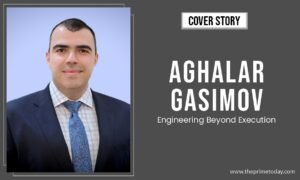
Aghalar Gasimov: Engineering Beyond Execution
The energy industry has always stood at the centre of global progress, powering economies, supporting industries, and shaping the infrastructure that societies depend on every day. As projects become larger and more technically demanding, engineering success is no longer measured only by the strength of design or the scale of construction. It is equally defined by the ability to manage risk, coordinate diverse teams, maintain the highest safety standards, and ensure that every phase of a project works seamlessly from concept to operation. Behind every successful energy project are professionals who understand that lasting results come from combining technical expertise with disciplined leadership and effective collaboration.
Aghalar Gasimov has built his career around this philosophy. An Azerbaijani Chartered Engineer and project and programme management professional based in Doha, he brings nearly 15 years of international experience across some of the energy sector’s most complex projects. His journey began in field operations with Schlumberger in Saudi Arabia, where working in live operating environments shaped his understanding that engineering decisions must perform safely under real-world conditions. From there, he progressed into major EPC programmes, contributing to landmark developments including the South Caucasus Pipeline Expansion across Azerbaijan and Georgia, BP Caspian brownfield modifications and turnaround projects, and the Absheron Early Production Scheme.
Today, working within the client Project Management Team supporting QatarEnergy LNG on a major offshore compression programme, he leads project interfaces while contributing to risk management, systems completion readiness, and operational handover. Looking back on his career, Gasimov believes that delivering successful projects is not solely about technical excellence. It is about bringing people, processes, and engineering together to achieve safe, reliable, and sustainable outcomes.
From Field Engineering to Global Project Leadership
With nearly 15 years of international experience in the oil and gas industry, Aghalar has steadily progressed from field engineering to leading complex project interfaces on major energy developments. An Azerbaijani Chartered Engineer based in Doha, his career began with Schlumberger in Saudi Arabia, where working in field operations taught him that engineering decisions must perform safely under real operating conditions.
His professional journey later expanded into major EPC projects, including the South Caucasus Pipeline Expansion across Azerbaijan and Georgia, BP Caspian brownfield modifications and turnaround programmes, and the Absheron Early Production Scheme. Today, working within the client Project Management Team supporting QatarEnergy LNG, he contributes to project interfaces, risk management, systems completion, and operational handover. Looking back, he believes successful project delivery depends as much on collaboration, governance, and people as it does on technical expertise.
Inspired by an Engineering City
Growing up in Baku, a city closely connected with the energy industry, sparked Aghalar’s interest in understanding how major infrastructure is designed and delivered. That curiosity led him to study mining and civil engineering at Middle East Technical University, where he built a strong technical foundation while developing an appreciation for the complete asset lifecycle.
Each stage of his career added a new perspective. Field assignments in Saudi Arabia strengthened his practical judgement and commitment to safety. The South Caucasus Pipeline Expansion introduced him to the complexity of delivering large cross-border EPC projects, while offshore brownfield work developed his experience in managing shutdowns, SIMOPS, and tie-ins on operating facilities. His role on the Absheron project further strengthened his leadership in interface management and execution, and his current assignment has broadened his experience across multiple EPC packages. Becoming a Chartered Engineer alongside earning PgMP, PMP, and risk management credentials marked an important step from managing individual tasks to leading integrated project outcomes.
Supporting One of the World’s Leading LNG Operations
Aghalar currently works within the client PMT supporting QatarEnergy LNG, one of the world’s leading LNG operators with an integrated value chain covering offshore production, gas processing, liquefaction, storage, and export. The organisation operates 14 LNG trains with a combined production capacity of 77 million tonnes annually.
His responsibilities focus on coordinating technical and organisational interfaces across EPC packages, engineering disciplines, contractors, vendors, operations teams, and other project stakeholders. The role involves defining scope boundaries, resolving interface issues, assessing schedule and risk impacts, and supporting commissioning and handover activities. In an operating LNG environment, he believes project success is measured not only by construction progress but also by safe integration, operational reliability, and long-term asset performance.
Creating Engineering Excellence Through Clarity
Aghalar believes engineering excellence is achieved when projects deliver solutions that are safe, technically sound, maintainable, and fully prepared for operation. Completing construction alone is never enough. Success comes when project scope is clearly defined, risks are managed, interfaces are resolved, systems are tested, and operations teams are ready to take ownership.
His leadership approach centres on early systemisation, disciplined change management, and clear ownership of project interfaces. He also encourages an environment where people raise concerns early and decisions are guided by facts rather than hierarchy. By bringing together engineering, project controls, and operations, he works to protect safety and quality even when projects face demanding schedules. To him, excellence is built through repeatable processes rather than last-minute efforts.
Projects That Strengthened Energy Infrastructure
Several major projects have shaped Aghalar’s career and leadership philosophy. During the South Caucasus Pipeline Expansion, he held a lead project engineering role within a major cross-border EPC programme involving new 48-inch pipeline sections and associated facilities across Azerbaijan and Georgia, strengthening regional energy connectivity.
His work on BP Caspian assets focused on offshore brownfield modifications and turnaround activities that improved safety, production continuity, and operational reliability during tightly controlled shutdowns. On the Absheron Early Production Scheme, he led interface and brownfield execution activities supporting the integration of new gas-condensate facilities with existing offshore assets, contributing to first gas production for Azerbaijan’s domestic market. Today, he continues to lead project interface activities within a major offshore LNG compression programme in Qatar, where his focus remains on aligning multiple stakeholders, resolving scope boundaries, and turning engineering complexity into safe and practical project execution.
Turning Complex Challenges into Coordinated Solutions
One of the most demanding assignments in Aghalar’s career was the brownfield integration work on the Absheron Early Production Scheme. The project required connecting new facilities to an existing offshore operating asset while working within limited space, incomplete legacy information, strict shutdown windows, and multiple organisations with shared responsibilities.
While the engineering complexity was considerable, the greater challenge was aligning different stakeholders, each viewing the project through its own contractual scope. Aghalar addressed this by bringing engineering, construction, commissioning, HSE, and Operations teams together through joint walkdowns and interface workshops. The team clarified battery limits, formalised interface agreements, linked outstanding issues to shutdown schedules, and carried out readiness reviews covering drawings, materials, permits, procedures, and personnel. Decisions were escalated based on safety and schedule impact rather than hierarchy. This disciplined approach enabled successful tie-ins and handover while protecting operational safety and production priorities.
Delivering Projects Through Discipline and Early Visibility
Aghalar believes successful project delivery begins with integrating every core project control from the outset. Clear scope definition, work breakdown structures, realistic schedules, cost baselines, execution strategies, interface planning, risk registers, quality plans, and systems completion must work together rather than as separate documents.
He points out that a delayed engineering decision can quickly affect procurement, construction, commissioning, and overall project cost. Instead of relying only on milestone reporting, he monitors leading indicators such as overdue engineering decisions, interface closure, vendor documentation, material availability, punch trends, and subsystem readiness to identify risks early. Project changes are evaluated for their technical, commercial, and schedule impacts, while safety and quality remain mandatory requirements before work proceeds. Short decision cycles, clear ownership, and evidence-based escalation help remove obstacles before they affect project progress.
Digital Innovation Supporting Better Engineering Decisions
Aghalar sees the industry’s biggest technological shift as the move from document-based management to connected project data. Technologies such as common data environments, 3D models, 4D planning, digital twins, and integrated completion systems now provide a clearer picture of design maturity, construction progress, and system readiness.
Digital interface management platforms have become especially valuable on multi-package EPC projects by creating transparent records of responsibilities, technical decisions, deadlines, and project dependencies. Technologies including drones, laser scanning, remote inspections, sensors, and predictive analytics are also improving verification, maintenance planning, and asset reliability. Artificial intelligence is beginning to support document reviews, schedule risk analysis, trend identification, and lessons learned. Even so, Aghalar sees technology delivers real value only when supported by reliable data and accountable engineering judgement. Digital tools should strengthen decision-making and transparency rather than replace sound engineering practice.
Making Sustainability Part of Engineering Design
Aghalar believes sustainability should be built into engineering decisions from the earliest stages of project development rather than treated as a reporting requirement at the end. Working on major LNG projects has shown him that environmental performance depends on practical engineering choices made throughout the asset lifecycle.
He points to QatarEnergy LNG’s environmental strategy, which focuses on greenhouse gas reduction, carbon dioxide injection, flare reduction, energy efficiency, methane emission reduction, wastewater reuse, circular economy practices, and biodiversity protection. These objectives influence everyday project decisions, from selecting efficient equipment and reducing routine flaring to designing maintainable systems, reusing existing infrastructure where practical, controlling waste, and protecting the marine environment. He also considers operational reliability an important part of sustainability, believing that facilities designed for efficient operation and maintenance consume fewer resources and deliver stronger long-term environmental performance.
A Culture of Collaboration and Continuous Improvement
Aghalar believes collaboration begins with ensuring every team understands both the project objective and the decision-making process. Engineers perform more effectively when they see how their work contributes to the entire project rather than focusing only on individual deliverables.
He encourages this through interface workshops, design reviews, field walkdowns, and readiness reviews that bring engineering, construction, commissioning, HSE, quality, planning, contracts, and Operations teams together. Team members are encouraged to question assumptions early and distinguish technical facts from contractual viewpoints. In his view, innovation is not always driven by new technology. Sometimes the greatest improvements come from simplifying project boundaries, improving work sequencing, or presenting information more clearly. Continuous improvement comes through reviewing interface issues, punch trends, delayed decisions, and lessons learned, then applying those findings immediately. He also supports transparent dashboards and meaningful KPIs while fostering an environment where people can raise concerns openly, balancing psychological safety with professional accountability.
Leading with Clarity, Trust, and Technical Credibility
Aghalar believes successful leadership in large engineering projects is built on clarity, technical credibility, integrity, composure, and the ability to bring people together. Clear priorities and well-defined decision-making responsibilities are essential because uncertainty at the leadership level quickly creates delays and conflict across a project.
He views technical credibility not as knowing every discipline in detail but as asking the right questions, understanding the wider impact of decisions, and valuing specialist expertise. Integrity becomes particularly important when commercial or schedule pressures challenge safety and quality. He also believes leaders must remain calm when information is incomplete or stakeholders disagree, responding with facts rather than emotion. Equally important is what he describes as “horizontal leadership”, the ability to influence contractors, partners, functions, and Operations teams through listening, negotiation, cultural awareness, and consistent follow-through. In his experience, authority may begin discussions, but trust and accountability are what resolve them.
Making Risk Management Part of Every Decision
Aghalar approaches risk management as a continuous decision-making process rather than a document reviewed periodically. Every assessment begins by defining the objective, project boundaries, assumptions, and clear ownership before evaluating potential causes, consequences, existing controls, and remaining exposure with both technical specialists and operational teams.
When making mission-critical decisions, he considers safety, technical integrity, schedule, cost, operability, reputation, and contractual impact together instead of viewing them separately. High-consequence risks require independent review, clear hold points, and evidence that protective measures are effective. He also connects risks with project interfaces and schedule activities, recognising that unmanaged dependencies often become the source of delays. Where information is incomplete, he favours staged or reversible decisions whenever possible. His goal is not to remove all uncertainty but to understand it early, assign ownership, and make informed decisions at the appropriate level.
A Project That Reinforced the Value of Interface Leadership
Among the many projects in his career, Aghalar considers the Absheron Early Production Scheme in Azerbaijan his most rewarding achievement. The project involved integrating a new offshore gas-condensate development with the existing Oil Rocks facilities, creating a technically demanding brownfield environment involving multiple organisations.
He led interface management and brownfield execution activities, coordinating technical boundaries, tie-ins, change management, SIMOPS, shutdown readiness, and the transition into commissioning and handover. What made the project particularly meaningful was the need to build trust between organisations with different contracts, priorities, and working methods. When the project achieved first production in July 2023 and began supplying gas to Azerbaijan’s domestic market, it marked the successful transformation of engineering plans into an operating energy asset. The experience reinforced his belief that effective interface management is a critical project control discipline that safeguards safety, schedule, cost, and operational readiness.
Learning Through Experience and Continuous Development
Remaining current in a rapidly evolving industry requires both structured learning and practical experience. Aghalar follows developments through professional organisations such as the Energy Institute, PMI, the Engineering Council, and CIOB while regularly studying technical papers, sustainability reports, industry case studies, and lessons learned from major projects.
He also values conversations with engineers, vendors, construction teams, and Operations personnel, believing that field experience often provides insights beyond published guidance. Maintaining professional certifications and continuing postgraduate study allows him to test his knowledge against international practice rather than simply adding qualifications. Writing technical articles on megaproject risk, resilience, and energy project delivery has become another important part of his learning process. Alongside this, he continues to follow developments in digital platforms, artificial intelligence, and systems completion methods that strengthen engineering decision-making.
Advice for the Next Generation of Engineers
Aghalar encourages aspiring engineers to focus on building technical depth before pursuing leadership positions. Developing a strong understanding of engineering fundamentals and gaining experience on site or in operations provides valuable insight into how designs and specifications become functioning assets.
He also believes future leaders should strengthen their commercial awareness, communication skills, and understanding of project controls, since senior engineering decisions rarely remain within a single discipline. Asking questions early, especially when responsibilities or scope boundaries are unclear, can prevent costly issues during construction and commissioning. Safety and professional ethics should always remain personal commitments, while certifications should support practical experience rather than replace it. He also encourages engineers to learn from operators, technicians, and supervisors, whose practical knowledge often identifies risks before they become problems. Above all, he believes leadership begins with taking ownership and consistently helping teams solve problems, regardless of formal authority.
Looking Ahead with Purpose
Over the next five years, Aghalar aims to take on broader programme and project leadership responsibilities across complex international energy and infrastructure developments. Building on his experience in engineering, interface management, risk, brownfield execution, and systems completion, he hopes to lead projects from concept and FEED through EPC delivery, commissioning, start-up, and operational handover.
Another priority is integrating digital project controls, data analytics, and practical artificial intelligence into project delivery while maintaining strong engineering accountability. Alongside continued academic and professional development, he plans to contribute more technical publications and mentor the next generation of engineers. Looking beyond individual projects, he hopes to support developments that strengthen energy security, improve asset resilience, and deliver better environmental performance. His long-term ambition is to build teams and delivery systems capable of managing increasing project complexity through discipline, transparency, and consistent execution.
Engineering with Responsibility for the Future
Reflecting on the future of the profession, Aghalar believes engineering remains one of society’s greatest responsibilities because its impact extends far beyond individual projects. The decisions engineers make today influence safety, energy access, environmental performance, and economic development for decades.
He believes the next generation of infrastructure will be more connected, digital, and environmentally demanding, making collaboration across disciplines, organisations, and cultures more important than ever. Technology will continue to evolve, but lasting success will depend on engineers who communicate uncertainty honestly, think across the full asset lifecycle, and avoid short-term compromises. He also encourages greater openness in sharing lessons from failures alongside successes so the profession can continue improving. In his view, engineering excellence is not about perfection but about consistently delivering safer, simpler, more reliable, and more sustainable solutions while maintaining the trust society places in the profession.
Read Also : Dr. Mohammad Al Awadhi: Powering the Future of Intelligent Healthcare