
AI technology and data governance leader, Dr. Azua Himmel, on transforming complex global institutions while strengthening audit, risk, and fiduciary oversight
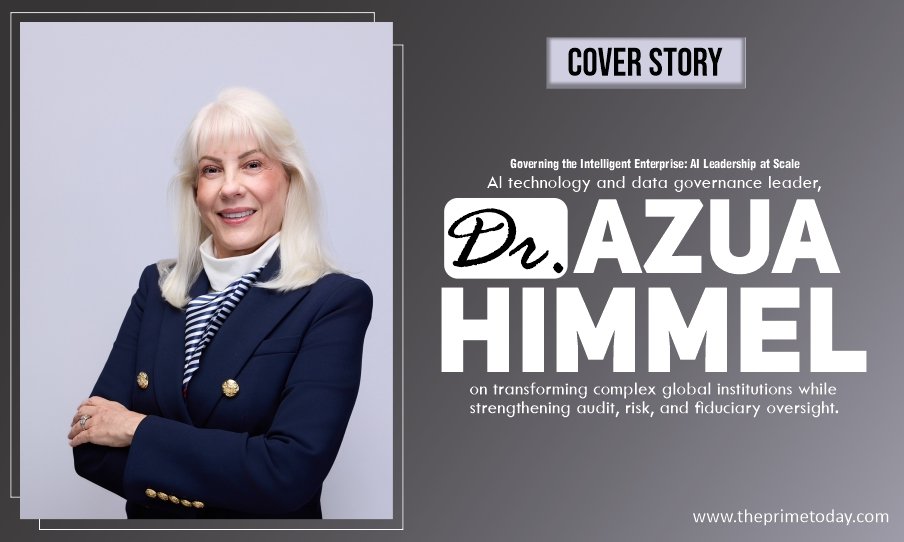
Governing the Intelligent Enterprise: AI Leadership at Scale
A positive change that is accelerated yet regulated and properly governed, instead of a speedy but unguided technological transformation, is the need of our times. A time in which artificial intelligence has disrupted everything in a short span, including enterprise at scale. To achieve that progressive revolution, we need more influential leaders like Dr. Azua Himmel, rightfully honored as one of the most impactful leaders of this era.
A Compliance, Data, Cloud & AI expert, Dr. Azua Himmel is an accomplished technology executive and board leader with a distinguished career spanning global financial institutions and the tech industry. A former CTO and CIO of IBM’s Global Process Outsourcing division, she later served as Managing Director at leading firms including Bank of America, Barclays, and Fidelity Investments. Recognized as an expert in data and AI governance, Dr. Azua Himmel has helped shape digital transformation and compliance strategies at the highest levels.
The renowned author of The Social Factor: Innovate, Ignite, and Win Through Mass Collaboration and Social Networking, a forward-thinking book on enterprise innovation, Dr. Azua Himmel, brings value in technology oversight, audit, and finance corporate governance.
Serving today as an Independent Director at Pan American Life Insurance Group and as part of Capri Ventures’ advisory ecosystem, she views leadership through the lens of fiduciary accountability, value creation, and long-term enterprise resilience. Her philosophy is clear and uncompromising: foster a culture that embraces innovation, focus relentlessly on creating durable value, and maintain governance structures that enable progress without compromising trust.
Enabling Trusted Transformation
Earlier in her career, as Global Managing Director of Enterprise Data and AI Platforms at Bank of America, and in senior leadership roles at Fidelity, Barclays, and IBM, Dr. Azua Himmel operated at significant scale, leading organizations ranging from specialized teams to global workforces of more than 2,700 professionals. Across each role, the constant priority was building technology platforms that were not only high-performing but institutionally sound. Leadership, in her experience, is not about speed alone. It is about disciplined acceleration, building systems that scale, withstand regulatory scrutiny, and earn stakeholder confidence. Whether constructing one of the largest financial data lakes in the industry, leading cloud migration at Fidelity, or driving global engineering transformation at Barclays, Dr. Azua Himmel’s north star has remained consistent: create competitive advantage through trusted transformation.
Having served as CTO, CIO, Managing Director, and now an Independent Corporate Director, Dr. Azua Himmel’s perspective on influence and responsibility evolved at the highest, i.e., the board level. In these executive roles, she says that influence is operational. You execute strategy, allocate capital, build teams, and deliver measurable outcomes. At the board level, influence becomes strategic and fiduciary. The lens widens from performance execution to institutional stewardship. You are no longer responsible only for results, but for safeguarding the enterprise itself. As a director, Dr. Azua Himmel thinks through the framework of duty of care and duty of loyalty, focusing on risk appetite, capital allocation discipline, cyber resilience, AI governance, and audit readiness. The board is not there to manage technology; it is there to ensure that technology risk and opportunity are aligned with long-term shareholder value, she believes.
Her perspective has evolved from building systems to overseeing the integrity of systems. From implementing controls to ensuring management’s control environment is robust and future-ready from driving innovation to asking whether innovation aligns with the company’s risk profile, regulatory exposure, and reputational footprint. Effective board oversight today requires fluency across audit, risk, cyber, and AI. That integrated capability is no longer optional. It is foundational to responsible governance, she insists.
The Most Urgent Governance Challenge of this Era
Widely recognized for her expertise in data and AI governance, according to Dr. Azua Himmel, the most urgent governance challenge over the next two years is elevating AI governance to the same fiduciary category as credit risk, operational risk, and cyber risk. AI is not an IT initiative. It is simultaneously an enterprise risk vector and a strategic asset. Boards must treat AI oversight as a duty-of-care responsibility. Failure to do so creates material exposure across compliance, reputation, customer trust, and even financial reporting integrity.
Dr. Azua Himmel explains that the three dimensions demand immediate attention. First, AI governance frameworks must be embedded into enterprise risk management rather than operating as stand-alone controls. Second, regulatory readiness must become proactive in an environment of accelerating global oversight. Third, cyber resilience must evolve to address increasingly autonomous systems, the implications of quantum computing, and the growing interconnection with digital assets and cryptocurrency ecosystems. The pace of regulatory change is intensifying, and boards must ensure visibility into model inventories, use cases, third-party dependencies, and outcome monitoring. Institutions that succeed adopt speed with guardrails. They define risk appetite clearly, pursue disciplined innovation, and ensure governance structures mature at the same pace as technological capability.
Human-Centered Tech Transformations
To ensure AI-driven transformation remains ethical, transparent, and human-centered rather than purely efficiency-driven, Dr. Azua Himmel says that boards must insist on accountable AI and values-led design. Efficiency alone cannot be the primary KPI. Human oversight must be built into system architecture. Accountability must be measurable.
At the board level, this translates into asking very specific questions:
- “Do we have a complete inventory of AI models and agentic systems in production?”
- Are incident response mechanisms in place for AI-driven events or unintended consequences?
- Is there a scoring and monitoring framework for autonomous AI agents to ensure decisions align with defined business and ethical parameters?
- Are outcomes being monitored against expected performance and bias thresholds?
Proactive cyber defense must be integrated into AI oversight. AI systems expand the attack surface. Governance must assume that adversaries will exploit weaknesses. Boards must ensure management implements structured frameworks such as NIST-aligned AI risk practices, strong model validation processes, and continuous control testing. The objective is not to slow innovation. It is to protect long-term enterprise value. Accountable AI is not theoretical. It is an operational discipline applied to advanced systems.
Balancing Innovation with Compliance
As regulatory expectations grow worldwide, Dr. Azua Himmel feels that leaders must balance innovation with compliance without slowing organizational momentum. She explains that compliance should not be viewed as friction but instead as a strategic asset. The most resilient organizations operate under disciplined innovation within a clearly articulated risk appetite. When governance is embedded early, innovation accelerates rather than stalls.
Speed with guardrails is the model. Leaders must ensure that regulatory alignment is not retrofitted after deployment. It must be integrated into product design and technology architecture from inception.
Dr. Azua Himmel adds, “We operate in an environment of constant regulatory evolution responding to rapid technological advancement.” Boards and executives must remain agile. That requires forward-looking scenario planning, regulatory intelligence, and close alignment between legal, risk, and technology functions. The organizations that win are those that treat trust as a competitive differentiator.
Moreover, she says that independent directors like her serve as stewards of long-term resilience within the enterprise. “We provide objective oversight informed by external perspective and cross-industry experience, helping management navigate complexity with clarity and discipline.” In heavily regulated sectors such as financial services, pharmaceuticals, and energy, true independence reinforces governance credibility and strengthens stakeholder confidence.
Dr. Azua Himmel also shares that as independent directors, their responsibility is not to constrain ambition, but to ensure that ambition is grounded in prudence. Constructive challenge is part of that duty. “We ask whether strategy aligns with risk appetite, whether audit and control environments are sufficiently robust, whether cyber defenses are proactive rather than reactive, and whether capital deployment supports durable value creation.” Trust is built patiently over years and can be compromised in an instant. Independent directors play a central role in safeguarding that trust through disciplined oversight and unwavering fiduciary commitment.
Inclusion as a Strategic Lever
Since her work emphasizes human-centered digital economies, when asked about how technology leaders can embed inclusion and social responsibility into core business strategy, Dr. Azua Himmel replies, “Inclusion, in my view, is not a philanthropic initiative operating at the margins of a business.” It is a core strategic lever that strengthens market reach, operational resilience, and long-term growth. Organizations that embed inclusion into their operating model expand their addressable markets, deepen stakeholder trust, and reduce systemic risk.
During her service with the Red Cross, she recalls that they worked to secure mobile medical units capable of delivering primary care and blood donation services directly into underserved communities. That initiative was not only humanitarian in nature; it was operationally strategic. It extended reach, increased engagement, and strengthened the organization’s capacity to serve broader populations effectively. It reinforced a lesson that has stayed with Dr. Azua Himmel throughout her corporate career: disciplined execution and social responsibility are not competing forces. When aligned properly, they reinforce each other, she insists.
In corporate settings, inclusion translates into accessible digital platforms, equitable data practices, and intentional workforce development. It means designing systems that reflect the diversity of the customers they serve and ensuring that data governance frameworks prevent unintended bias. It also requires leadership capable of navigating cultural nuance and global complexity.
Also, earlier in her career, Dr. Azua Himmel had the opportunity to grow business operations across Latin America, scaling a billion-dollar process outsourcing organization while building cross-border teams that operated seamlessly across regions. Being fluent in Spanish and deeply familiar with both North American governance standards and Latin American growth markets has reinforced her belief that cultural fluency is a competitive advantage. Inclusion is not simply about representation. It is about building organizations that are structurally capable of serving diverse markets responsibly and sustainably. That capability drives expansion, strengthens resilience, and positions enterprises for long-term success.
Traits of the Most Influential Global Leaders of the Next Decade
In Dr. Azua Himmel’s view, some distinct leadership traits will define the most influential global leaders of the next decade. She says that exceptional leaders of the next decade will combine technological fluency with deep governance understanding. They will need to possess the courage to make disciplined and ethical decisions in environments defined by uncertainty and rapid change. Most importantly, they will know how to integrate innovation with ethics, ensuring that progress strengthens rather than erodes institutional trust.
The future will not favor leaders who treat AI, data, and cyber as isolated technical domains. It will reward those who recognize their systemic impact on enterprise value, risk exposure, and client trust. Leadership in this era requires seeing technology not merely as an enabler of efficiency, but as a force that shapes markets, institutions, and long-term trust.
Dr. Azua Himmel has advised and overseen organizations during periods of disruption. Over the course of navigating cyber incidents and leading complex M&A integrations, one lesson she reveals that remained constant is that clarity of communication and disciplined governance ultimately matter more than speed alone. In moments of disruption, organizations do not rise to the level of their aspirations; they fall to the level of their preparation.
Effective crisis leadership begins with establishing control, transparency, and accountability immediately. The tone set at the top reverberates across the enterprise. When leadership remains composed and aligned, the organization stabilizes more quickly. When it does not, uncertainty compounds risk.
Crisis has a way of revealing the true strength of an institution’s culture and governance architecture. Enterprises with embedded risk discipline, strong board management alignment, and clearly defined decision frameworks respond with focus and decisiveness. Those without that foundation struggle to regain control.
Resilience is not built during a crisis. It is built well before one occurs. Preparedness is a board-level commitment, rooted in oversight, scenario planning, and proactive risk governance. The organizations that endure are those that treat resilience as a strategic priority rather than a reactive necessity.
Creating a Futuristic Talent Strategy
When asked how senior executives and boards should rethink talent, culture, and skills in an era dominated by AI, cloud, and automation, Dr. Azua Himmel says that talent strategy can no longer lag behind technology strategy. As AI, cloud, and automation reshape enterprise operating models, organizations need hybrid leaders who understand business economics, risk frameworks, and advanced technologies at the same time. Boards must assess whether management teams possess the depth to oversee AI systems, cyber resilience, and data compliance with confidence and discipline.
Equally important is culture. Accountability must be embedded into performance expectations, and incentives must reward responsible innovation rather than unchecked acceleration. Continuous learning should not be episodic; it must be institutionalized. AI adoption without workforce readiness introduces material risk. When adoption is paired with cultural alignment and skill development, however, it becomes a multiplier of enterprise value rather than a source of instability.
Emergence of Thought Leadership
As an author, Dr. Azua Himmel has always believed that thought leadership should emerge from execution, not abstraction. When she wrote The Social Factor, it was during the early stages of cloud transformation and large-scale digital collaboration. The book captured practical lessons from building global platforms and scaling enterprise operations across regions, including significant growth across Latin America. It reflected what it takes to lead transformation responsibly at scale.
Thought leadership serves to clarify principles. In the AI era, that clarity is more important than ever. Artificial intelligence is reshaping strategy, risk, and culture simultaneously. Boards and executives need coherent principles to ensure innovation advances performance while preserving trust. Thought leadership provides the intellectual foundation. Governance ensures those principles translate into durable enterprise value.
A Message to the Aspiring Women Leaders
Penultimately, the message Dr. Azua Himmel would like to share with aspiring women leaders aiming to influence technology, governance, and global decision-making at the highest levels is pragmatic: Aspiring women leaders should commit to developing deep technical expertise while simultaneously building governance fluency. Master the fundamentals of risk, audit, capital allocation, and regulatory dynamics alongside emerging technologies such as AI and cyber. Seek operational roles that build credibility and board exposure that sharpen judgment. The global economy needs leaders who can integrate innovation with integrity, and women are uniquely positioned to shape that future with rigor, confidence, and strategic discipline.
The Most Powerful Competitive Advantage of Tomorrow
Finally, Dr. Azua Himmel’s closing perspectives reveal her bold vision. She says that we are entering a decade in which AI governance, cyber resilience, and data integrity will distinguish enduring enterprises from those that struggle to adapt. Boards that approach AI not as an experiment but as a fiduciary responsibility will unlock both innovation and trust at scale.
“My commitment as an independent director is to help organizations move forward boldly, embedding strong guardrails that align with risk appetite while enabling transformative technology to deliver measurable value.” The future belongs to enterprises that innovate with confidence, govern with discipline, and recognize that long-term trust is the most powerful competitive advantage of all, she concludes.