
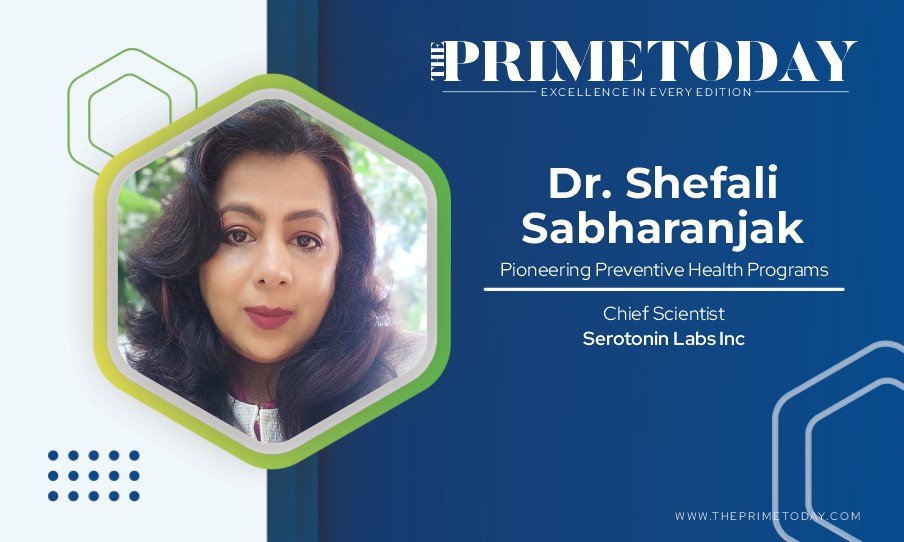
Dr. Shefali Sabharanjak: Navigating Micronutrient Complexity
The wellness world is full of promises, miracle supplements, viral trends, and endless advice. But beneath the surface lies a challenge most people don’t talk about: How do we know what truly works for our unique body? With thousands of studies and conflicting information, the average person is left overwhelmed, unsure, and often misled.
This very chaos sparked a vision in Dr. Shefali Sabharanjak. As a scientist with decades of research in molecular biology, neuroscience, and genetics, she understood one thing clearly, health is not a one-size-fits-all proposition at all. Her career began with decoding how cells absorb nutrients, leading to her discovery of a new CDC42-regulated pathway, work that reshaped how we understand micronutrient transport at a cellular level.
But Dr. Shefali didn’t stop at theory. She saw an opportunity to bring clarity to everyday health. At Serotonin Labs Inc, where she serves as Chief Scientist, she leads a team that turns complex science into usable tools. Under her guidance, they built a cutting-edge evidence engine that reads over 40,000 clinical studies, cross-matching the evidence against a person’s genetics, lifestyle, and biomarkers to create truly personalized supplement plans.
For her, it’s not about selling products, it’s about building trust through science by delivering measurable outcomes. Her work ensures that every recommendation is not just tailored, but trackable, giving users real feedback from their bodies over time.
In a world full of noise, she brings confidence, anchored in science, powered by empathy, and focused on helping people take control of their own well-being.
The Roots of Scientific Curiosity and the Spark of Innovation
Dr. Shefali’s leadership journey in healthcare is deeply rooted in her early exposure to scientific research. Her passion for inquiry took shape during her BSc studies at SP College in Pune, where she was mentored by eminent figures in Botany, Professors Madhav Pendse, Suresh Bhagwat, Chirputkar, and Ranade. Their influence helped her realize the transformative power of scientific thinking and ignited a lifelong pursuit of discovery.
Her understanding of the connection between research and innovation deepened under the guidance of Prof. Sohan Modak at the University of Pune. It was here that the belief, that research paves the way for new knowledge, which, when thoughtfully applied, leads to innovation, began to crystallize. This philosophy became the cornerstone of her mission.
Her doctoral journey at the National Center for Biological Sciences under the guidance of Prof. Satyajit Mayor further reinforced this conviction. The experience of engaging in rigorous fundamental research opened her mind to how emerging knowledge can reshape real-world scenarios, especially in healthcare. For Dr. Shefali, research was never confined to academic publications; it was a tool to inspire meaningful, tangible change.
Fundamental research, in her view, is the fertile ground from which real innovation grows. When paired with a mindset geared toward application, it becomes a powerful engine for progress in the healthcare sector, one that Dr. Shefali has been passionately driving forward throughout her career.
Evolving Leadership Style
In a field marked by constant evolution, Dr. Shefali defines her leadership style as one rooted in trust and empowerment. Over the years, she has embraced what she calls a “broad brackets” approach, providing strategic direction without falling into the trap of micromanagement.
For Dr. Shefali, micromanagement not only stifles creativity but also undermines a team’s confidence and growth. Instead, she believes in setting clear goals and frameworks, then allowing her team the space to explore, experiment, and arrive at effective solutions on their own. This approach, she notes, fosters innovation and accountability, and ensures that individuals grow into problem-solvers who are both agile and independent.
As her field has evolved, so too has her understanding of what leadership truly demands, not control, but the ability to guide, inspire, and step back so others can step up.
Transforming Preventive Healthcare Through Project Serotonin
Dr. Shefali, as the Chief Scientist and founding team member at Serotonin Labs Inc., has been at the forefront of redefining how preventive healthcare is delivered. One of her most impactful contributions has been the creation and evolution of Project Serotonin, an innovative platform designed to proactively identify health risks and counter them with personalized, precise interventions (www.sr.tn).
Unlike conventional healthcare approaches that often address symptoms after they appear, Project Serotonin focuses on early detection and prevention. The platform uses a fusion of genomics-guided nutrition, tailored exercise routines, and dietary protocols personalized to individual profiles. Every six months, participant data is evaluated to refine and update their wellness plans, ensuring interventions remain aligned with their current health status.
Dr. Shefali and her team have not only tackled existing health concerns but have also developed enhancement modules, such as lean muscle mass building, to optimize wellness outcomes. Measurable health improvements have been observed across the board. For instance, participants suffering from rheumatoid arthritis have reported significantly improved mobility and reduced pain, while many women have experienced relief from menstrual discomfort using precision nutrition strategies.
What sets Project Serotonin apart is its foundation in translational science. Drawing from a diverse range of disciplines, including Botany, Genetics, Biochemistry, Cell Biology, and Nutrition, Dr. Shefali has led the transformation of complex scientific insights into actionable, real-world solutions that make a tangible difference in people’s lives. The journey, though challenging, has been intellectually enriching and an example to the power of interdisciplinary collaboration in modern healthcare.
Overcoming Industry Challenges Beyond Gender
Dr. Shefali emphasizes that the most significant challenges she faced while innovating in a high-stakes industry were NOT rooted in gender. Contrary to common assumptions, her experience has been largely free of gender-specific barriers. Instead, the real test has been in creating awareness around a new product category and introducing consumers to a completely different approach to health management.
Her work with Project Serotonin represents a paradigm shift, moving away from reactive, curative health interventions toward a proactive, continuous health-preservation model. The program is built on a foundation of deep scientific research and analytics-guided iterations. It offers a unique, long-term health journey that evolves with an individual as they age, rather than stepping in only when illness strikes.
One of the biggest surprises for consumers is the idea of a comprehensive ecosystem that integrates precise nutrition, tailored exercise, mindfulness, and meaningful social connection, all designed to preserve health before any symptoms appear. Traditionally, people are conditioned to seek help only after falling ill. Breaking this mindset has been a primary challenge for Dr. Shefali and her colleagues at Project Serotonin.
Interestingly, gender dynamics have not hindered her mission. In fact, Dr. Shefali proudly highlights the fact that women form the backbone of her organization across multiple domains- from scientific research and technology, app development, to sales, marketing, and administration. Their collective efforts have been instrumental in bringing this revolutionary health platform to life.
Designing Personalized Wellness Programs
Dr. Shefali emphasizes that the foundation of her platform is not illness but wellness. Unlike traditional medical models, where individuals are viewed as patients, her platform refers to them as program members. The distinction is intentional. As a preventive wellness initiative, the goal is to proactively enhance and perpetuate a state of good health before clinical issues arise.
Each program is highly individualized. The philosophy behind it mirrors the concept of N=1 clinical trials in scientific research, where the entire focus is on one individual’s longitudinal health journey. This allows for integration of personalized insights and interventions that evolve over time, as per the status of a person’s health. The program uses a wide range of decision-support inputs: blood biomarker assessments, genomic information, personal and family health history, sleep patterns, fitness performance, wearable device data, and even behavioral science insights.
All of this data is integrated using dynamic algorithms. These algorithms are not static—they recalibrate continually based on emerging scientific evidence and the real-world outcomes of users. This adaptive & evolving design ensures that each individual’s wellness plan remains safe, optimal, scientifically grounded, and aligned with both assessed health needs and personal health goals.
Moreover, the platform doesn’t function in isolation. It partners with medical doctors and healthcare professionals to provide support where needed. If any user consistently displays abnormal health markers, they are referred to appropriate medical experts for further evaluation. Dr. Shefali notes that in many cases, these wellness programs have complemented medical therapies seamlessly, functioning as ideal therapy companions that support recovery, mitigation of collateral damage , and overall well-being.
Integrating Generative AI into Translational Science
Dr. Shefali reflects on the cutting-edge technologies that are currently shaping her work. As a pioneering figure at a fusion Lifesciences Tech company, she has been instrumental in designing knowledge systems, algorithms, and an intuitive app that bridges the gap between scientific insights and real-world applications. This synergy between scientists and engineers has been central to the company’s progress.
Among the technologies she finds most exciting, generative AI stands out. Its strength lies in organizing vast datasets and delivering precise outputs, even when prompted with natural, conversational questions.
According to Dr. Shefali, this capability makes generative AI a powerful tool in the realm of translational science. While she acknowledges there are still initial challenges, such as AI-generated inaccuracies, she emphasizes that pairing AI with human oversight, known as “Human-in-the-loop”—offers a robust solution. Generative AI can help scientists accelerate their work ; However, it is not a substitute for the insights gained from hands-on experimental scientific work. This collaboration not only mitigates hallucinations but also accelerates the journey from data to actionable scientific insights, ultimately enhancing the pace and accuracy of innovation in the lifesciences domain.
Power of Collaboration in Project Serotonin’s Growth
Dr. Shefali highlights that the success of Project Serotonin is a testament to the transformative power of cross-disciplinary partnerships. This initiative stands out as a seamless blend of expertise from scientists and engineers, brought together by a shared vision. The team behind Project Serotonin includes specialists from biochemistry, industrial biochemistry, cell biology, and nutrition, each contributing unique insights and skills that elevate the project’s potential.
But the collaboration doesn’t end within scientific circles. Project Serotonin actively seeks to become part of the larger health ecosystem, aiming to bridge the gap between scientific innovation and real-world application. To this end, Dr. Shefali and her team are forging connections with physicians across various specialties;cardiologists, gynecologists, general practitioners, Ayurveda experts and clinical psychologists are just a few of the key partners they wish to engage with. This commitment to interdisciplinary and cross-sector collaboration is central to Project Serotonin’s mission and impact.
Beyond clinical collaborations, Dr. Shefali expresses a strong interest in working with academic laboratories. She envisions helping research institutions translate their findings into accessible, consumer-friendly health solutions.
Personalization as a Path to Equitable Healthcare
Dr. Shefali emphasizes that personalization is the most effective way to bridge disparities in healthcare access, delivery, and outcomes, especially for underrepresented or vulnerable populations. By tailoring healthcare and preventive wellness strategies to individual profiles, the biases often present in traditional clinical trials can be overcome. This personalized approach minimizes the disadvantages linked to being part of a social minority or having specific genetic predispositions.
While clinical trials offer valuable insights, Dr. Shefali points out that group-level data does not always apply equally to every individual. Instead, profile-specific discriminators allow sicentists and practitioners to adapt these findings to suit unique physiological needs. Even if a particular intervention proves effective in a large study, it may not be suitable for every profile. In those cases, alternative treatments are explored. This methodology aligns with the N=1 philosophy, treating each person as their own reference point, a perspective she considers a great equalizer in healthcare.
Reflecting on her time at Strand Life Sciences, Dr. Shefali recalls their work in analyzing the genetics of rare disorders. One principle stood out: “For the world, the disorder is rare. For the afflicted person, the rare disorder is their entire world.” You have to solve a problem for each individual by understanding their unique physiology. This powerful sentiment shaped her commitment to treating each person as a unique individual rather than a statistical outlier.
Additionally, Dr. Shefali advocates for the development of multifactorial algorithms that assign appropriate weightage to profile-specific factors. By doing so, healthcare delivery becomes not only more personalized but also more “just”, ensuring every individual receives care that truly fits them.
Embedding Long-Term Sustainability into Leadership Strategy
Dr. Shefali emphasizes that embedding sustainability, across clinical, organizational, and environmental domains, requires a forward-thinking, adaptive approach. Her problem -solving focuses on building multifaceted, data-driven dynamic algorithms and robust knowledge management systems that adapt to new inputs. These foundations are not only innovative but also inherently sustainable.
She believes that when healthcare products are developed, their ability to evolve with the changing health status of an individual becomes essential for long-term impact. According to her, true sustainability lies in adaptability, creating solutions that are not fixed in time but responsive to the dynamic nature of health. This perspective ensures that products remain relevant, effective, and valuable across time, contributing to more resilient healthcare systems and outcomes.
Strength in Stillness
In the high-pressure world of healthcare leadership, staying mentally strong and focused is essential, but not always easy. For Dr. Shefali, resilience is not just a trait; it is a deeply personal legacy.
She draws her emotional strength from her late father, who passed away 16 years ago after a long battle with oesophageal cancer. Despite the grim diagnosis and the pain of his condition, he faced each day with extraordinary calm, choosing joy and presence with his children and grandchild. Dr. Shefali sees her own steady, focused approach in high-stress situations as a tribute to the way her father lived his final years, with grace and unwavering mental strength.
In addition to her emotional anchors, Dr. Shefali finds balance and mental clarity through resistance training (RT), which she champions as both a physical and emotional reset. She strongly advocates for more women to embrace RT, pushing back against outdated fears of “bulking up” or “looking manly”. According to her, RT offers women a chance to build strong muscles, address postural imbalances, and even protect against joint erosion, all the while relieving stress.
To her, RT is more than a fitness regimen; it’s a metaphor for inner strength. Just like lifting weights helps fortify the body, consistently facing challenges with discipline and focus strengthens the mind. Through both her lifestyle and her leadership, Dr. Shefali continues to prove that real strength often lies in calmness, and resilience is something that can be nurtured, one grounded step at a time.
Empowering Young Women to Lead
Dr. Shefali encourages young women to actively engage with the growing start-up ecosystem as a gateway to healthcare innovation. She believes this space offers immense opportunity for aspiring female leaders to test their ideas, build solutions, and drive meaningful change.
According to her, there is a wide range of entrepreneurship programs available specifically for women entrepreneurs, yet not enough women are stepping forward to take advantage of them. Dr. Shefali emphasizes that more young women should tap into these underutilized resources, as they offer valuable support, mentorship, and funding avenues that can accelerate their journey in healthcare leadership and innovation.
Embracing the Future of Healing
Dr. Shefali is deeply inspired by the transformative technologies redefining the landscape of modern medicine. Among the most exciting advancements, she highlights CRISPR-based gene editing, stem cell-aided organ repair, genomics-driven drug and therapy selection, personalized curative medicine, personalized immunotherapy, and microbiome-enhanced physiological interventions. These innovations, she believes, are not just revolutionary, they are ushering in a new era of personalized and precision healthcare, both on the preventive and on the curative fronts.
She expresses particular fascination with restorative technologies that aim to repair or regenerate missing cells, tissues, and organs. These hold immense promise in reversing damage, restoring function, and possibly even curing diseases once considered irreversible. CRISPR, with its ability to precisely edit genes, also stands out to her as a tool of extraordinary potential in correcting genetic disorders at their very root.
For Dr. Shefali, the future of healthcare is not just about prolonging life, it’s about improving its quality in ways that were previously unimaginable.
A Legacy Rooted in Risk, Science, and Preventive Wellness
Dr. Shefali hopes to be remembered as a fearless scientist, one who was never afraid to take bold risks in the field of translational science and preventive wellness. Her vision for healthcare innovation is not just about breakthroughs in treatment, but also about redefining how society approaches health at its roots.
She aims to leave behind a legacy of leadership grounded in scientific rigor, transformative ideas, and a commitment to shifting healthcare from reactive to preventive models.
Read the full magazine edition: Click Here