
EDUCATION THAT EMPOWERS
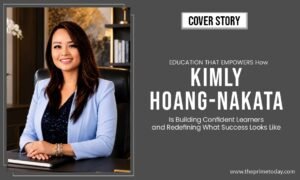
How Kimly Hoang-Nakata Is Building Confident Learners—and Redefining What Success Looks Like
The Hallway After the Applause
The applause had long since faded.
Inside the ballroom, the stage lights dimmed one by one until only a faint glow remained across the empty podium. Rows of chairs that had been quietly folded and stacked against the wall.
For many keynote speakers, this is where the evening ends.
For Kimly Hoang-Nakata, it is often where the most meaningful conversation begins.
Outside the ballroom, small groups lingered in the hallway. Educators waited patiently to ask one more question. Parents hoped for reassurance after months—even years—of watching their children struggle. School leaders sought answers to problems that no new curriculum or policy seemed able to solve.
One principal described classrooms where students appeared increasingly disengaged despite every well-intentioned initiative.
A mother fought back tears as she recounted nightly homework battles that had slowly eroded her daughter’s confidence.
A teacher wanted advice for the child who never raised her hand.
Kimly welcomed each conversation with the same quiet attentiveness.
She didn’t begin by offering solutions.
She listened.
Then, almost inevitably, she asked a single question.
“Tell me about the child.”
It is a deceptively simple question, yet one that reflects the philosophy that has come to define her life’s work.
Because behind every educational challenge is a human story.
And behind every human story is someone longing to feel seen, understood, and believed in.
That conviction has become the foundation of everything Kimly Hoang-Nakata has built—not simply as an educator, but as an author, international speaker, learning specialist, educational leader, and advocate for children whose potential is too often hidden beneath anxiety, discouragement, or misunderstanding.
In an era increasingly defined by standardized testing, artificial intelligence, and rapidly changing educational expectations, Kimly represents a different kind of leadership. Rather than asking how schools can produce higher-performing students, she asks a more fundamental question:
How do we help every child believe they are capable of learning in the first place?
It is a question that has shaped decades of work and continues to influence educators, families, and communities around the world.
As Founder and CEO of Achieve Education, co-creator of MindSmart Learning, and creator of the Glow Philosophy, Kimly has become one of the emerging voices championing a more human-centered vision of education—one that places confidence, emotional well-being, and meaningful relationships alongside academic excellence rather than beneath it.
Working alongside her husband, Dr. Roger Nakata, a board-certified pediatrician, she helped develop MindSmart Learning, a whole-child framework that brings together educational practice, pediatric insight, brain science, emotional regulation, and practical learning strategies. Their shared philosophy recognizes what research increasingly confirms: children learn best when they feel emotionally safe, intellectually engaged, and deeply connected to the people guiding them.
Rather than asking what is “wrong” with struggling learners, MindSmart Learning encourages educators and families to ask a different question:
What does this child need in order to thrive?
That shift—from correction to curiosity—has become one of the defining characteristics of Kimly’s work.
It is also one of the reasons her influence continues to grow.
Her work has earned international recognition, from being named an NBC 7 Inspirational Teacher to receiving the Exceptional Educator of Excellence Award and earning top honors from The BookFest and the International Impact Book Awards. She has been recognized as an Author of the Year finalist in Hollywood, while her educational insights have appeared everywhere from The New York Times Magazine and Executive Diary Magazine to Global Thought Leaders TV, the Women’s Leadership & Health Academic Journal, and even Times Square’s Nasdaq billboard.
The Achievements That Matter Most
Although Kimly has received numerous recognitions throughout her career, the moments she treasures most rarely involve awards or public celebrations. Her greatest sense of accomplishment comes from witnessing personal transformation in the lives of students and families.
A child who once believed they were incapable discovering confidence. A parent sharing that learning has become a joyful experience again. A former student returning years later to say that one teacher’s belief changed the direction of their life. Those moments remind her why she chose education in the first place. They cannot be measured through certificates or titles because their impact reaches far beyond the classroom. Helping even one child recognize their own worth and believe in their potential remains the achievement she values above all else.
For her, these are the moments that matter.
Because while recognition celebrates past accomplishments, transformation points toward the future.
Finding Her Voice Through Education
Long before she became an educator, Kimly understood what it meant to sit silently in a classroom filled with words she could not understand.
When her family immigrated from Vietnam to the United States, she entered school carrying the same curiosity, imagination, and dreams as every other child. What she lacked was the language to express them.
Unable to communicate in English, she struggled to participate in conversations, answer questions, or explain what she already knew. To classmates, her silence was often misunderstood. For nearly two years, she endured teasing and the label of being “mute.”
The experience left an imprint that has never fully disappeared.
“It wasn’t that I had nothing to say,” she has reflected in conversations about her journey. “I simply didn’t yet have the words.”
For many children, language barriers become invisible barriers to confidence. Kimly experienced both.
She remembers what it felt like to possess ideas that remained trapped behind unfamiliar words, to want desperately to belong while wondering whether anyone could truly see beyond the silence.
Yet within those same classrooms, she also discovered something that would quietly reshape her future.
Books.
At first, they offered an escape. Soon, they became companions. Page by page, they introduced her to language, possibility, and worlds larger than her own circumstances.
Then came a moment she still describes as transformative.
She discovered a bilingual children’s picture book.
For the first time, she saw her own language and culture reflected in the pages before her. It was more than a reading experience; it was a profound affirmation that her identity belonged in the story of learning. That single discovery strengthened not only her English development but also her sense of belonging.
Looking back, Kimly recognizes that books gave her something even more valuable than vocabulary.
They gave her confidence.
More importantly, they introduced her to educators who recognized her potential before she fully recognized it herself.
Those teachers changed the trajectory of her life.
Years later, when Kimly entered the teaching profession, she carried those memories into every classroom she led.
She resolved to become the educator she had once needed—the teacher who looked beyond test scores, beyond behavior, beyond first impressions, and saw possibility where others might have seen limitation.
Her classrooms became places where mistakes were welcomed as part of learning, curiosity mattered more than perfection, and every child was reminded that growth begins with believing improvement is possible.
As the years passed, her work with students and families revealed a pattern that would shape the next chapter of her career.
Many children who struggled academically were not lacking intelligence.
They were carrying anxiety.
Low confidence.
Emotional stress.
Learning experiences that simply did not align with how their brains naturally learn.
Again and again, she watched children flourish once someone addressed what existed beneath the surface rather than focusing only on what appeared on a report card.
Those observations became more than professional insights.
They became a calling.
Today, whether she is writing bilingual children’s books that celebrate identity, speaking to educators and leaders across the globe, coaching families, or helping schools rethink how learning happens, Kimly continues to return to the lesson that first changed her own life:
Every child wants to succeed.
Sometimes, they simply need someone willing to see the brilliance that already exists within them.
And perhaps that is why, after every keynote, after every conference, after every standing ovation, she still chooses to begin each conversation with the same simple question:
“Tell me about the child.”
Redefining Success Beyond Report Cards
If there is one idea that sits at the heart of Kimly Hoang-Nakata’s work, it is this:
Education should never be measured solely by what a child knows today, but by who that child is becoming tomorrow.
For generations, academic success has been defined by report cards, standardized tests, and measurable outcomes. These indicators certainly matter, Kimly acknowledges, but they reveal only part of a child’s story.
A report card can measure performance.
It cannot measure courage.
A standardized assessment can capture what a student remembers on a particular day.
It cannot reveal resilience after repeated failure, the confidence to ask a difficult question, or the curiosity that inspires lifelong learning.
“The greatest lessons children carry with them,” Kimly often says, “rarely fit inside a grading rubric.”
That perspective has gradually evolved into something much larger than a teaching philosophy. It has become the foundation of Achieve Education and the driving force behind MindSmart Learning—a model that challenges educators to see children not as collections of scores and data points, but as whole human beings with extraordinary potential waiting to be developed.
Rather than asking how schools can produce higher achievement, Kimly asks a different question:
What conditions allow children to flourish?
The answer, she believes, begins long before instruction ever starts.
Where Brain Science Meets the Human Heart
Several years ago, Kimly and her husband, Dr. Roger Nakata, a board-certified pediatrician, found themselves asking remarkably similar questions from different professional perspectives.
As an educator, Kimly watched children lose confidence when traditional approaches failed to meet their individual learning needs.
As a pediatrician, Dr. Nakata observed how stress, anxiety, sleep, emotional regulation, and overall health profoundly influenced a child’s ability to focus, process information, and succeed in school.
Although they approached children through different professions, they kept arriving at the same conclusion.
Learning cannot be separated from well-being.
That realization became the catalyst for MindSmart Learning—a whole-child framework that brings together educational practice, pediatric insight, developmental science, emotional regulation, and practical learning strategies into one integrated approach.
Their work reflects a growing body of neuroscience showing that learning is not simply an intellectual activity. It is biological, emotional, relational, and deeply human.
The brain does not learn in isolation.
It learns through relationships.
It learns through safety.
It learns through connection.
One sentence has become central to Kimly’s educational philosophy:
“The brain learns best when it feels safe.”
It sounds simple.
Yet it challenges decades of educational practice.
When children experience chronic stress, fear of failure, or emotional uncertainty, the brain instinctively shifts its attention toward protection rather than exploration. Instead of asking questions, children withdraw. Instead of taking risks, they become cautious. Instead of discovering joy in learning, they begin associating education with anxiety.
Too often, these behaviors are mistaken for laziness, defiance, or lack of motivation.
Kimly sees something different.
She sees communication.
She sees children whose behavior is revealing an unmet need rather than a lack of ability.
That subtle shift in perspective changes everything.
Instead of asking,
“Why isn’t this child trying harder?”
educators begin asking,
“What might this child be experiencing?”
Compassion replaces judgment.
Curiosity replaces assumption.
Connection replaces correction.
That shift has become one of the defining characteristics of MindSmart Learning.
Learning That Engages the Whole Child
Walk into one of Kimly’s learning environments and the atmosphere feels noticeably different.
Children are moving.
Engaging
Building.
Reflecting.
Collaborating.
Instead of rows of passive learners completing identical worksheets, students engage with manipulatives, stories, conversations, creative problem-solving, and meaningful challenges designed to activate both thinking and curiosity.
Movement is intentional.
Conversation is purposeful.
Reflection is expected.
Because learning is no longer viewed as the transfer of information from teacher to student.
It becomes an experience.
One where children are encouraged to ask questions before memorizing answers.
To discover patterns before being shown formulas.
To build confidence before chasing perfection.
Kimly’s continued study of brain science, resilience, emotional leadership, and mindfulness through Harvard Medical School Executive Education has further strengthened this framework. Rather than allowing research to remain confined to academic journals, she translates neuroscience into practical strategies that teachers, parents, and school leaders can immediately apply in classrooms and homes.
This bridge between research and practice has become one of the distinguishing features of her work.
Complex science becomes accessible.
Educational theory becomes practical.
And children experience learning in ways that feel both meaningful and sustainable.
For Kimly, academic achievement is never the destination.
It is the natural outcome of an environment where children feel emotionally secure, intellectually challenged, and genuinely believed in.
Preparing Children for the Future
The world today’s children will inherit is changing at extraordinary speed.
Artificial intelligence is transforming industries.
Technology is reshaping communication.
Information is available within seconds.
In such a world, Kimly believes education must evolve beyond teaching children what to think.
It must help them learn how to think.
Critical thinking.
Adaptability.
Creativity.
Emotional intelligence.
Ethical decision-making.
Communication.
Collaboration.
These are no longer “soft skills.”
They are essential human skills.
Ironically, the more advanced technology becomes, the more valuable distinctly human qualities become.
“Knowledge will always matter,” Kimly says.
“But wisdom, empathy, and character will determine how we use that knowledge.”
That perspective has positioned her as an emerging thought leader within conversations surrounding future-ready education.
Rather than viewing innovation and humanity as competing priorities, she argues they should strengthen one another.
Technology should personalize learning.
It should never replace relationships.
Because no algorithm can replicate the encouragement of a trusted teacher.
No software can replace the confidence a child gains when someone genuinely believes in them.
The Glow Philosophy
Growing from Within
While MindSmart Learning transformed how Kimly thought about education, another question continued to occupy her mind.
Why do so many successful people still struggle to feel fulfilled?
Again and again, she met individuals who had accumulated impressive achievements yet quietly questioned their own worth.
Students believed perfect grades would finally make them enough.
Professionals chased promotions while sacrificing their well-being.
Parents measured themselves against impossible standards.
Educators gave everything to others while forgetting to care for themselves.
The pattern was remarkably consistent.
People were learning how to succeed.
Few were learning how to become whole.
That realization inspired what would become known as The Glow Philosophy.
Unlike traditional models of success built around comparison and competition, the Glow Philosophy invites people to look inward before looking outward.
Growth begins with identity.
Purpose.
Reflection.
Resilience.
Authenticity.
Rather than asking,
“How can I be better than someone else?”
it asks,
“How can I become the person I was created to be?”
It is a subtle shift.
Yet it changes everything.
Within classrooms, students begin celebrating progress instead of perfection.
Educators rediscover that their greatest influence is not simply delivering curriculum but shaping confidence, character, and possibility.
Parents learn that the most powerful leadership often happens through everyday conversations around the dinner table rather than extraordinary moments.
At its heart, the Glow Philosophy reminds people that leadership is not a position.
It is a way of living.
It is choosing courage over comfort.
Purpose over popularity.
Service over recognition.
Kimly often returns to one central belief:
“When we become the healthiest version of ourselves, we give others permission to do the same.”
Perhaps that explains why her influence now extends well beyond classrooms.
She speaks to educators.
School leaders.
Parents.
Healthcare professionals.
Business executives.
Authors.
Community organizations.
Across every audience, the message remains remarkably consistent.
Human potential does not begin with achievement.
It begins with belief.
And when people believe—in themselves, in one another, and in what is possible—they don’t simply accomplish more.
They become more.
Kimly’s work is not ultimately about changing education.
It is about changing the way we see people.
Because when we choose to see children not as problems to be solved, but as lives waiting to be nurtured, education becomes something far greater than instruction.
It becomes transformation.
Building a Future Where Every Child Feels Seen
Every meaningful movement begins with a simple idea.
For Kimly Hoang-Nakata, that idea has never been about creating another educational program.
It has always been about changing the way we see children.
Throughout her career, she has watched countless students arrive carrying invisible burdens—fear of failure, anxiety, language barriers, self-doubt, and the quiet belief that they simply were not “good at school.” Too often, these children were defined by what they lacked rather than by the strengths waiting to emerge.
Kimly refused to accept that narrative.
She believed every child deserved to be seen before they were assessed.
Heard before they were corrected.
Encouraged before they were evaluated.
It is a philosophy that has quietly reshaped thousands of lives, not because it promises quick solutions, but because it begins with a profound truth:
Children flourish when someone believes in them before they believe in themselves.
That belief continues to guide every initiative she leads through Achieve Education, MindSmart Learning, and the Glow Philosophy.
Her vision extends far beyond helping children achieve higher grades.
It is about nurturing resilient thinkers, compassionate leaders, confident communicators, and lifelong learners who understand that success is measured not only by what they accomplish, but by the character they develop along the way.
Changing Mindsets, One Child at a Time
Introducing a different way of thinking about education has not always been easy.
For generations, many educational systems have emphasized measurable outcomes above all else. Grades, test scores, and academic benchmarks remain important indicators of progress, but they tell only part of the story.
Kimly has often found herself challenging a common misconception—that focusing on emotional well-being somehow lowers academic expectations.
In her experience, the opposite is true.
Children who feel emotionally safe are more willing to take intellectual risks.
They ask questions.
They persist through difficulty.
They recover from mistakes more quickly.
Confidence fuels perseverance, and perseverance fuels achievement.
Rather than debating philosophical differences, Kimly allowed the evidence to emerge through the lives of the families she served.
Parents began sharing stories of children who once dreaded school but now woke up excited to learn.
Teachers described quieter students finding the confidence to participate.
Children who had once withdrawn from learning gradually became curious, engaged, and joyful again.
These stories became far more persuasive than statistics alone.
They demonstrated that emotional well-being and academic excellence are not competing priorities.
They are partners.
When educators invest in both, children discover they are capable of far more than they imagined.
Creating Classrooms Where Every Child Belongs
Kimly’s own story continues to shape her understanding of belonging.
Having arrived in the United States as a young immigrant who could not yet speak English, she knows firsthand how easily children can feel invisible inside a classroom.
She remembers wondering whether anyone could truly see beyond the silence.
That memory continues to influence every learning environment she helps create.
For Kimly, inclusion is not achieved through slogans or special events.
It is built through everyday decisions.
The books children read.
The stories they hear.
The cultures they celebrate.
The conversations teachers encourage.
The relationships they build.
Children should never feel they must leave their language, culture, or identity at the classroom door in order to belong.
Instead, those experiences should become part of the learning itself.
This conviction inspired her to write bilingual children’s books that celebrate Vietnamese language, culture, and family traditions while creating opportunities for children of every background to appreciate different perspectives.
For immigrant families, these stories preserve heritage.
For young readers, they become mirrors that reflect their own identities and windows into the lives of others.
Literature, Kimly believes, has the power not only to teach children how to read—but to help them understand one another.
Parents: A Child’s First Teachers
Although Kimly has spent decades working inside classrooms, she is quick to point out that education does not begin at school.
It begins at home.
Long before children meet their first teacher, they are already learning through conversations, relationships, routines, and the examples set by the adults around them.
“Parents are a child’s first teachers,” she often says.
Schools build upon that foundation.
They do not replace it.
This belief has shaped one of the defining characteristics of Achieve Education and MindSmart Learning: a commitment to partnering with families rather than working independently from them.
Kimly encourages educators to move beyond conversations centered exclusively on grades and academic performance.
Instead, she advocates for partnerships rooted in trust, communication, and shared responsibility.
How is the child feeling?
What motivates them?
What challenges are they carrying?
What strengths are beginning to emerge?
These questions often reveal far more than any report card ever could.
When parents and educators work together with a common purpose, children experience something remarkably powerful.
Consistency.
Security.
Belonging.
Learning becomes more than an academic task.
It becomes a shared journey.
Keeping Humanity at the Heart of Innovation
As artificial intelligence reshapes nearly every profession, education finds itself standing at a crossroads.
Technology now offers extraordinary possibilities.
Personalized learning.
Adaptive instruction.
Real-time feedback.
Greater access to educational resources than ever before.
Kimly welcomes these advances.
She believes technology has the potential to make learning more accessible, responsive, and individualized.
But she also offers a gentle caution.
Technology should strengthen human relationships.
Never replace them.
Artificial intelligence can analyze learning patterns.
It cannot inspire hope.
It can generate information.
It cannot build trust.
It can personalize instruction.
It cannot replace the moment when a teacher looks into the eyes of a discouraged child and says,
“I believe in you.”
Those moments still change lives.
Perhaps they always will.
As education continues to evolve, Kimly believes the qualities that make us most human will become even more valuable.
Critical thinking.
Empathy.
Ethical judgment.
Creativity.
Communication.
Resilience.
These are not simply future-ready skills.
They are timeless human capacities that technology can support but never substitute.
“The future belongs to those who know how to think, connect, and care,” she says.
“And those are qualities we develop together.”
The Achievements That Matter Most
Over the years, Kimly’s work has earned international recognition.
Her educational leadership has been celebrated through prestigious teaching awards, bestselling books, international speaking invitations, media features, and honors recognizing her contributions to education and leadership.
Yet, surprisingly, those are not the accomplishments she speaks about most often.
Instead, she recalls quieter moments.
A child who once whispered now confidently reads aloud before an entire class.
A parent who says evenings are filled with laughter instead of homework battles.
A former student returning years later simply to say,
“You believed in me before I believed in myself.”
For Kimly, these moments define success.
Awards recognize excellence.
Lives transformed create legacy.
That distinction explains why recognition has never become the destination.
It has simply become another platform from which to serve.
A Global Movement for Whole-Child Education
Ask Kimly about the future, and she rarely begins by describing new programs.
She speaks instead about possibility.
She envisions classrooms where academic excellence exists alongside emotional well-being.
Schools where curiosity is valued as highly as correctness.
Communities where families and educators work together as partners rather than separate systems.
Her long-term vision extends beyond expanding Achieve Education or MindSmart Learning.
It is to help build a global movement that reimagines education through the lens of the whole child.
Through teacher development, parent education, children’s literature, international speaking engagements, and leadership initiatives, she continues working toward a future in which every child—regardless of background, language, or circumstance—has access to learning environments that nurture both achievement and humanity.
It is an ambitious vision.
But then again, every meaningful transformation begins with someone willing to imagine a different future.
Whether speaking on global stages, mentoring leaders, writing books, developing innovative curricula, or partnering directly with families and schools, Kimly’s mission remains steadfast:
To help every child discover their potential, every educator inspire meaningful learning, and every family experience the transformative power of education.
She believes that education is about far more than academic achievement. It is about nurturing confident learners, compassionate leaders, resilient problem-solvers, and purposeful human beings who are equipped to make a positive difference in the world.
Through Achieve Education, MindSmart Learning®, CEO of Me™, and The Glow Philosophy, Kimly Hoang-Nakata continues to shape the future of education—one child, one educator, one family, and one community at a time.
The Hallway Before Tomorrow
As our conversation came to an end, I found myself thinking back to the hallway outside the ballroom where this story began.
The crowd had grown smaller.
The lights were nearly off.
Yet Kimly remained exactly where she had been hours earlier.
Listening.
Encouraging.
Asking questions.
One parent approached with a hesitant smile.
“My son thinks he’s not smart,” she said softly.
Kimly paused before answering.
Then she smiled.
“Maybe,” she replied, “he just hasn’t discovered how he learns best yet.”
There was no grand speech.
No dramatic conclusion.
Just quiet confidence.
Hope offered with sincerity.
It struck me that this is perhaps the true measure of leadership.
Not the size of an audience.
Not the number of awards displayed on a shelf.
Not even the influence of bestselling books or international stages.
Real leadership is measured by what happens after the applause fades.
It is found in conversations that restore hope.
In teachers who choose encouragement over judgment.
In parents who continue believing when learning becomes difficult.
And in children who begin to see themselves not through the lens of limitation, but through the limitless possibilities that someone else first saw in them.
Kimly Hoang-Nakata’s work reminds us that education has never been solely about preparing children for the future.
It is about helping them discover who they are before the world tells them who they should become.
Because every child carries extraordinary potential.
Sometimes, all it takes is one educator…
One parent…
One conversation…
One person willing to say,
“I believe in you.”
Perhaps that is where education has always begun.
And perhaps that is where the future of learning begins, too.
Editor’s Reflection
In an era captivated by artificial intelligence, accelerating innovation, and relentless performance metrics, Kimly Hoang-Nakata offers a timely reminder: the future of education will not be determined by technology alone, but by our willingness to invest in the human spirit.
Her work challenges us to rethink what success truly means—not as a collection of grades, awards, or accomplishments, but as the confidence to learn, the courage to grow, and the compassion to help others do the same.
For Kimly, education has never been about producing better students.
It has always been about developing better human beings.
And in a world that increasingly values what can be measured, that may be the most visionary lesson of all.