
G’Secure Labs: Engineering Practical Cyber Resilience for the Digital Enterprise
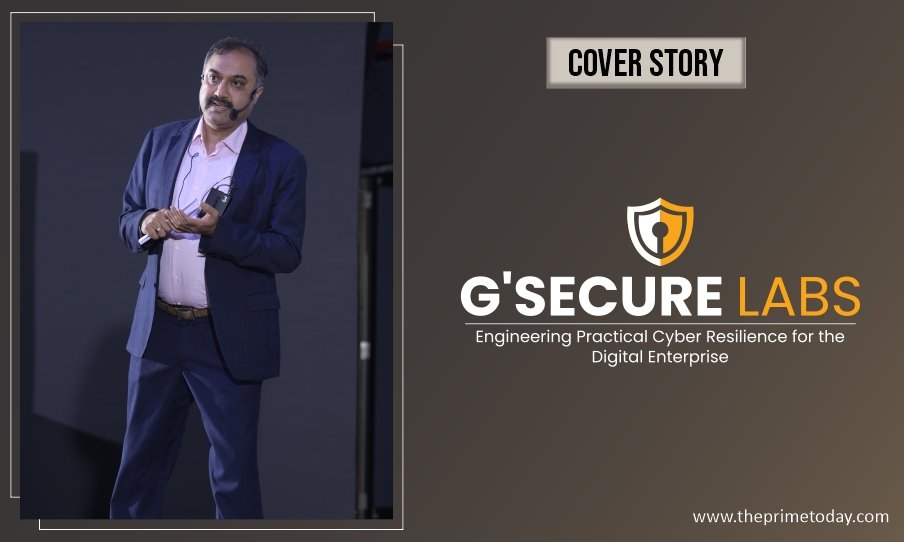
As digital transformation accelerates across industries, many organisations initially approached cybersecurity as a compliance requirement rather than a strategic business function. G’Secure Labs was founded on the belief that security should be embedded into the core of business operations and not added as an afterthought.
According to Indrajeet Mitra, Co-founder of Gateway Group of Companies and CEO of G’Secure Labs, the company was built on a simple but critical observation: organisations were treating cybersecurity as a checklist rather than a business imperative.
From the outset, G’Secure Labs made a conscious decision not to build every capability internally. Instead, it focused on forming strong partnerships with leading global cybersecurity providers such as Trend Micro, Trellix, Guardsix, and Recorded Future. By integrating proven technologies, the company was able to concentrate on what truly matters – adapting enterprise-grade security to each client’s operational environment.
“This philosophy allows us to focus on aligning global-grade security with the operational realities of each client, whether it’s an Indian industrial enterprise, a Nordic telecom provider, or a Middle Eastern logistics company,” says Indrajeet.
Over time, the company has evolved from a consulting-led governance, risk, and compliance (GRC) firm into a full-spectrum managed security provider. Its Managed Detection and Response (MDR) platform is designed to detect threats in under a minute, investigate within ten, and respond within forty-five.
However, the most significant transformation has been philosophical.
“The industry has shifted from trying to prevent every attack to embracing cyber resilience – the ability to detect, contain, and recover quickly when breaches occur.”
Designing Security Around the Client
A defining strength of G’Secure Labs lies in its ability to tailor cybersecurity architecture to each organisation’s unique operating environment.
Indrajeet recalls working with one of Sweden’s largest trotting organisations, where the infrastructure involved live events, real-time betting systems, and sensitive cross-border data. While many vendors found the requirement too specialised, G’Secure Labs treated it as a custom architecture challenge.
“We built a security model around their ecosystem rather than forcing them into a standard framework.”
This approach reflects the company’s positioning as a “right-sized partner”, large enough to deliver enterprise-grade capabilities globally, yet agile enough to customise solutions.
Its two Centres of Excellence play a vital role by capturing insights from every engagement and feeding them back into future projects. Over time, this builds a powerful collective intelligence across industries, threat landscapes, and regulatory environments.
The foundation of this model is what the company calls outcome-driven security.
“We don’t sell tools, we deliver measurable outcomes, such as faster detection, reduced false positives, and improved compliance.”
The MDR platform integrates endpoint detection, network monitoring, UEBA, forensic analysis, and automated response into a unified system, allowing analysts to focus on actionable insights rather than fragmented alerts.
Supporting this platform is a multidisciplinary team representing fourteen nationalities, including red team specialists, blue team defenders, forensic experts, and GRC consultants working in unison.
“Technology only delivers value when supported by exceptional people, and that’s where we invest the most.”
Building Trust Through Independence and Transparency
In cybersecurity, trust is fundamental, and at G’Secure Labs, it is reinforced through independence and transparency.
The company operates with zero debt, no external investors, and no financial liabilities.
“This isn’t just a financial detail; it’s a statement of independence. Our only obligation is to deliver on our promises, without external pressures.”
Transparency is equally central to client relationships. Organisations are given real-time visibility into their security posture, and incidents are communicated openly and clearly.
“When incidents occur, we provide full transparency, explaining root causes, remediation steps, and preventive measures.”
Many client relationships span over a decade, evolving alongside technological and organisational changes.
“That longevity transforms trust into something institutional, and that’s our strongest competitive advantage.”
The Dual Challenge Facing Enterprises
According to Rahul Ganatra, Chief Strategy Officer, enterprises today face two rapidly evolving challenges.
First, the threat landscape itself. Artificial Intelligence has dramatically accelerated cyberattacks, enabling campaigns that once took weeks to unfold within hours.
Second, the increasing burden of regulatory compliance, particularly across Europe and Asia.
At the same time, the traditional network perimeter has dissolved. Modern work environments span remote work, cloud systems, and hybrid infrastructure, expanding the attack surface significantly.
“Many providers respond by adding more tools. We focus on simplifying complexity through unified visibility.”
By consolidating endpoint, network, cloud, and behavioural analytics into a single view, organisations can shift focus from tool management to effective threat response.
“In a rapidly evolving landscape, clarity becomes the ultimate advantage.”
Innovation That Performs Under Pressure
For Rahul, innovation in cybersecurity is only meaningful if it performs reliably during real-world incidents.
G’Secure Labs follows a three-layered approach. First, proactive security to anticipate threats. Second, a reactive response to manage incidents. Third, strategic planning is aligned with long-term risk.
This model is supported by three global Security Operations Centres (SOCs) – two in Europe and one in India, ensuring 24/7 coverage.
The company also maintains a vendor-agnostic approach, selecting technologies based on effectiveness rather than partnerships.
AI plays a key role in enhancing threat detection and analytics, enabling systems to evolve alongside emerging threats.
Building a Security-First Culture
Embedding a security-first mindset is a core priority.
Operating within the Gateway Group ecosystem, G’Secure Labs integrates security into the foundation of every solution.
“Security isn’t an add-on; it’s embedded from the start.”
Beyond implementation, the company helps organisations adopt security as a business-wide mindset rather than an IT function.
“The most valuable outcome is when security becomes part of organisational thinking.”
Continuous Research and Operational Learning
For Harish Shukla, Head of Cyber Security and Managed Services, research is not a separate function; it is embedded in daily operations.
Threat intelligence, simulation exercises, cloud experimentation, and compliance engineering continuously feed into service improvements.
“Every new threat we encounter strengthens our detection models and response strategies.”
This creates a powerful feedback loop where insights from live environments are quickly integrated into operational frameworks.
The company also tracks evolving regulations such as NIS2, DORA, and AI governance standards to prepare clients proactively.
A Multidisciplinary Cybersecurity Talent Model
G’Secure Labs structures its expertise across three core roles.
The builders: engineers and automation architects design and maintain the tools and frameworks used in security operations.
The breakers: red team specialists and adversary simulation experts test those tools through realistic attack scenarios.
The defenders: SOC analysts and incident responders apply both in real-world environments.
This integrated model ensures rapid knowledge transfer and continuous improvement. Performance is measured using key operational metrics such as mean time to detect and respond, keeping focus firmly on outcomes.
Sector-focused Security Strategies
The company sees strong demand across financial services, healthcare, automotive, and manufacturing sectors. Each industry presents unique priorities.
A hospital managing patient records prioritises availability and data integrity differently than a bank managing financial transactions, while a manufacturing environment must prioritise operational continuity to avoid production disruption.
“Our starting point is always threat modelling based on the client’s actual operating environment,” Harish explains. “Control frameworks such as NIS2, DORA, and ISO 27001 are then mapped to those operational realities rather than applied generically.”
In automotive environments, for example, the company has developed expertise in connected vehicle data ecosystems, dealership network infrastructure, and emerging OT security considerations that are becoming increasingly central as the sector moves toward software-defined vehicles.
Expanding Through Partnership Ecosystem
Looking ahead, Fredrik Jubran, Vice President at G’Secure Labs, sees ecosystem collaboration as a key strategic direction.
Rather than competing directly for every enterprise engagement, the company is increasingly partnering with solution providers and service organisations that want to embed cybersecurity capabilities within their own offerings.
“We position G’Secure Labs as the partner that provides the depth and infrastructure behind their security promise,” Fredrik explains.
“Three core service offerings anchor this strategy. The first is 24/7 SOC-as-a-service, giving partners and their clients continuous monitoring and response coverage without the capital and talent investment of building their own operations centre. The second is Managed GRC-as-a-service, helping organisations navigate an increasingly complex regulatory environment on an ongoing basis rather than through periodic, expensive engagements. The third is Cloud Security and Infrastructure Management, as cloud environments become the primary attack surface for most enterprises.”
These services allow partners to deliver enterprise-grade security capabilities without needing to build their own security operations infrastructure.
Competing Through Ecosystem Value
In a competitive cybersecurity market dominated by large global providers, differentiation requires clarity of positioning.
Fredrik believes G’Secure Labs’ strength lies in enabling partners rather than displacing them.
“Where larger firms typically pursue direct enterprise engagements, we focus on strengthening the security capabilities of solution providers and service companies,” he says.
This approach expands market reach while building deeper long-term relationships within the partner ecosystem.
“In a crowded market, the organisations that endure are the ones that create mutual value across the ecosystem. That is the space we have chosen to compete in.”
Looking Ahead
For Indrajeet, the goal is not to become the largest, but the most trusted cybersecurity partner.
“I want us to be the firm a CISO calls first because we have consistently delivered the right guidance over time,” he says.
Three priorities define that vision.
First, expanding G’Secure Essentials, which aims to bring enterprise-grade detection and response capabilities to mid-market organisations.
Second, advancing resilience-focused security across emerging domains, including CASB, OT security, and AI-driven threat response.
Third, continuing to invest in cybersecurity talent through the organisation’s Centres of Excellence.
After nearly three decades in the industry, Indrajeet believes the ultimate measure of success in cybersecurity is often invisible.
“After nearly three decades, I know one thing: cybersecurity is thankless when done well, because the best outcome is that nothing happens,” he reflects. “And that is the legacy worth building.”