
Jan Veuger: Advancing Social and Commercial Real Estate
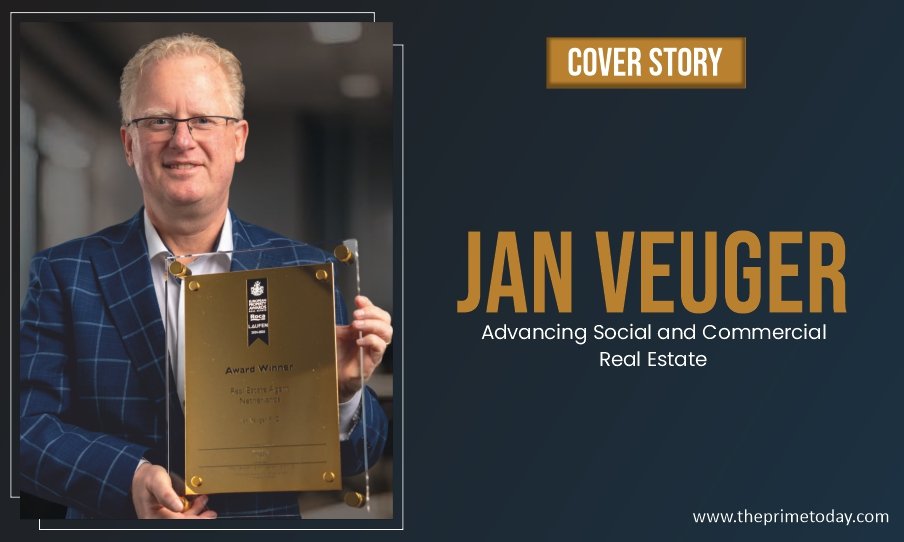
Turning Real Estate Challenges into Practical Solutions!
Every city has corners that feel alive and others that feel forgotten. Behind these spaces are decisions about design, management, and investment that shape the way people live, work, and learn. For Jan Veuger, understanding these connections has guided a career that blends research, practice, and strategic insight in property management.
Jan has built an international reputation for helping organizations see beyond bricks and mortar. With a PhD from Erasmus University Rotterdam, he explored how real estate can serve social goals while staying financially sound. Since then, he has balanced an academic career with hands-on projects, working with governments, housing associations, healthcare providers, and educational institutions to create solutions for complex property challenges.
He has held professorships at the Institute of Business Administration, Hanze University Groningen The Netherlands and School of Finance and International Business Saxion University Enschede The Netherlands, applying research to practical outcomes. His work focuses on the future of social and commercial real estate, looking at how financial opportunities can align with social values. This dual perspective allows him to advise boards and directors in ways that make property a strategic tool rather than just a line item.
Jan’s research, including his widely used dissertation ‘Material Immaterial,’ demonstrates his ability to combine theory with real-world application. Over the years, he has been recognized internationally, receiving 6 awards in 2024 and 2025 for his contributions. These honours reflect his skill in translating complex property and financial matters into actionable strategies that organizations can use today.
Recently, he has been expanding his focus into Urban Facility Management, continuing his role as a connector between management, design, and strategy. Jan thrives on interpreting complex systems and helping people make choices that create lasting value for communities.
Through every project, Jan emphasizes that property is about people. Spaces can influence how communities grow, how organizations operate, and how social goals are achieved. By combining research, consulting, and strategic guidance, he has formed environments where real estate supports both human and organizational needs, making him a leading voice in his field.
Bridging Academic Research and Practical Consultancy in Real Estate
Jan has always been motivated by a desire to connect academic research with real-world consultancy and property management. He remains curious about understanding control processes and emphasizes the importance of questioning the accuracy of observations, believing that further investigation is always necessary since many aspects remain unseen.
For many years, Jan has conducted research alongside consultancy and interim management assignments, exploring the future of social and commercial real estate and identifying best practices in collaboration with clients. His expertise in combining social value with financial opportunities has formed the foundation for expanding his work to consultancy for owners of the built environment, including recent projects in Urban Facility Management. He sees the role of connecting link and interpreter in management and design processes as a compelling challenge. This approach has earned him international recognition.
Jan has consistently combined a part-time academic career with practical projects. Since the publication of his widely used dissertation, Material Immaterial (2014), he has advised directors, boards, and managers across government, housing associations, healthcare, and education, offering solutions to strategic challenges in real estate and housing.
Balancing Social Impact and Client Financial Goals in Real Estate
In addressing how social values can be pursued alongside the financial priorities of clients, Jan draws on his dissertation, Material Immateriaal: management of housing associations in line with social values. He explains that scientific research is applied to map out precise methods for integrating social objectives into real estate projects while meeting clients’ financial needs. The 13 frameworks of Corporate Real Estate Management (CREM) have proven most effective in achieving this balance (Veuger 2014: 126-131).
Identifying Valuable Technologies for Real Estate Practice
He began his academic path with a PhD from EUR in 2014, where his focus rested on the management of housing associations. In that environment, he saw the difficulty of aligning the wishes of residents, the demands of local authorities and the limits of financial resources. Many rely on long rounds of consultation to find answers. His approach grew far more ambitious.
The field has shifted greatly since those early years. Property management remains a relatively conservative domain, and he believes new developments still move through it slowly. In 2017, he committed himself to a serious effort to introduce technological progress into daily practice. The rise of AI, Blockchain and the Internet of Things created clear openings for this shift. He often explains that solving urban challenges from a facility management perspective calls for cooperation among varied stakeholders as well as smart use of tools such as Blockchain, IoT and AI.
His interest in technology grows stronger with every study, reading effort and research project. He works through all available material and turns his insights into a steady flow of publications. His body of work now includes books on blockchain in healthcare, the energy transition and waste processing for Routledge, along with titles on Urban Facility Management for 2025, Interdisciplinary Research on Real Estate for 2026 and AI and Real Estate for 2026. He is also preparing a paper titled Supervision of Algorithms and Artificial Intelligence in Relation to Real Estate.
His vision for real estate strategy and management centres on a built environment that fully supports living and working. He believes that strong property management, guided by well-applied technological developments, helps communities grow. This conviction, which he shares widely, continues to draw the attention of many organizations. This interest has led to roles on Supervisory Boards of housing associations, healthcare institutions, educational bodies and scientific editorial committees. He accepted these responsibilities with care, as they allow him to contribute meaningfully while gaining insight into varied organizations. These experiences deepen and refine his perspective on property management.
How Material Immaterial Shapes Strategic Real Estate Thinking
Material Immaterial introduced a way of seeing how social aims shape real estate choices, and Jan continues to draw from its central ideas. His study offered several conclusions that guide his present approach.
He explains that the improvement of social objectives in corporate governance appears through three clear areas. The first concerns the housing of the primary target group. The second involves investment in the living environment. The third focuses on contributions to the socio-economic growth of neighbourhoods. He adds that financial position, effectiveness and efficiency carry equal weight.
He shares that existing legal forms give the corporation room to act with true intention. The special character of social property relates to communication linked to the built environment, the facilitation of essential needs and service to others based on a recognized public interest.
Jan states that corporations aim to create social values by directing resources with deliberate attention to social goals. They work to preserve these values, restore them and renew them. Social integration and sector organization guide the behaviours that emerge.
He observes that boards use control models in practice, yet coherence between financial returns, social returns, social trust, effectiveness and efficiency remains limited. He believes that CREM as a theory may support stronger coordination of values.
He also points to a gap between narratives and performance within board work. He sees room for real innovation in the fourth age of housing associations through planning that moves in harmony with social values.
He shares that the multidisciplinary nature of social property management creates ease when definitions and observations are clear. Hard skills and soft skills together form the overall control of a corporation and its accountability. He concludes with the overall summary that answers the central question of the study. Directors who think at the highest level about how to deal with values ensure they guide their organizations with intention, monitor outcomes, understand consequences and take responsibility.
Global Appeal of His Real Estate Work
Jan’s work draws strong international attention because it brings clear knowledge and accessible insight into social and technical forces that guide real estate today and in the future. He shares these ideas through scientific research, collaboration with leading specialists, books, lectures, and the conferences he helps direct, including the worldwide economic and built environment gathering in Japan in November 2025 and the interdisciplinary real estate research conference in October 2025, which carries more than eighty years of study in urban facility management and ten years of CIRRE activity.
He maintains an open and curious view toward the evolving use of real estate. He invites new ideas and encourages thoughtful exchange. He also drives new research efforts, including two significant studies on data-driven methods that support faster housing development in the Netherlands and the use of AI as an accelerator for housing construction.
His recent awards include:
- UK: November 14, 2025: BUILD ‘Most Innovative Real Estate Management Director 2025: Jan Veuger’
- London, UK: October 23, 2025: Nominee The European Property Award 2024-2025 ‘Best Real Estate Agent /Consultancy Europe.’
- London, UK: October 23, 2025: Winner The European Property Award 2024-2025 ‘ Best Real Estate Agent /Consultancy The Netherlands’
- UK: September 8, 2025: BUILD Real Estate & Property Awards 2025: ‘Most Innovative Real Estate Management Director 2025: Jan Veuger’
- UK: August 1, 2025: BUILD 2025 Award: ‘Most Innovative Urban Facility Management Company’
- USA: July 11, 2025: Global Recognition Award 2025 for ‘Revolutionary Urban Facility Management Innovation’
- London, UK & Dubai, UAE: January 15, 2025: Winner of The Global Economics Award 2025 ‘Most Innovative Real Estate Advisory Firm’
- Dubai, UAE: December 13, 2024: Winner World Real Estate Excellence Awards 2024 ‘Best Property Management Consultancy’
- Dubai, UAE: December 13, 2024: Winner World Real Estate Excellence Awards 2024 ‘Best Facility Management Company’
- London, UK: October 17, 2024: Winner of the European Property Award 2024-2025, ‘Real Estate Agent, The Netherlands’
- United Kingdom: September 2024: Winner BUILD Facilities Management Awards 2024 ‘Most Visionary Real Estate Management Enterprise 2024 The Netherlands’
- New York, USA: July 17, 2024 TITAN Gold Winner 2024 Property Award Real Estate ‘Outstanding Property Consultancy The Netherlands’
Urban Facility Management and Its Key Points
Urban Facility Management emerges as a fresh professional focus for Jan, which gives readers a sense of why his long-term study carries weight. He shares 4 conclusions shaped by 8 years of research:
Conclusion 1: Alignment of varied definitions and solutions
Conclusion 2: Current developments with standards, funding, and interest carry weight
Conclusion 3: Methodologies, triangulation and models carry value
Conclusion 4: Process improvement leads to a clearer picture
He presents Urban Facility Management as an interdisciplinary field devoted to effective and efficient care of urban infrastructure, buildings and services. It involves coordinated maintenance of real estate, public services and social facilities.
He outlines the sequence that guides his view:
- Governability is linked to societal values.
- Safety
- Sustainable environment
- Public services
- Urban facilities
- Economy
- Energy management within a sustainability context
- Integration of technologies
He also cites a 20-minute podcast titled Jan Veuger: A Holistic Approach to Urban Facility Management, based on chapter one of his book Urban Facility Management published by Routledge in 2025. The book offers structured insight into this emerging field and its growing relevance.
Urban Facility Management is a recent area of focus for you. What challenges or opportunities in this field do you find most compelling?
Integrating Interdisciplinary Expertise
Talking about his publications, he affirms that his publications show a strongly interdisciplinary approach. This is made possible by a holistic approach and clear collaboration with other experts in various fields.
This often yields new and progressive insights in diverse areas such as finance, social housing, and AI. By combining science and collaboration with stakeholders, he arrives at coherent strategies for clients.
Translating Research into Decisions for Boards
In advising boards and directors, He asks what the group is looking for and whether the question is correct or if the answer is already present, while the search continues for the right question. Once this is clarified, he turns to research insights, whether his or those of others, and translates them into useful decisions.
Through triangulation, looking at the same subject from different perspectives, and by looking broadly and then peeling away what truly appears and looking broadly again from that point and peeling away again, he shows how crucial nuances can be simplified.
Most Transformative Project
Discussing his projects and the work that formed his path, the focus turns to the portfolio he assembled for the International Property Award. It offers a clear view of his achievements, as outlined in the appendix. The work received a 5-star award in London this year.
During the same period, he also received a nomination as Property Agency and Consultant Europe for the title of Best in the World at The International Property Awards London in January 2026.
Staying Ahead While Remaining Practical
As someone who operates at the intersection of theory and practice, he states that it is quite simple. It is precisely through this combination over many years that he has built up his expertise. By combining his twelve years of part-time professorship with practical experience, he has been able to continuously make the transition from science to practice and vice versa with regard to current and future developments.
In addition, he conducts a lot of research in collaboration with the business community and government. Thanks to his many collaborations and visits to a few conferences each year, reading trade journals and many in-depth newspapers, he has a keen sense of what is going on and is happy to be influenced by good arguments, or contradiction, if you will. As a result of this contradiction and collaboration with science and practice, the business community and the government, his advice is always realistic and feasible.
In general, he receives compliments for his ability to switch between strategic, tactical and operational modes and vice versa. This means that he can serve the advisory board well, but he can also translate this to the workplace and vice versa.
Facilitating Genuine Collaboration
In a setting where several stakeholders carry competing priorities, he describes collaboration as central to his methodology. The most important thing he has learned is that when people look at an object from different angles, few individuals see the same thing. By sharing those views with each other, the group arrives at a broad acceptance of what they have seen and what may well be the truth they have seen together. This also has a positive corrective effect on each participant and provides new insights.
Evolving Views on the Future of the Built Environment
Reminiscing about his career, from his first publications to his most recent work on AI in the property sector, Jan shares that his view of the built environment has certainly changed. From just looking at the bricks and mortar and their economic value to a more holistic approach to the built environment in which living, working, and life go well together. Feeling at home somewhere depends on the bricks and mortar, along with the environment that can influence a person in a positive way.
He has said before that a housing association does need houses. Rather, they need to provide housing, a roof over a person’s head. In other words, facilitating housing. A more integrated approach to housing, such as that taken in Belgium, for example, is much more essential. Sharing cultural differences about how to live and work, with a vision that real estate can align with and facilitate this, should be the guiding principle. Real estate follows.
Due to the economic impact of real estate, which is strongly linked to the financial world, Jan believes it is very important to have a long-term vision with an awareness of social and economic global developments.