
Justin Ray: Advancing Practical Psychiatric Care Through Clinical Leadership
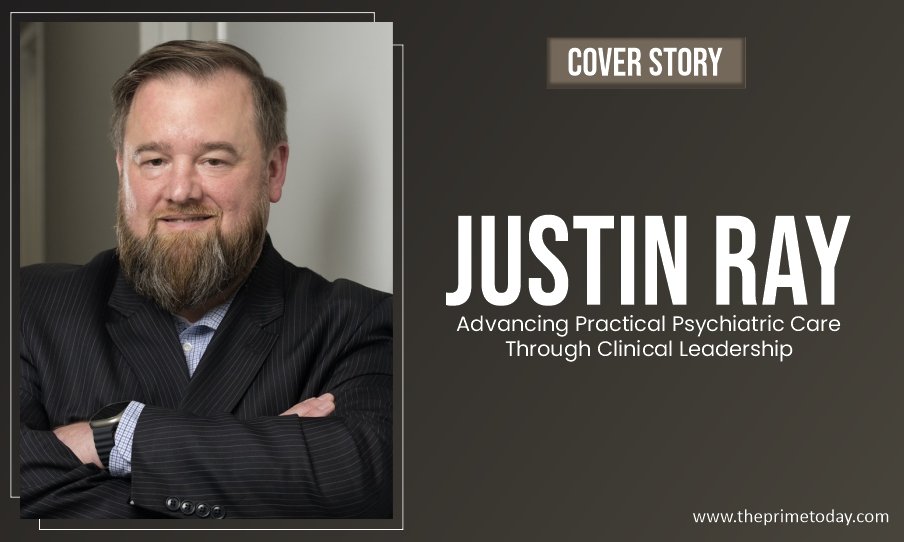
Mental health care still leaves many people waiting too long, explaining their pain too often, and receiving help too late. Long queues, scattered services, and unclear treatment paths create fatigue for patients and families alike. A person may speak to several professionals and still feel unheard. Progress slows when care lacks structure and continuity. Strong systems exist, yet personal guidance often feels missing. What many patients search for is steady medical leadership, clear treatment direction, and care that respects their dignity from the first visit.
That gap between need and delivery formed the professional path of Justin Ray.
He serves as a Psychiatric Mental Health Nurse Practitioner, a retired U.S. Navy veteran, and the founder of South Chesapeake Psychiatry and Transforming Minds Interventional Psychiatry. His work focuses on bringing organised, reliable psychiatric care closer to people whose lives face disruption from mental illness.
His journey into mental health began through military service. He entered healthcare in the U.S. Navy as an enlisted Hospital Corpsman and received an early posting in inpatient psychiatry. Daily exposure to severe psychiatric conditions changed his career direction. He observed how mental illness can affect identity, relationships, and independence. He also observed how skilled and compassionate treatment can restore stability and self-respect. That contrast gave his work a clear purpose.
Over the years, his role expanded through advanced training and clinical responsibility. Experience across decades helped him design care models that combine medication support, interventional psychiatry, and consistent follow-up. Each step in treatment connects to the next, so patients experience continuity rather than confusion.
Military training still influences his leadership style today. Care plans follow discipline, careful evaluation, and accountability. Each patient receives focused attention and structured guidance. Psychiatric treatment becomes a steady, organised process aimed at real recovery and stronger daily living.
Let us learn more about his journey:
Built in Crisis, Shaped by Psychiatry
Serious psychiatric care is often learned in high-pressure environments where theory meets real human volatility. Justin’s foundation was not academic first. It was operational, clinical, and immediate. His earliest years in mental health came through military service, where exposure was constant, and stakes were high.
His early years as a Neuro-Psychiatric Technician became foundational. He spent over a decade working in inpatient units, emergency evaluations, suicide prevention, and crisis stabilization. This was not observational work. It was hands-on, often intense, and deeply human. He learned to de-escalate violence, sit with despair, and recognize subtle shifts in behavior long before they became emergencies.
Those years taught him that psychiatry is not practiced in textbooks; it is practiced in moments. In late-night conversations, in restraint decisions that weigh safety against dignity, and in the long arc of trust built with patients who have often been failed repeatedly. The Navy gave him structure, discipline, and exposure to psychiatric illness across cultures, ages, and acuity levels. It also built a lifelong respect for teamwork, because psychiatry is never a solo endeavor.
Choosing Psychiatry Over Comfort
Career direction in medicine often shifts at moments of institutional need. For Justin, the move toward advanced psychiatric practice did not come from convenience. It came from recognizing where his experience could matter most.
The transition was formed as much by leadership as by circumstance. He had spent 13 years working as a Neuro-Psychiatric Technician before attending nursing school, and after graduating, he was assigned to a medical-surgical floor at Naval Hospital Pensacola. At that point, his trajectory was leaning toward critical care.
However, this was during the height of the conflicts in Afghanistan and Iraq. Service members were returning with devastating physical injuries, profound psychological trauma, and complex presentations of PTSD. At the same time, the military was critically undersupplied with experienced mental health providers. His leadership recognized both the urgency of the need and his psychiatric background, and they pushed him to return to mental health in the service of a larger mission.
That moment reframed his career path. Rather than pursuing critical care, he recommitted himself to psychiatry, not as a fallback, but as a response to where he was most needed. That decision led him toward advanced training as a Psychiatric Mental Health Nurse Practitioner, allowing contribution at a higher clinical and systems level during a period when mental health care for service members was not just important, but essential.
The Hardest Clinical Environment
Not all psychiatric settings test clinicians the same way. Some demand more ethical stamina than technical skill. For Justin, correctional psychiatry proved to be the most personally demanding arena.
Correctional psychiatry was the most personally challenging. Treating severe mental illness in an environment built around control rather than care exposes the limits of even strong clinical intentions. Resources are constrained, trust is fragile, and outcomes are often dictated by legal realities rather than clinical ones.
That environment strengthened his resilience and moral clarity. It forced ongoing questions about autonomy, consent, and responsibility. He learned that his role was not to fix broken systems, but to practice ethically and skillfully within them, advocating when possible, stabilizing when necessary, and never losing sight of the person behind the diagnosis.
Precision Over Protocol
Advanced psychopharmacology is rarely about rigid protocols. It is often about careful adjustment, mechanism awareness, and patience. One long-acting injectable case continues to represent how Justin approaches complex medication decisions.
One case that captures his approach to advanced psychopharmacology involved a client who had previously done exceptionally well on paliperidone palmitate (Sustenna). Symptom control was strong, functional gains were meaningful, and for a time, the medication appeared to be an ideal fit. However, she developed an unusual pattern of isolated oculogyric crises, intermittent, distressing, and not easily explained by typical dose-related side effects.
Rather than abandoning long-acting treatment altogether, the process slowed, and the mechanism was carefully troubleshooting. After a detailed assessment, she was transitioned to aripiprazole (Maintena). The result was striking: the oculogyric episodes almost resolved completely. A few additional symptoms emerged, likely reflecting the difference between roughly 70 percent D2 receptor occupancy with a partial agonist versus the 80 to 90 percent range seen with higher-potency antagonists, yet the overall clinical picture improved meaningfully.
But the true success of the case was not found in receptor charts. It was found in her life trajectory. She is living independently, no longer cycling toward legal trouble, instability, or incarceration. She experiences only mild residual symptoms and works full time, outcomes that once felt out of reach. During a recent visit, they even shared a laugh about the time he told her, “I graduated high school with a 1.9 GPA, some memories, don’t need to stick.”
For him, the case underscores why long-acting injectables are not about control or convenience. They are about precision, flexibility, and restoring trajectories. The goal is not simply symptom suppression. It is helping people reclaim stability, dignity, and a future beyond the clinic walls.
Fixing What Patients Actually Experience
Many mental health practices struggle with patient trust, not because of clinical errors, but because of access and communication failures. Justin built his practice model by first studying where patients felt most let down.
If someone types mental health or psychiatry practice into Google, what often appears is a long list of frustrated reviews. When those reviews are read closely, most complaints are not about clinical skill. They are about communication. Phones that are not answered. Messages that are not returned. People feel ignored at moments when they are already vulnerable.
He recognizes that some of this strain is structural. Psychiatry practices operate under heavy insurance pressure. Staff spend long hours on prior authorizations, claim denials, and reimbursement disputes just to keep operations stable. That administrative load pulls attention away from what patients value most: access and responsiveness.
When he stepped back to define what was missing in real mental health delivery, five concepts kept resurfacing: Quality, Expertise, Excellence, Accountability, and Availability. These were not branding terms. They were operational corrections to daily failures he kept seeing.
His practices were built intentionally around those pillars, with workflows, staffing, and expectations structured to support them. Quality means not rushing care to satisfy volume targets. Expertise means staying clinically sharp in a complex field. Excellence means refusing to normalize mediocrity. Accountability means owning both outcomes and shortcomings. Availability means recognizing that communication is not extra in mental health care. It is part of the treatment itself.
Those five principles became the operating base. In his view, they proved not optional, but necessary.
Recognition That Measures Experience
Awards in healthcare can sometimes reflect marketing scale more than clinical depth. What made this recognition different to him was how it was earned.
Recognition as Coastal Virginia’s #1 Psychiatry Practice carries weight for a specific reason. Winning once is meaningful. Winning twice signals consistency. It points to repeated experience, not novelty.
The recognition is volume-based voting. His practice is measured alongside groups that, in some cases, serve five or six times more clients. That means the result is not driven by reach. It is driven by patient experience. People take the time to vote when they feel heard, supported, and respected.
He is most proud of that response pattern. The practice model was deliberately not built as high volume and high churn. The design favors depth over breadth. Longer visits. Careful medication strategy. Accessible communication. Outcome accountability.
Seeing that model hold ground in a crowded healthcare market confirms something simple to him: quality still registers. Patients notice. Integrity and rigor are not barriers to sustainability.
Staying Grounded in Community Psychiatry
Private practice offers control and structure. Community psychiatry removes both. Justin keeps an active role in ACT work because the environment tests real-time judgment and presence.
Since retiring from the Navy, he has kept one foot in community mental health and the other in private practice by design. The balance matches how he works best as a clinician. His training, temperament, and values converge in that split model.
ACT work happens outside controlled office settings. Care happens in the client’s environment, not the provider’s. That demands constant awareness and flexible judgment. Each visit may include heightened emotion, conflict, or long-standing distrust of institutions.
He often describes moments that involve family tension, such as when a client with schizophrenia refuses medication while a parent is desperate for stability and safety. In those moments, the work is not only about adherence. It is about respecting the client’s autonomy and dignity while acknowledging the fear and exhaustion of the family member. Holding both realities at once is the work.
That complexity keeps him engaged. He prefers situations that require careful listening, ethical balance, and real-time reasoning. Private practice and ACT settings sharpen each other. Each keeps him connected to why he chose psychiatry.
Shifting the Treatment Target
In psychopharmacology circles, innovation is often measured by symptom reduction. Justin pushes for a different primary target in schizophrenia care.
As a Key Opinion Leader, the innovation he most strongly advocates is shifting schizophrenia treatment toward cognition as a central target. For decades, treatment emphasis has centered on positive and negative symptoms. Those matters, but they do not best predict long-term functional outcomes.
Cognition does. Attention, working memory, processing speed, and executive function determine whether someone can live independently, maintain employment, manage relationships, and function daily. Yet many trials still treat cognitive outcomes as secondary or exploratory.
He argues cognition should move upstream in trial design as a primary or clearly defined secondary endpoint. That requires better measurement tools and more deliberate methodology, along with recognition that symptom reduction alone does not equal recovery.
He notes growing movement toward novel mechanisms, including muscarinic-based approaches, that may support cognitive benefits beyond dopamine blockade.
Alongside that, he remains a strong advocate for long-acting injectables. LAIs provide pharmacokinetic stability that allows cognition and function to be evaluated consistently over time. Without stable exposure, it is difficult to separate illness-related cognitive impairment from adherence fluctuation. In his view, LAIs do not only reduce relapse. They create the conditions where functional and cognitive recovery can be measured and sustained.
His reframing is direct. Success in schizophrenia treatment should not mean only fewer hallucinations or hospitalizations. It should mean clearer thinking, stronger function, and restored life direction.
Training the Next Generation Right
Clinical training in psychiatry often creates early comfort zones that later become blind spots. Justin treats mentorship as a place to widen the range, not narrow it.
The most rewarding part of mentoring future psychiatric providers, in his view, is watching them expand both confidence and clinical range without losing empathy. His training approach pushes breadth before specialization. He encourages trainees to use every available tool, psychotherapy principles, pharmacology, long-acting injectables, and interventional treatments, instead of closing doors too early.
When a trainee expresses discomfort with a medication class, patient population, or treatment method, he pauses the discussion and examines the source of that discomfort. In many cases, it reflects an education gap or an unrecognized personal bias rather than a true clinical boundary. He treats that moment as a growth point, not a weakness.
His mentoring style normalizes discomfort and reframes it as evidence that learning is happening. He teaches that psychiatry does not reward staying inside familiar territory. Growth comes from stretching clinical judgment.
His message to trainees is consistent: become comfortable being uncomfortable. That is where curiosity sharpens, reasoning improves, and better clinicians are formed. The goal is not to know everything. The goal is to remain open, careful, and willing to extend in the service of better care.
Compassion Across Diagnoses
Working across a wide diagnostic spectrum can pull clinicians toward categorization over connection. Justin keeps his anchor elsewhere.
He maintains versatility and compassion by separating diagnosis from human experience. Diagnostic labels may change over time. Suffering does not. Whether someone presents with ADHD or psychosis, he believes they deserve the same baseline: curiosity, respect, and individualized care.
Versatility, for him, depends on continuous learning. Compassion depends on humility. He treats both as disciplines, not personality traits.
A Clear Standard for Care
Many mental health models drift toward dependency rather than restoration. Justin draws his line in a different place.
His deepest personal commitment in advancing mental health care is to practice psychiatry in a way that restores dignity and function, not dependency. He frames the future of mental health care as thoughtful integration of science, systems, and humanity rather than dominance of any single domain.
Every decision I make is guided by one question: Does this genuinely help the person in front of me live better?
That question guides medication choices, care models, and system design decisions.