
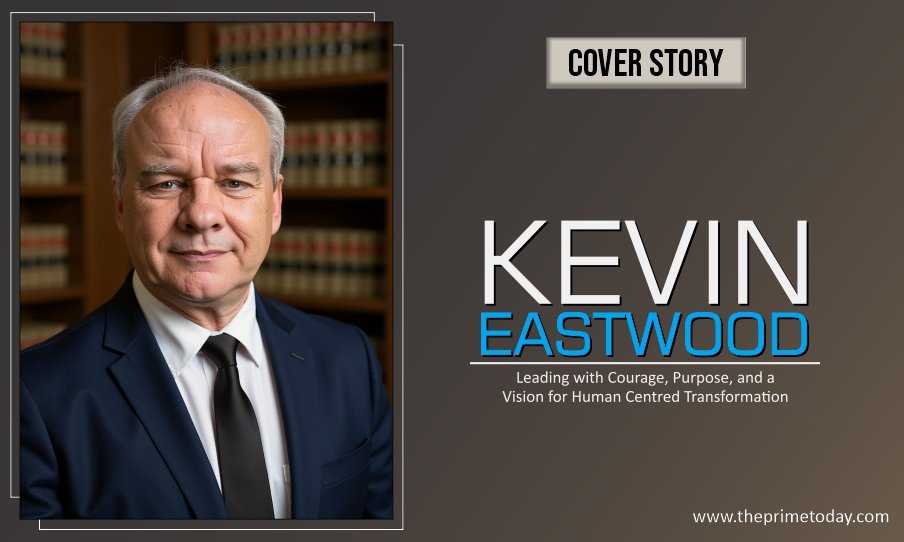
Kevin Eastwood: Leading with Courage, Purpose, and a Vision for Human Centred Transformation
Does an individual hold the power to reshape reality?
The answer is yes. We know it. We have seen it. When that individual is a leader as visionary and as powerful as Kevin Eastwood, reality gets transformed every day. Today, in such a world reshaped daily by technology, uncertainty, and accelerating change, few leaders can claim to bridge the human and digital realms with equal mastery. Even fewer have lived a life that reflects resilience, service, and reinvention as fully as Kevin Eastwood has.
From the streets where he served as a police constable to the boardrooms of global enterprises navigating AI adoption, Kevin Eastwood’s leadership has always carried a rare trait: he sees people, not processes, as the heart of transformation. His journey through entrepreneurship, enterprise architecture, mental health challenges, and coaching initiatives has become a testament to what modern leadership looks like when courage meets compassion.
In this exclusive Prime Today feature, Kevin Eastwood offers a human blueprint for the future, one that blends technology, empathy, and purpose into a vision of progress the world urgently needs.
Kevin Eastwood, your journey spans policing, entrepreneurship, and enterprise leadership. What higher purpose has carried you through such different worlds?
When I look across the chapters of my life, I see one unifying purpose: the desire to protect, uplift, and empower people. It began long before technology ever entered my vocabulary. As a police constable, I saw humanity in its most vulnerable moments where safety, trust, and compassion were not optional; they were essential. That experience didn’t just shape my early career; it reshaped my understanding of leadership. You learn very quickly that people don’t remember your job title; they remember how you made them feel.
When I moved into entrepreneurship and built my IT consultancy, serving more than six hundred clients, I discovered another truth: technology, at its best, is an enabler of dignity. It can simplify someone’s day, remove friction from their work, or give them back the confidence they lost in a world that moves too fast. I carried that belief into the complex world of enterprise transformation, where I’ve seen how systems can either empower thousands or overwhelm them.
What has guided me is a simple but profound question: Does my work help people thrive?
If the answer is yes, then I know I am exactly where I need to be.
You’ve led organisations through complex, high-stakes transformations. What do leaders often misunderstand about real progress?
Progress is often mistaken for movement, a faster tool, a bigger programme, a louder announcement. But genuine progress is quieter and far more meaningful. It begins with people, not platforms.
In every transformation, I look for the invisible forces: the incentives that shape decisions, the habits that shape culture, and the unspoken fears that hold teams back. Technology amplifies whatever is already present. If behaviour is misaligned, tools will magnify the chaos. If culture is fragile, technology will expose it.
Real progress happens when people feel clarity instead of confusion, when leadership becomes a source of courage rather than pressure, and when organisations embrace simplicity instead of complexity. Transformation does not begin with software. It begins with honesty about what is working, what is not, and what truly matters.
When leaders grasp that, transformation becomes not just possible, but inevitable.
You’ve helped global organisations adopt AI responsibly. What separates those who truly succeed from those who struggle?
The organisations that succeed with AI are the ones that approach it with humility, intention, and integrity. AI is not a shortcut; it’s a capability that must be nurtured. It rewrites workflows, reshapes decisions, and asks organisations to rethink what human potential looks like when it’s amplified by intelligent systems.
Those who excel understand three truths:
1. AI is strategic, not cosmetic.
It must be tied to outcomes that leadership truly cares about: resilience, decision velocity, customer experience, and risk reduction.
2. AI requires trust before speed.
Governance, ethics, and transparency are not bureaucratic hurdles; they are the foundation upon which innovation stands.
3. AI expands human talent; it does not replace it.
The greatest value comes not from automation, but from elevation, freeing people to think, create, and lead with clarity.
When organisations get this right, AI stops being a technology project and becomes a competitive advantage woven into the company’s identity.
Your early career as an apprentice and later as a business owner clearly shaped you. What core principles have endured through every chapter?
Three principles have never left me: reliability, clarity, and empathy.
As an apprentice electrician, reliability wasn’t a metric; it was a moral obligation. Systems had to work because people depended on them. That sense of responsibility continues to guide how I build, advise, and lead.
As a business owner, clarity became essential. Clients didn’t want jargon or complexity; they wanted someone who could translate technology into trust, outcomes, and confidence. Running a P&L teaches you quickly that clarity is kindness, and ambiguity is costly.
And empathy that came from every chapter. Empathy is what allows you to design systems that fit people, not force people to fit systems. It transforms leaders into humans and organisations into communities.
Those principles have been my compass, keeping me aligned no matter how fast the world changes.
You’ve been open about your mental health challenges. How has that shaped your life, your leadership, and your definition of success?
My mental health journey reshaped me more deeply than any promotion, title, or external success ever could.
Twice in my life, I reached a point where my reserves were completely empty, emotionally, mentally, and physically. Not burned out in a metaphorical sense, but truly depleted. Those moments stripped away any illusion of invulnerability I still carried. They were at the time frightening but also humbling and, in hindsight, they were profoundly formative.
They taught me that vulnerability is not a liability, it is a form of intelligence. That resilience is not about enduring endlessly or pushing through at all costs, but about recognising when your body and mind are asking you to stop. And they fundamentally rewired my understanding of success: not as survival or stamina, but as the ability to show up consistently, honestly, and sustainably without losing yourself in the process.
As a leader, this changed everything.
I no longer celebrate exhaustion disguised as commitment or heroics fuelled by silence. I celebrate truth. I value the courage it takes for someone to stand defiantly and say, “I’m struggling,” “I need help,” or “This isn’t sustainable.” I understand that psychological safety isn’t a soft concept or a leadership ‘nice-to-have’ it is the bedrock on which trust, creativity, and real performance are built.
My teams know that they don’t have to armour themselves to belong. They don’t have to suffer quietly to be seen as capable. Because when people feel safe enough to be human, they do their best work.
My mental health journey didn’t derail my path, it clarified it.
It gave me deeper empathy. Greater patience. And the ability to see people not as roles, resources, or outputs, but as human beings carrying unseen pressures, sometimes private battles, and personal hopes alongside their professional ambitions.
It made me a better leader a more present mentor and a more grounded man.
And that, for me, is what success truly looks like.
Why must AI now be considered a critical pillar in every company’s strategic planning?
AI has moved beyond emerging status; it is now a foundational capability that will decide which organisations lead, follow, or fall behind.”
Strategically, AI reshapes three fundamental pillars of a company:
1. Decision-making.
AI accelerates decisions, surfaces insights, and reduces blind spots. Organisations that embed AI into their decision systems move faster and with greater confidence than those who rely solely on traditional reporting.
2. Productivity and innovation.
AI frees teams from repetitive tasks, allowing them to focus on creativity, design, strategy, and problem-solving the irreplaceably human parts of work.
3. Risk and resilience.
Companies that fail to adopt AI responsibly will face increased operational risk, talent risk, and competitive risk. In the coming years, governance and AI capability will be inseparable.
AI doesn’t just change how companies work. It changes what they can become. That’s why it must sit at the centre of every strategy conversation, in every boardroom, across every industry.
From your perspective, what defines a future-ready organisation?
A future-ready organisation is built on intentional simplicity, meaningful collaboration, and trust by design. It is a place where systems support people, not the other way around.
Future-ready organisations design for:
• Transparency, so decisions are clear, fair, and traceable.
• Governance, so innovation is bold but safe.
• Human experience, so people feel capable, not overburdened.
• Adaptability so that teams can evolve without fear.
The organisations that thrive are the ones that align technology with humanity, where strategy, culture, and behaviour move together in harmony.
Outside of all the high stakes work you do, what keeps you grounded?
Family and nature. Becoming a great-grandparent reframed everything for me. It reminded me that the legacy we leave is not defined by the systems we build, but by the people we impact. Long walks allow me to reset my mind and reconnect with the simplicity of the world beyond the screen.
In the quiet of the countryside, I remember why I do what I do to help create a working world that is not just efficient, but humane. A world worthy of the generations who will inherit it.
Looking back, what fills you with the deepest sense of pride?
The people. Always the people.
I’m proud of every colleague who discovered their confidence, every leader who shifted from fear to clarity, every team that found a healthier, more sustainable rhythm. Tools fade, projects end, and technologies evolve, but the positive change you ignite in others continues long after you’ve moved on.
In the end, I don’t measure my career by what I achieved, but by whether I helped others stand a little braver, stronger, and more supported than they were before and by that measure, it has been a success.