
Nitin Gupta: The Architecture of Sustainable Growth
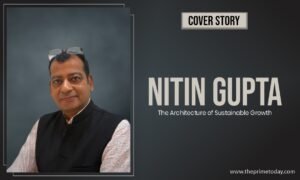
How Nitin is redefining revenue leadership through decisive execution, data-led strategy, strong partnerships, and people-powered growth!
Growth can look very different from the inside. A company may have a strong market position, capable people, and years of experience behind it, yet changing customers, tougher competition, and shifting markets can quickly test what once worked. For leaders, keeping a business moving means knowing when to trust what has worked before and when to rethink it.
Nitin Gupta’s 25-year career has been determined by that understanding. He has driven transformations across telecom, hospitality, FMCG, and industrial sectors, taking on executive roles at industry powerhouses such as Reliance, Vodafone Idea, OYO, and Apollo Tyres. Working across such varied businesses has given him a close understanding of how markets behave, how organisations respond to change, and how growth can be built to withstand pressure.
These experiences have formed the way Nitin sees his own role. He defines himself as a business architect, market strategist, and growth orchestrator, viewing revenue leadership through a balanced lens of algorithmic precision and human empathy. For him, numbers matter because they bring clarity to decisions, while people matter because they are the ones who turn those decisions into action.
His core mission has been building resilient, scalable, and sustainable business engines. This also explains why his thinking around growth extends beyond revenue metrics. People-centricity and systemic adaptability remain central to how he approaches transformation, particularly when businesses are operating across changing teams and trade ecosystems.
Nitin believes true growth is never accidental. It comes from deliberate choices, beginning with data-based decision-making and decisive strategic positioning, and strengthened by a growth mindset across teams.
His approach brings these elements together into one simple idea: a business grows sustainably when its strategy, people, decisions, and ability to adapt are moving in the same direction.
From Revenue Ambition to Economic Enablement
A career in revenue leadership often begins with a fundamental question: what turns a strong product or business idea into something that can actually succeed in the market? For Nitin, the answer emerged early from observing the gap between what a company creates at the strategic level and what ultimately reaches customers through complex, highly localised markets.
His spark ignited when he recognised that even the most revolutionary product remains powerless without velocity, access, and market adaptability. He became obsessed with solving a central problem: how to translate high-level boardroom strategy into seamless last-mile execution across complex micro-markets.
What drew him into revenue leadership was the challenge of building economic resilience for localised trade partners. Seeing how structured distribution and data-based decision-making could turn a fragile business model into a high-yield enterprise showed him that commercial growth is not simply about selling. It is about economic enablement, systematic problem-solving, and driving sustainable scale.
Finding the Growth Principles Which Travel Across Industries
Moving between telecom, hospitality, FMCG, and manufacturing gave Nitin a broad view of how very different businesses create and sustain growth. Each industry demanded a different operating rhythm, yet the experience also revealed a set of principles that remained remarkably consistent.
Transitioning across drastically different operating environments taught him that adaptability towards change is the ultimate competitive advantage for any leader. Telecom demanded hyper-scale velocity and continuous network optimisation. Hospitality with OYO required rapid asset-light scaling, dynamic pricing, and continuous pivot capability. FMCG and manufacturing at Reliance and Apollo Tyres built his discipline in supply chain resilience, channel margin governance, and long-term brand equity.
Across all of them, he found the necessity of decisiveness backed by hard metrics, alongside people-centricity. Regardless of product category, he believes growth is anchored in three fundamentals:
- Partner P&L Health: Ensuring commercial ecosystems thrive on mutual profitability.
- Operational Velocity: Eliminating friction between strategy and market-level execution.
- Trust Capital: Relying on data-driven clarity to build long-term alignment across teams and trade allies.
The CRO as an Ecosystem Growth Architect
The changing nature of revenue leadership has made the CRO role considerably broader than its traditional focus on sales targets and pipeline. Nitin sees the modern CRO operating at the intersection of data, technology, people, partners, and multiple functions working towards a common growth engine.
5 years ago, he believes the Chief Revenue Officer was predominantly an operational sales lead focused on quarterly quotas, pipeline volume, and top-line acquisition. In 2026, the CRO role has evolved into an Ecosystem Growth Architect requiring relentless adaptability towards change.
Today’s CRO must master data-based decision-making, synthesising predictive AI, unit economics, dynamic pricing, and customer lifetime value across synchronised cross-functional streams.
Yet pure data without human perspective creates operational detachment. Nitin believes the modern CRO must balance hard data analytics with people-centricity, aligning product, marketing, operations, and partner networks into an integrated, agile growth engine capable of surviving market volatility.
Turning Channel Partners into Co-Owners
Revenue growth becomes more durable when the businesses responsible for taking products into the market have a genuine stake in the outcome. Nitin’s experience building distribution and channel networks has reinforced his belief that partner relationships are ultimately built around shared economics, trust and decisive action.
He sees the dividing line between transactional delivery and strategic co-ownership as people-centricity and executive decisiveness. Average organisations view channel partners as margin-extraction points; visionary leaders treat them as long-term wealth-creation allies.
During a challenging expansion period, traditional volume-push tactics were causing severe partner fatigue and channel churn. Nitin made a decisive call to dismantle short-term inventory dumping and replace it with a joint-investment model: co-funding digital inventory management systems and guaranteeing baseline margin floors.
Leveraging real-time data to optimise their inventory turns, partner capital efficiency doubled within 90 days. Channel churn plummeted by 40%, and the initiative flipped a lagging territory into a benchmark region, generating a 35% year-on-year revenue surge.
Revolving a Stagnant Product Vertical Around
Building a product vertical from the ground up often requires difficult choices around portfolio complexity, margins, and the distribution model. One of Nitin’s proudest turnaround journeys brought those pressures together in a regional business where growth had become constrained by structural inefficiencies.
The turnaround involved restructuring a stagnant regional product vertical burdened by complex SKUs, margin compression, and channel friction. It demanded both structural resilience and strict data-based decision-making.
Nitin’s team systematically audited product profitability, cut underperforming SKUs, and decentralised decision-making power to frontline teams equipped with localised micro-market data. The turning point came during a regional partner summit when a legacy distributor, previously the toughest critic, demonstrated how the data-driven replenishment framework had doubled his capital turnover speed in seven weeks.
Seeing field teams and partners embrace a growth mindset to outperform historical benchmarks proved to Nitin that the agile model was not simply functional, but market-defining.
Developing Trust Through Partner Profitability
A successful turnaround can improve performance, but long-term distribution strength depends on whether partners believe the relationship will remain fair when market conditions change. For Nitin, trust is built through predictable decisions and a genuine commitment to partner economics.
He identifies three uncompromising values at the heart of trade trust: Predictability, Transparency, and People-Centricity. Trade partners invest their own capital, meaning any arbitrary shift in corporate policy can directly threaten their livelihood.
Turning transactional accounts into lifelong allies requires leaders to treat partner profitability as non-negotiable. Nitin believes channels should never be loaded with stock simply to print a quarterly vanity metric. Territorial integrity must be protected, incentive payouts executed transparently without fine-print delays, and partner workforces supported through upskilling.
When trade partners see that strategic growth directly expands their balance sheet, he believes transactional compliance can evolve into unwavering strategic loyalty.
Guarding Against Algorithmic Detachment
The growing reliance on data and automation has created a new revenue challenge. Technology can make businesses faster, but excessive dependence on automated dashboards can distance leadership from the conditions shaping performance on the ground.
Nitin identifies the single biggest revenue risk in 2026 as “Algorithmic Detachment,” the dangerous temptation for leadership teams to rely exclusively on automated dashboards while losing touch with ground realities and market friction. Technology is a powerful accelerator, but hyper-growth without human intuition creates fragile systems.
His approach to staying ahead rests on pairing data-based decision-making with ground-level field intelligence:
- Audit Unit Economics Continuously: Ensure algorithms drive sustainable contribution margins, not empty acquisition volume.
- Maintain Modular Networks: Build flexible channel structures capable of pivoting rapidly as consumer shifts occur.
- Empower Frontline Leadership: Give ground-level teams the autonomy and data to make decisive operational calls in real time.
Pursuing Growth Without Burning Out Teams
Aggressive revenue targets can create enormous pressure inside an organisation, particularly when teams lack clarity around how those targets will be achieved. Nitin believes sustainable performance depends on creating an environment where challenge is matched by support.
For him, burnout is not caused by hard work; it is caused by ambiguity, lack of support, and rigid environments. Balancing aggressive revenue goals with team vitality requires building a growth mindset across the team within a high-challenge, high-support structure.
His methodology rests on three principles:
- People-Centric Empowerment: Breaking daunting macro targets into clear, manageable micro-milestones while ensuring teams have the tools, data, and cross-functional support required to win.
- Psychological Safety: Encouraging calculated risk-taking and analysing unsuccessful initiatives constructively without penalty.
- Building Resilience: Celebrating incremental operational victories publicly so teams recognise progress even amid volatility.
When teams know leadership supports them through uncertainty, Nitin believes aggressive targets can become a unified mission rather than overwhelming pressure.
Learning When Decisiveness Matters
Years of revenue leadership inevitably produce lessons about decisions that should have been made sooner, alongside choices worth repeating throughout a career. For Nitin, one of his early lessons came from waiting too long to intervene in structurally misaligned situations.
Early in his career, he occasionally delayed structural interventions out of misplaced optimism, attempting to fix misaligned channels or outdated processes long after the data signalled a need for change. His advice to young revenue leaders is to cultivate sharp decisiveness. When operational data indicates a model is broken, swift realignments are necessary. Indecision only compounds inefficiencies.
The principle he would repeat without hesitation is equally clear: relentlessly investing in people and embracing adaptability towards change. Voluntarily taking on complex, broken, or unorganised turnarounds provided him with his steepest learning curves. Giving young managers real accountability and fostering their growth mindset consistently yields the highest returns throughout any career.
Making Impossible Targets into Executable Momentum
Large growth targets can become paralysing when they remain abstract. Nitin’s approach is to break the ambition into operational decisions that teams can understand, influence, and execute.
When faced with an intimidating target, his first step is removing panic through rigorous data-based decision-making. Monolithic targets cause paralysis; structured breakdown creates clarity.
His process follows a simple progression: Macro Target → Micro-Market Data → Execution Sprints → Team Velocity
He begins by deconstructing the mathematics, breaking macro goals into granular operational levers such as conversion rates, channel velocity, yield optimisation, and retention expansion.
From there, he focuses the organisation on immediate, high-probability wins. Momentum builds confidence, and confidence dispels anxiety.
The final step is establishing decisive execution rhythms, aligning product, sales, and operations around real-time performance indicators. Converting pressure into daily operational focus transforms perceived impossibility into momentum.
Creating a Legacy of Resilient Growth
Nitin’s ambition for the next 5 years extends beyond revenue numbers. He wants his leadership legacy to be measured by the resilience of the enterprises he helps build and by the people who become stronger leaders through the process.
His aim is to create resilient enterprise value and empower future business leaders. He wants to be remembered as an architect who built sustainable, market-leading revenue engines while instilling a permanent growth mindset across organisations.
For the next generation of CROs, he offers six foundational principles:
- Decisiveness: Make bold, informed choices swiftly; velocity beats perfection in volatile markets.
- Resilience: View market disruptions as opportunities to re-engineer strength.
- Data-Based Decision Making: Ground strategy in rigorous analytical truth, not unverified assumptions.
- Adaptability Towards Change: Pivot seamlessly as technologies, markets, and consumer habits evolve.
- People-Centricity: Remember that strategies do not execute themselves. Inspired, valued people do.
- Building a Growth Mindset: Invest continuously in expanding a team’s capabilities, autonomy, and leadership potential.