
Prof. Javier Fiz Pérez: The Humanistic Mind Behind Modern Finance
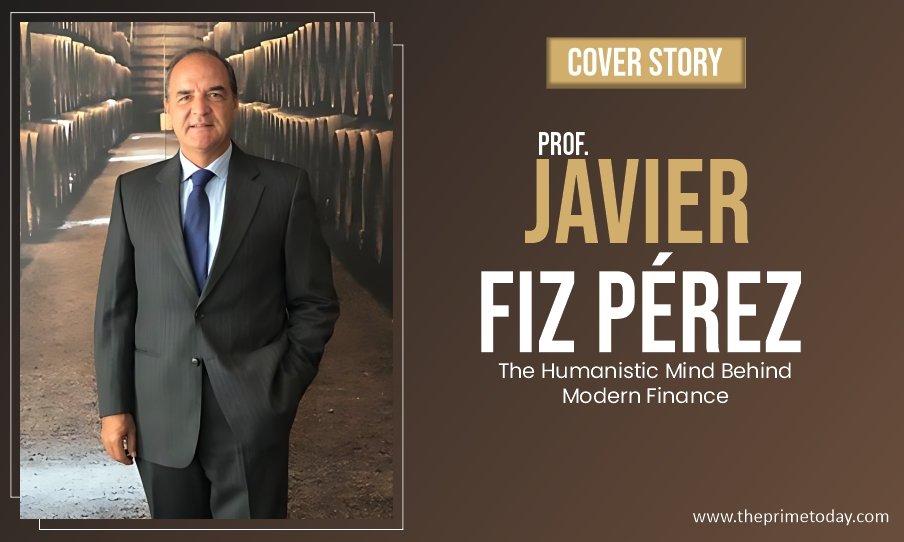
Through diplomacy, research, and executive education, he helps leaders build financial progress that protects dignity and the common good.
The real economy and authentic finance are not ends in themselves, nor are they mere architectures of algorithms and profits, but rather noble instruments at the service of human dignity. Their deepest purpose lies in their ability to generate widespread well-being, transforming capital into concrete opportunities for growth, inclusion, and social development. When finance rediscovers its ethical vocation, it ceases to be a speculative mechanism and becomes the engine that sustains the real economy, protecting savings and inspiring the dreams of future generations. In this vision, the market is not a jungle, but an ecosystem of human relationships based on trust and shared responsibility for the common good.
This is exactly where Prof. Javier Fiz Pérez offers a revolutionary vision by bringing together economic leadership, international diplomacy, and applied ethics into one coherent approach. He is widely recognised as an Architect of Ethical-Economic Strategies, a professional who translates philosophical, bioethical, psychological, and financial thinking into practical models that leaders can apply in real institutional and market environments.
His leadership in finance is shaped by a humanistic foundation. With a background in Philosophy and Organisational Psychology, supported by an EMBA, a Master’s in Finance and a PhD in Social Bioethics, he has developed a framework he defines as Neorealistic Generative Humanism, a bridge between financial practice and ethical market behaviours. It guides leaders to see finance as a real instrument of balance, where investment decisions, risk strategies, and institutional frameworks must reflect both efficiency and humanity. His constant presence at international conferences as a keynote speaker and his wide range of scientific publications are a source of inspiration for other academics worldwide.
Javier’s contribution also extends into European governance and digital transformation, where the future of work and market structures is being redesigned through policy and innovation. Through his engagement with SME Connect EU as co-chair of Emerging Markets and Global Business Trade, being co-founder of the Coalition for Digital Advertising (CDA), and his role as a Fellow expert member for the commission on the transformation of work context, he supports conversations that shape how digital systems influence business, employment, and economic fairness across Europe.
Alongside these institutional mandates, he continues to strengthen his academic impact through international research and leadership in advanced Master’s programmes with the European University of Rome, focusing on integral formation, excellence in education, sustainable welfare systems, business development, human resources and institutional finance. Across every role, Prof. Javier Fiz Pérez stands for one central belief: markets become stronger when leadership protects values, and progress becomes meaningful when it serves people with the same seriousness it serves numbers.
Where Ethics Shapes Economic Power to promote true integral development
Prof. Javier has built his career around exactly that responsibility. He works at the intersection of ethics and economics, using research, institutional engagement, and executive training to help markets behave in a more human way. His core idea, Neorealistic Generative Humanism, is his answer to a world where financial progress often feels separated from values. He does not treat ethics as a soft topic, and he does not treat finance as a cold machine. He treats both as parts of one living system, where decisions shape people, and people shape outcomes.
He is often described as an Architect of Ethical-Economic Strategies, because he takes deep thinking from philosophy, psychology, and social bioethics, then turns it into practical guidance for leaders who need to act responsibly in complex economic and finance realities. That translation ability is what makes him stand out. Many experts explain problems. Fewer people design ways forward. Prof. Javier does the second, and he does it with calm precision.
Academic excellence built on multidisciplinary knowledge, With One Clear Purpose
Some careers grow in a straight line. He did not, and that is exactly why it holds such depth.
His training in Philosophy gave him the habit of asking better questions, the kind that challenge comfortable assumptions and expose what people avoid discussing. It taught him to look for meaning, logic, and moral responsibility inside everyday choices. Over time, that foundation grew into more specialised work through a PhD in Social Bioethics, where he engaged with questions that sit at the heart of modern society: responsibility, health, vulnerability, and the ethical obligations institutions carry.
Alongside that, he built a strong base in Organisational Psychology, which shaped his understanding of how people behave at work, how culture forms inside companies, and why stress and motivation change the quality of decisions. His professional experience as a psychologist and clinical psychotherapist gave this knowledge a sharp sense of reality, because he has seen what pressure does to people when systems demand more than they can sustainably give.
What makes this combination powerful is that it does not stay academic. It becomes practical in the way he speaks about leadership, performance, and the human factor. In his view, progress at work means little if people feel depleted, unseen, or reduced to output alone.
Then comes a part of his profile that gives him strong credibility in the economic world: he holds an Executive MBA and a Master’s in Finance and Institutional Investment Funds. This is where his bridge becomes complete. He is able to read markets as they are, understand the language of investment structures, and speak to executives in terms they respect, while still carrying a deep ethical perspective in every discussion.
This is the essence of his intellectual leadership: a humanistic mind that understands finance from the inside, and a financial professional who keeps moral clarity in view. This vision sees him today very involved and active in the creation and development of investment funds created with the aim of helping businesses and the real economy.
Research focused on social and economic development based on integral formation, with a particular focus on transferable skills.
Prof. Javier’s academic contribution demands a strong message: business success and social well-being grow stronger together, especially when leadership understands human factor and the psychology of work.
His well-known research explores various social issues relating to economic and business development, the integral growth of people and territories, the human factor in the relationship between countries and organizations, the internationalization of business etc. Among other topics, he has also published papers about how financial systems affect people inside organisations, especially in environments where pressure becomes routine.
He has studied psychosocial stress in banking and financial contexts, paying attention to how rapid digitisation, constant performance expectations, and market intensity can quietly reshape the emotional health of workers. This matters because economic progress is often measured through speed and output, yet the cost appears later through burnout, fear-driven decision-making, and loss of loyalty.
Professional life is rewarding when, in addition to the specific skills required for a particular field of work, people have a vision, motivation, and important values in their lives that give meaning to everything they do. The quality of relationships within organizations, together with proactive and stimulating governance, is the basis for a healthy, productive, and innovative working environment, as Prof. Javier often states at international conferences where he participates as a keynote speaker.
This is where his concept of Neorealistic Generative Humanism becomes a real thesis to be explored as a school of thought. It becomes a working method. It supports what he calls integral formation, where professionals are trained to develop technical skill and ethical maturity together. That approach makes leadership more stable, because it produces people who can handle complexity without losing empathy or responsibility.
His academic role demonstrates this mission. As a Professor of Psychology of Organisations and Business Development at the European University of Rome, and as Delegate for International Research Development, he supports work that aims to strengthen professional growth while protecting human value. His experience as an Academic Visitor at the University of Oxford also reflects the international nature of his intellectual presence.
His involvement in scientific direction and institutional research adds another layer. He is connected to research communities and committees that focus on applied psychology, emotional intelligence, integral development, and the relationship between education and real-world practice. In each space, his aim remains consistent: build systems where human strength grows along with economic strength.
He also contributes to training connected to social security and welfare systems through work with Centro Studi e Ricerche Itinerari Previdenziali in collaboration with Prof. Alberto Brambilla, focusing on managerial and ethical aspects of pension funds and welfare funds. This is an area where his thinking becomes deeply practical, because social security is where economics becomes personal for millions of people, shaping how they imagine the future and how safe they feel about ageing, health, and stability.
Global Social Diplomacy as a Modern Form of Leadership
Diplomacy today is no longer limited to international politics. Economic decisions and institutional frameworks now shape societies so directly that diplomacy must include values, welfare, and social protection.
Prof. Javier contributes to this space through his role as Vice-President and Founding Member of the Core Values Association and through Fondazione Forum International being Marco Frattini the President and coworking also with Vincenzo Bassi, (President of the European Federation FAFCE.) Prof. Javier reflects with his work a belief that values must be translated into action, especially when societies face complex challenges like inequality, cultural fragmentation, and unstable trust in institutions. He advances the work of Global Social Diplomacy, supporting a vision where values become part of institutional strategy rather than an added layer. His role reflects a belief that diplomacy is no longer limited to politics alone, because financial systems and social stability are increasingly linked, requiring collaboration that is grounded in responsibility, cultural awareness, and long-term impact.
Fondazione Forum International – “Forum des organisations d’inspiration catholique” operates as an engine for collaboration across organisations, supporting the exchange of knowledge and building a shared voice for social action and institutional influence worldwide and serving countless NGOs operating in good faith, benefiting millions of families across five continents since this area of families is one of his mean focuses. It aims to participate in global conversations where ethical perspectives are needed, and to support an approach where social responsibility remains linked to real decision-making.
Core Values Association focuses for more than twenty years on the transmission of values in the digital age, addressing how communication, education, and finance can support the common good. It connects leaders across different fields and promotes models of development that recognise social responsibility and human dignity as essential, rather than optional. Currently, the Core Values Association is very active in the development of a European Formation and Research Center with an important focus on the historical and current reality of the millennial cultures of the Mediterranean.
Making Ethics Measurable: Values Metrics and the Real Economy
Ethics often struggles to find a place in modern finance because it is seen as a hindrance or limitation rather than a guarantee of true sustainability. Prof. Javier is collaborating with Maurizio Griffoni (President of the Fon.Te pension fund), Enrico Molineri, and Marco Frattini (President of the Core Values Association) on the development and implementation of this metric called “Values Metrics.”
Through the perspective connected to Values Metrics, the focus shifts towards evaluation, measurement, and validation, giving investors and institutions clearer tools to guide decisions towards a more responsible economy. It draws on principles of social doctrine and modern sustainability criteria, aiming to support real-world financial behaviour that values long-term welfare.
This approach becomes particularly important for institutional investors, pension funds, insurance companies, foundations, and welfare funds, because their choices shape the stability of entire communities. The idea is simple but powerful: money must create value in ways that strengthen society, support responsible business, and protect the quality of life.
Sustainability, in this thinking, includes environmental responsibility and social responsibility, recognising that organisations rely on human, relational, intellectual, and social resources. Responsible management means supporting growth, training, respect for needs outside work, and long-term stability for people who make the system function.
This is where his collaboration with UNIAPAC holds strategic value as well. UNIAPAC brings together Christian business leaders across the world, promoting an economy centred on dignity and the common good. For Prof. Javier, this aligns naturally with his belief that business leadership can carry moral clarity while still producing strong performance.
European Governance, Digital Transformation, and the Future of Work
Digital transformation has changed how societies function, and it has reshaped how businesses compete. Yet the digital economy can widen gaps when access, fairness, and responsibility are treated as side issues.
Prof. Javier’s ongoing work with SME Connect EU (Global Business Tread) and the Coalition for Digital Advertising (CDA) reflects his understanding that small and medium-sized enterprises need fair tools to compete, especially when large multinational players dominate the field.
He has taken roles connected to emerging markets, trade, and platform economy discussions, engaging with the transformation of work as a topic that shapes people’s daily lives. His perspective is grounded in a belief that digital tools can support opportunity when guided ethically, and that accessible marketing and communication channels can protect smaller businesses from being pushed aside.
In this European context and in collaboration with Alfonso Montanarini, his work becomes both strategic and human. It is about helping systems evolve while protecting fairness in the market, so that growth remains possible for the many, not only the few.
Neorealistic Generative Humanism
Prof. Javier’s larger philosophy comes alive in the structure of his concept.
- Neo-realism in his work is an honest commitment to reality, especially in an era where virtual perception can distort truth. It is about working with facts, analysing markets carefully, and making decisions that respect limits and consequences. A sound philosophy is necessary as a method for an objective analysis of social, cultural and economic reality.
- Humanism places the person at the centre. It treats dignity as the foundation of every system. It reminds leaders that institutions exist to serve human life, rather than the other way around. The multidisciplinary nature of knowledge, bringing together the social sciences, is the solid foundation for true scientific reasoning.
- Generativity focuses on creating value that lasts. It means building processes that continue growing after the leader steps away. It lives through mentorship, education, institution-building, and choices that create opportunities for others. Integral development is always generative, impacting every territory thanks to the principle of the common good.
Taken together, this vision presents a leadership model that feels grounded and ambitious at the same time. It accepts complexity, respects people, and pushes for progress that carries meaning.
A necessary Bridge for the Modern Economy to always be at the service of integral development.
Prof. Javier Fiz Pérez represents a rare type of leadership, because he moves comfortably between different worlds without losing his identity. He can sit in academic spaces and speak with depth, then step into institutional and market conversations and act with clarity. He defends the role of ethics without turning it into a slogan, and he supports financial progress without reducing human life to numbers.
His work shows that markets can be guided with conscience, that education can shape stronger leaders, and that diplomacy can extend into the economic decisions that touch everyone. In a time when society searches for stability and meaning in leadership, Prof. Javier Fiz Pérez offers a direction that feels both practical and deeply human, creating space for a healthier economy where success and dignity walk side by side.
Read the full magazine edition: Click Here