
Solving the Oldest Puzzle of Multiplication by Zero – Lionel Gustavo Raggio: Presenting CLVN-LRR™ Theorem
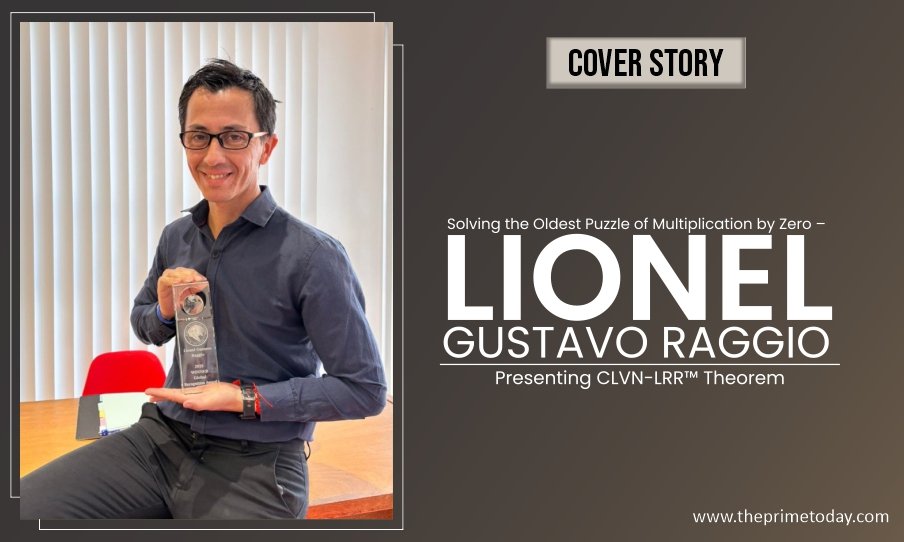
If you are a hardcore mathematician, can you answer this simple question: “When you multiply everything by zero, will you get zero or something else?” Even if you are not a mathematician, you can look at this phenomenon with a simple lens: “Does nothing or void equals zero?” The question is not philosophical. According to Lionel Gustavo Raggio, the question is mathematical. His work centers on the development of original theoretical and mathematical frameworks. Such fundamental questions and limitations in existing scientific models motivated him to formulate the CLVN–LRR™ theorem.
The starting point of Lionel Gustavo Raggio’s work was a conceptual limitation he repeatedly encountered across different scientific domains: the implicit assumption that certain mathematical operations eliminate information completely. The most notable example is multiplication by zero. In classical arithmetic, if a value is multiplied by zero, the result is treated as absolute nullity. However, from an informational standpoint, this raises a paradox. If a quantity disappears entirely, the system has effectively destroyed information, which conflicts with deeper principles observed in physics, particularly those related to conservation and reversibility.
The Mathematical Annihilation
This observation led Lionel Gustavo Raggio to question whether mathematical ‘annihilation’ might actually represent a transformation rather than a true disappearance. The CLVN–LRR™ framework emerged from this inquiry. Instead of interpreting operations involving zero as eliminations, the model proposes that numerical value transitions into a latent state — a compressed domain where the value persists but is not directly observable.
The central idea is therefore not the creation of a new number system, but the introduction of a structural interpretation for how value may be conserved across manifest and latent domains. This reinterpretation attempts to bridge a conceptual gap between mathematics and physical information conservation.
Lionel Gustavo Raggio redefined the concept of zero not as nullity but as compressed, reversible latency. This reinterpretation challenges classical assumptions in mathematics and physics. He explains: traditionally, zero represents absence. In arithmetic, it acts as the additive identity, while in multiplication, it functions as an annihilator. These properties are foundational and remain valid within conventional mathematics.
The Formulation Framework
However, CLVN–LRR™ proposes an additional interpretative layer: operations involving zero may represent transitions between two informational regimes — a causal domain, where values are directly observable, and a latent domain, where values remain structurally preserved but compressed.
Within this framework, the causal domain refers to the conventional mathematical space where quantities appear directly in calculations and observable results. Values in this regime retain magnitudes that participate in arithmetic operations in the usual way. By contrast, the latent domain represents a compressed informational regime in which numerical identity is preserved but magnitudes are scaled to levels that are effectively hidden from standard observation. The distinction therefore lies not in the existence of the value itself but in the scale at which it is represented.
This perspective does not invalidate classical mathematics; instead, it complements it by introducing a conceptual framework that preserves information continuity. In physics, similar ideas appear in discussions of reversible processes, hidden states, and information conservation in quantum systems.
By treating zero as a boundary between manifest and latent information, the model provides a way to reinterpret certain mathematical operations as transformations of state rather than absolute eliminations.
The formulation λ(a) = a · 10⁻¹⁰⁰ introduces an extreme scale of latent value. According to Lionel Gustavo Raggio, the conceptual significance of this scale is significant, and it was very crucial for the internal consistency of his framework. He further explains: The λ operator was introduced as a symbolic compression function representing the transition of a value from the observable domain into the latent domain.
To illustrate this mechanism with a simple example, consider the value a = 5. Applying the operator gives λ(5) = 5 × 10⁻¹⁰⁰. The resulting value is mathematically non-zero, yet so extremely small that it becomes practically negligible within standard calculations. In this interpretation, the value has not disappeared but has transitioned into an informationally compressed state within the latent domain. The operator therefore serves as a formal representation of how numerical value may remain structurally present while becoming effectively undetectable at the observable scale.
The factor 〖10〗^(-100)is not arbitrary but serves a conceptual purpose. It represents an extreme scale difference between the manifest and latent domains. In practical terms, it ensures that latent values remain mathematically non-zero yet effectively negligible within conventional calculations.
This extreme compression mirrors phenomena observed in physics where values may exist beyond current measurement sensitivity. Examples include vacuum fluctuations or extremely small probability amplitudes.
The purpose of such scaling is therefore methodological: it allows the model to maintain mathematical continuity while clearly separating observable magnitude from latent magnitude. In essence, it provides a formal mechanism to encode the idea that information can be present without being directly detectable.
A Principle Extending an Idea
Also, the principle of Latent Conservation of Numerical Value differs structurally from traditional conservation laws used in physics. Lionel Gustavo Raggio clarifies. Traditional conservation laws describe quantities that remain constant within physical systems, such as energy, momentum, or charge. These principles operate within observable physical processes.
The CLVN–LRR™ principle extends this idea to informational structures within mathematical operations. Instead of focusing on physical quantities alone, the framework suggests that numerical value may also follow a conservation principle across transformations between manifest and latent domains.
Structurally, this means that when a numerical operation appears to eliminate value, the framework interprets this as a state transition rather than a loss. The conserved quantity is not necessarily an observable magnitude but an informational identity.
In this sense, CLVN–LRR™ functions more like an informational conservation principle than a traditional physical law.
Domains Appropriate for Immediate Experimental Exploration
Lionel Gustavo Raggio’s work proposes applications across physics, neuroscience, artificial intelligence, cryptography, and economics. He says that among these domains, artificial intelligence and information systems may offer the most immediate opportunities for experimental exploration.
In machine learning research, latent representations are widely used in models such as autoencoders, variational autoencoders, and generative networks, where complex data is compressed into hidden internal spaces that preserve essential information while reducing observable dimensionality. These architectures demonstrate how information can remain structurally encoded even when it is no longer visible in its original form. In this sense, the CLVN–LRR™ interpretation of latent numerical states offers a conceptual parallel to the way modern AI systems manage compressed informational structures.
Modern AI systems rely heavily on compression, representation learning, and hidden states within neural architectures. Latent variables are already central to machine learning models such as autoencoders and generative networks.
The CLVN–LRR™ framework introduces a conceptual interpretation for these hidden representations as reversible informational structures rather than purely statistical abstractions. While the theorem itself remains theoretical, computational systems provide a practical environment where ideas related to latent information preservation can be simulated and tested.
Therefore, AI may serve as a testing ground for exploring how latent structures encode and preserve information across transformations.
Answering Another Question
Although AI might have the answer, one other question emerges. In the context of artificial intelligence, how could symbolic memory and reversible latency transform current approaches to learning, memory retention, or model interpretability? In reply, Lionel Gustavo Raggio says that one of the major challenges in artificial intelligence is the interpretability of learned representations. Deep neural networks often store information in distributed patterns that are difficult to interpret or reconstruct.
The concept of reversible latency suggests that information transformations within AI systems could be designed to maintain structural recoverability. Instead of treating intermediate representations as opaque states, models could be designed to encode reversible transformations between manifest and compressed representations.
Symbolic memory architectures could therefore maintain traceable pathways between original inputs and compressed internal states. This could potentially improve interpretability and enable more transparent learning processes.
While this idea is still conceptual, it aligns with ongoing research in reversible computing and invertible neural networks.
Consciousness as a Structured Phenomenon
Lionel Gustavo Raggio describes consciousness as potentially ‘structured’ rather than emergent. When asked how his theoretical model contributes to this debate within neuroscience and cognitive science, Lionel Gustavo Raggio answers: The debate around consciousness often centers on whether it emerges from complex neural interactions or whether it reflects deeper organizational principles.
“My contribution to this discussion is conceptual rather than biological.” If information structures can exist in latent compressed forms while preserving identity, then consciousness may involve transitions between observable neural activity and deeper latent informational structures.
This does not contradict current neuroscience but proposes a complementary perspective: cognition may involve reversible transformations between different informational states rather than purely emergent processes.
Further interdisciplinary research would be necessary to explore whether such structures correspond to measurable neural dynamics.
Eliminating the Skepticism
Many disruptive frameworks face resistance due to their departure from established paradigms. Lionel Gustavo Raggio is also facing many primary conceptual and philosophical barriers when presenting this work. However, he says that the most resistance has been conceptual rather than technical. Scientific paradigms develop strong interpretative traditions, and ideas that challenge fundamental assumptions — such as the meaning of zero — naturally encounter skepticism.
This skepticism is healthy and necessary. Any theoretical proposal must withstand rigorous scrutiny before it can be considered credible.
The challenge is therefore not opposition but communication: explaining that the framework does not seek to replace existing mathematics but to introduce a structural interpretation that preserves informational continuity.
Scientific progress often begins with conceptual shifts that initially appear counterintuitive.
Ensuring Internal Coherence
Lionel Gustavo Raggio’s publication is now available with an official DOI. Before releasing the work, he says his priority was internal coherence. Any theoretical framework must maintain logical consistency across its definitions, axioms, and derived implications.
The publication therefore focused on three elements: a clear definition of the λ operator, a consistent interpretation of latent value transitions, and the articulation of the conservation principle underlying the model.
Establishing these foundations was essential to ensure that the proposal could be evaluated objectively by the scientific community.
When asked to distinguish between speculative theory and structurally grounded innovation when developing new mathematical or physical models, Lionel Gustavo Raggio says, “Speculation becomes scientific only when it is expressed through formal structure. A hypothesis must define clear assumptions, logical relations, and potential implications.”
In developing CLVN–LRR™, the focus was not on imaginative interpretation but on establishing a mathematical operator and examining its consequences under consistent rules.
The distinction lies in discipline: ideas must be constrained by logical rigor and openness to falsification.
Central to the framework is the structural role of the λ operator itself. Rather than being a purely symbolic notation, the operator functions as the formal mechanism that defines the transition between observable and latent informational regimes. By introducing a mathematically defined compression transformation, the model establishes a consistent rule governing how numerical values may move between these domains while preserving their informational identity.
Grounded in Ethical Responsibility
Ethical dissemination is a recurring theme in Lionel Gustavo Raggio’s work. According to him, there are some major responsibilities researchers carry when proposing models with potentially wide-ranging technological or societal impact. The nature of that responsibility is dual. First, they must ensure intellectual honesty by clearly distinguishing between established results, theoretical proposals, and speculative implications.
Second, they must consider the societal consequences of how ideas are communicated and applied. Scientific models can influence technological development, economic systems, and public perception.
Responsible dissemination, therefore, requires transparency, caution, and commitment to collaborative verification.
Activation of Symbolic Knowledge Network
Lionel Gustavo Raggio references the activation of a symbolic knowledge network (λNet). In practice, he says that λNet is envisioned as a conceptual framework for organizing knowledge structures based on relational patterns rather than hierarchical databases.
Instead of storing information as isolated entries, such a network would represent knowledge as interconnected nodes of meaning, where relationships between ideas become the primary organizing principle.
This concept parallels developments in semantic networks, knowledge graphs, and distributed intelligence systems.
The objective is not to replace existing infrastructures but to explore alternative architectures for representing complex knowledge systems.
Next, while defining scientific progress, Lionel Gustavo Raggio says it should ultimately be measured by clarity and explanatory power rather than institutional affiliation.
Independent research environments often provide intellectual freedom to explore unconventional ideas, while institutional frameworks offer resources and peer review. Both environments contribute to scientific development.
True progress occurs when ideas withstand critical analysis and demonstrate conceptual or empirical value.
Recommendations for Researchers
For emerging researchers interested in foundational theory rather than applied trends, Lionel Gustavo Raggio recommends some intellectual discipline or mindset that he considers most critical. He says, “Foundational research requires patience and intellectual humility. Many breakthroughs arise from questioning assumptions that are so deeply embedded they appear invisible.”
The most important discipline is therefore conceptual clarity. Researchers must be willing to examine basic definitions, challenge implicit assumptions, and explore alternative interpretations without abandoning logical rigor.
Curiosity must be balanced with methodological discipline.
Science advances when imagination and structure work together.
Looking forward, several areas of research may provide opportunities to explore the implications of this framework more deeply. Artificial intelligence offers a computational environment where latent informational structures can be modeled and simulated. Information systems may explore how compressed representations preserve relational structure across transformations. In theoretical physics, the framework raises questions about how informational continuity might manifest in domains that lie beyond current observational limits. While the CLVN–LRR™ theorem remains a theoretical proposal, these directions suggest potential pathways for interdisciplinary investigation.