
Susie Branagan: Consulting in Creating the Most Compassionate Trauma-Informed Healthcare Cultures
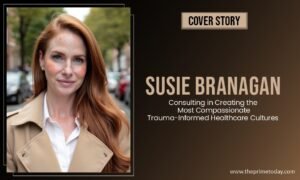
Only with infinite passion can one provide infinite care. Nurses are those ultimate caregivers who provide such unlimited care, whatever the situation or their own personal circumstances are. That is how nursing has always been one of the kindest professions. With such an ultimate caregiving passion, Susie Branagan, BSN, RN, began her nursing journey two-and-a-half decades ago. A registered nurse, she started at the bedside in 2003 (though she began her career as a certified nursing assistant three years earlier in 2000), worked eight plus years in highly acute units, spent 14 years managing adult medical telemetry and ICU units, and then led an inpatient pediatric psychiatry unit. Most recently, Susie served as Vice President of Enterprise Accounts and Clinical Experience at a leading AI company focused on healthcare.
Susie recalls, “I’ve been the nurse holding back tears throughout her entire shift.” The manager: fielding calls at two a.m. on a Saturday with no backup. The executive: watching technology get implemented without any consideration for the humans using it.” Susie’s motivation is simple: she watched too many good nurses leave.
Not because they couldn’t handle the work, but because the systems they worked in were never designed to protect them. “I became obsessed with one question: What would it look like if healthcare actually took care of its people? That question became my life’s work.”
A Leader Risen from Trauma Now Leading Others to Wellness
Today, as the Founder and Chief Executive Officer (CEO) of her own Susie Branagan Consulting, she is putting the most critical issue faced by all of those in the nursing profession to the fore; systemic and systematic apathy leading to emotional vulnerability.
As a 2026 recipient of the International Coaching Federation Scholarship and featured in Influential Women, Susie warns, “Your best nurse just quit. She didn’t tell you the real reason. From bedside nursing to leading inpatient pediatric psychiatry, I’ve watched the pattern repeat: high performers leave quietly, burned out and traumatized, while leadership wonders what went wrong. The answer is psychological safety.”
Erasing the Workplace Trauma
Susie has lived through the burnout and workplace trauma that is breaking the caregiving workforce. That is exactly why she can help you create real, lasting change. Today, she helps healthcare organizations build trauma-informed cultures where staff actually want to stay.
Through Susie Branagan Consulting, she works with:
→ Hospital systems ready to address the root causes of turnover, not just the symptoms.
→ Healthcare leaders who want to create Just Culture environments where speaking up is safe.
→ AI & health tech companies that need clinical insight to implement technology without traumatizing staff.
→ Individuals healing from workplace trauma through 1:1 coaching to rebuild confidence, process what happened, and move forward.
Learning Through the Lived Reality
Today, Susie intuitively recognizes burnout and trauma in high-performing healthcare professionals, she developed this core skill of hers by living the daily reality. She learned to read what people don’t say, the nurse who used to laugh and now just gets through the shift. The high performer whose documentation suddenly slips. The charge nurse who stops advocating for her team because she’s been shut down too many times.
Burnout doesn’t announce itself. It hides behind competence. Trauma hides behind professionalism. Susie has developed the ability to notice the subtle shifts: changes in tone, withdrawal from colleagues, the flat affect that replaces someone’s spark. “I see it because I lived it.”
She has been on every side. “I’ve been the nurse sobbing alone, holding dead children in my arms in the dark, waiting for transport to the morgue, with no one checking on me. I’ve been the manager, taking blows physically and mentally, so that my staff can have a break from an aggressive patient, watching my own health deteriorate while trying to protect my team. And I’ve been the executive in rooms where decisions were made about clinicians by people who hadn’t touched a patient in decades, or ever.”
That full spectrum means Susie never judges. When a clinician tells her they’re drowning, she believes them. When a leader admits they’re failing, she understands why. When an executive says they don’t know how to fix culture, Susie can show them how. She doesn’t offer advice from a distance. She offers it from lived experience at every level.
Fostering Psychological Safety
Drawing from moments when she has seen high performers leave quietly due to unspoken trauma, Susie has cultivated a key talent in fostering psychological safety, creating space for honesty before people reach their breaking point. She would take on any crisis in the hospital regardless of its risk, something Susie later learned would add to her own trauma.
Susie has learned to ask different questions. Not “How are you?” but “What’s weighing on you right now?” Not “Is everything okay?” but “What would make this job sustainable for you?” Today, she creates environments where people can tell the truth without fear. That’s how you keep a solid happy team.
Integrating the Human Element with Technology
To bridge the human element with AI and health tech implementations, Susie’s nursing background enabled her to develop specific skills. “This is where my career comes full circle.” “I spent years managing ICU and telemetry units, watching technology get rolled out with zero consideration for nursing workflow. Then I became the VP of Enterprise Accounts and Clinical Experience at a healthcare AI company. Thankfully, this team got it.”
Susie has seen both sides of the failure. Organizations focus on efficiency metrics and forget the humans who must use the systems. She asks the questions no one else is asking: “How does this change the nurse’s workflow? Does this add cognitive load? Are we creating more documentation burden while calling it innovation?”
Technology should serve clinicians, not traumatize them with extra clicks, redundant tasks, and unclear accountability. Since founding her consulting firm in September 2024, Susie has been helping organizations see the human cost before it becomes a retention crisis.
The Dual Power of Coaching
In this mission, Susie is now leveraging the ICF coaching scholarship to the fullest. In her own words, “The ICF scholarship validated something I already knew: coaching is a clinical skill as much as it is a leadership one. Healthcare workers carry a unique kind of trauma.” “It’s not just what they witness, it’s the moral injury of being unable to provide the care they know patients deserve.”
Susie uses her coaching training to help individuals process that weight without judgment. “We work on rebuilding identity after burnout, setting boundaries without guilt, and deciding whether to stay in healthcare or explore alternatives.” The scholarship sharpened her framework, but her 25 years across bedside, management, and executive leadership gave her the credibility to sit across from a broken nurse and say, “I understand. Let’s figure this out together.”
Rebuilding Confidence in Healthcare Workers
Also, Susie’s expertise in trauma-informed care evolved into a unique skill for rebuilding confidence in healthcare workers who’ve faced systemic breakdowns. She explains that when systems fail, individuals often blame themselves. The nurse who made an error because she was working her third double in a row. The tech who snapped at a patient because no one had relieved him for a break in eight hours. “Do you know how many nurses I’ve managed who have actually had bathroom accidents because they couldn’t get a break?” It’s unacceptable. It’s the actual reality. They carry shame for things that were never their fault.
Susie’s skill is helping them separate personal responsibility from systemic failure. She walks them through what actually happened, what the system failed to provide, and what was within their control. That clarity is the first step to rebuilding confidence. You can’t heal if you’re still carrying blame that doesn’t belong to you.
Nurturing Safest Environments
Susie also applies her leadership talents to create environments where speaking up feels safe, based on her own experiences carrying the weight of broken systems. She models vulnerability first. She shares her own growth opportunities, her own moments of burnout, the times she stayed silent when she should have spoken up. When leaders go first, it gives permission for everyone else to follow.
Susie also makes it structurally safe. Anonymous feedback channels. Regular check-ins that aren’t tied to performance reviews. Debriefs after critical incidents that focus on learning, not blame. Psychological safety isn’t a feeling you hope for. It’s an environment you build intentionally, every single day.
Moreover, the pediatric psychiatry taught Susie that behavior is communication. When a child acts out, there’s always something underneath. The same is true for staff.
When turnover spikes, most organizations look at exit interviews and shrug. Susie looks deeper. “What’s the culture in the unit? How does leadership respond to mistakes? Are staff supported after traumatic events, or are they handed a new admission and told to move on?”
Turnover is a symptom, she says. The root causes are almost always psychological safety failures, moral injury, and leadership that prioritizes metrics over people. “I know how to diagnose those problems and address them at the source,” she assures.
Creating a Safety Network
Furthermore, being part of Influential Women connected Susie with leaders across industries who are doing similar work in different contexts. It reminded her that the fight for humane workplaces isn’t unique to healthcare, but healthcare has some of the highest stakes.
The affiliation gave Susie a broader platform and a stronger network. It also reinforced her belief that women, especially women who’ve been told they’re “too sensitive” or “too emotional,” are often the ones who see what’s broken and have the courage to fix it. “I advocate louder now because I know I’m not alone.” Being sensitive and being emotional are phenomenal traits for a healthcare worker. “All those times I was called too sensitive…. I’ve realized those people only said that because they didn’t have answers, and I was vocal. Showing emotion when advocating is a healthy, normal response. It’s a gift.”
Healing and Supporting Simultaneously
Drawing from her dual perspectives as both staff nurse and manager, Susie learned the talent of processing personal trauma while guiding others forward at the same time. Her own healing doesn’t stop because someone else needs support. “And supporting others doesn’t mean I pretend I have it all figured out.” It means getting rid of your ego and actually crying with staff sometimes when everything has hit the fan. When staff see that you also see things as not okay, they feel safer.
The talent is integration. Susie processes her experiences through reflection, human connection, honesty, and trust. That ongoing work makes me a better guide for others. “I’m not leading from a place of ‘I’ve healed and you can too.’ I’m leading from a place of ‘Healing is ongoing, and we can walk this road together.”
Going Beyond the Just Cultures
Finally, the most important clinical insights and skills that make Susie exceptionally effective at helping healthcare leaders build something better than Just Culture environments that retain top talent. She claims that Just Culture fails when it’s a policy instead of a practice. “I’ve seen organizations claim they have Just Culture while still firing nurses for errors that were clearly system failures.”
Susie’s clinical background means she understands the difference between human error, at-risk behavior, and reckless behavior. She can help leaders analyze incidents without defaulting to blame. She also helps them see what staff see: the impossible patient ratios, the broken equipment, the lack of support after critical events.
Susie helps leaders build that trust through consistent action, not just words on a poster or promises with a hard chocolate chip cookie handed to staff while they’re drowning. When leaders show up with real support, staff stay and remember why they chose this work.
In essence, Susie promises, “I bring solutions born from experience across ICU, medical-surgical, telemetry, pediatrics, and psychiatric departments, AI, and more! I walk alongside you through transformation with deep compassion and genuine understanding. I bring both professional expertise and personal wisdom to every partnership. This work is my calling, born from my own experiences and my unwavering belief that every workplace can become a place of psychological safety! That’s why I understand every dimension of this profession, and why I can help you build something different. Ready to stop losing your best people? Or ready to heal from a workplace that broke your trust? Then let’s connect.”
Read Also: The Operational Partner: How Carmen Potgieter Bridges Corporate Strategy with Flawless Execution