
Turning Hands-On Manufacturing Experience into Customer-Driven, AI-Enabled Automation Leadership
Manufacturing has always been about more than machines, output, and efficiency. It’s about people—on the plant floor, in engineering teams, and across the communities that depend on manufacturing to thrive. When manufacturing slows, the impact is immediate. When it improves, confidence returns. Not through slogans, but through operations that run better day after day.
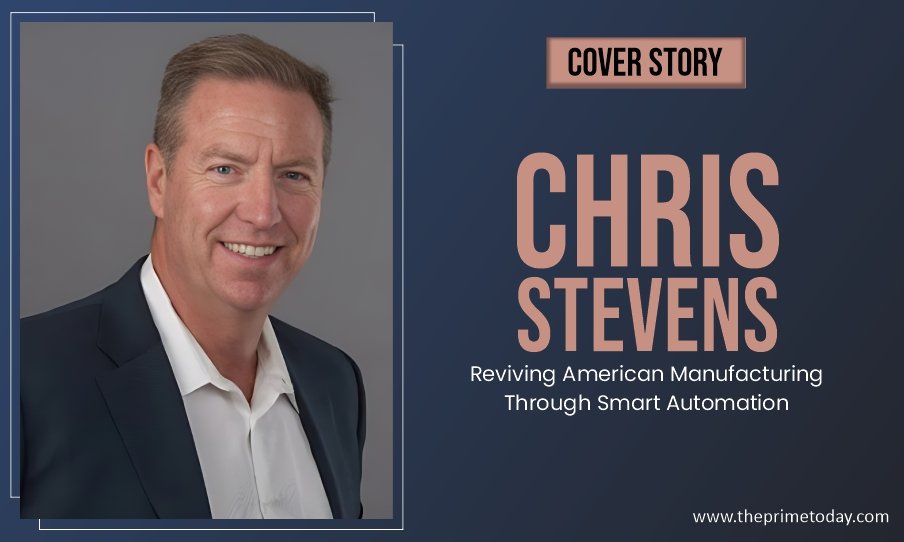
That perspective is personal for Chris Stevens, President of US Automation at Siemens Digital Industries.
Growing up in Detroit, he saw how manufacturing shapes a city’s identity and how deeply it matters to the people who rely on it. Today, that experience informs how he thinks about leadership: progress only counts if customers can feel it: in performance, in reliability, and increasingly, in how intelligently their systems respond.
Learning the Business Where It Actually Runs
Chris’s career began on the plant floor, testing equipment and working directly with machines. That early experience taught him something that no strategy deck can replicate: manufacturing is run by people solving problems in real time, often under pressure, with little margin for error.
It also built an appreciation for reliability and decision quality. One delay, one bad assumption, or one system that doesn’t behave as expected can ripple across an entire operation. That reality shapes his view of automation and AI today. Technology has to help people make better decisions faster, not add complexity or risk.
Automation, AI, and the Customer Experience
Today, Chris works closely with manufacturing-led customers who want more than advice. They want outcomes: higher throughput, better quality, safer operations, and the ability to adapt quickly when conditions change.
For him, automation and AI are inseparable. Automation provides consistency and scale. AI provides intelligence—helping systems learn, predict, and respond instead of simply executing predefined logic. Together, they change the customer experience from reactive to proactive.
“The fun part of this job is understanding what customers are really trying to solve, working alongside them, and seeing improvements show up where it matters—on the plant floor and in day-to-day decisions.”
Success isn’t measured by how advanced the technology is. It’s measured by whether customers can recover faster from disruptions, anticipate issues before they happen, and run operations with greater confidence.
Why Digital Transformation—and AI—Still Feel Personal
Digital transformation can look like a long-term initiative on paper. In practice, it’s deeply personal for the people living with the results every day.
What drives Chris’s commitment to digital transformation is its ability to improve both external outcomes for customers and internal execution for teams. AI plays a central role in that shift. Internally, it helps teams move faster, reduce manual effort, and focus on higher-value work. Externally, it enables customers to operate with more insight, agility, and resilience.
Chris enjoys working across all levels of an organization—from operators to executives—because AI only delivers value when people understand how it supports their role. The goal isn’t to impress with technology, but to make work easier, decisions clearer, and outcomes more predictable.
Software, AI, and the Shop Floor Converge
Manufacturers now expect the speed and adaptability of software across their operations. But speed alone isn’t enough. The real value emerges when software, AI, and automation are tightly integrated with the physical systems running production.
AI amplifies that integration. It connects data across machines, lines, and facilities, turning signals into insights and insights into action. When software, AI, and automation work together, customers move from hindsight to foresight—anticipating issues instead of reacting to them.
That convergence has reshaped how Chris thinks about the future. The manufacturers who get this right won’t just optimize processes, they’ll fundamentally change how they operate.
Adaptive Production, Powered by Intelligence
Customers are clear about what they need next: production systems that adjust faster, respond intelligently, and reduce friction without constant manual intervention.
Adaptive and increasingly autonomous production is being driven directly by customer demand. AI is what makes that adaptability real—learning from patterns, optimizing in real time, and helping systems respond to variability without stopping the line.
Helping customers accelerate this transition is motivating because the benefits are immediate: faster changeovers, improved quality, and greater resilience in the face of uncertainty.
Delivering Value Now, While Building for What’s Next
Every transformation effort has to balance near-term results with long-term sustainability. AI doesn’t change that tension—it makes it more important to get right.
Chris emphasizes flexibility and meeting customers where they are. AI solutions must work within today’s constraints while creating a foundation for future capability. That often means starting small, proving value quickly, and scaling intelligently.
He also focuses on structuring partnerships that reduce risk and support adoption. AI should earn trust through outcomes, not ambition.
Innovation With Guardrails
Innovation isn’t about chasing every new idea. It’s about creating conditions where teams can move quickly and accurately.
Chris views innovation through people, process, and technology. AI accelerates execution, but only when clear processes provide guardrails and people understand how to use it effectively. His role is to align teams, set expectations, and trust them to deliver.
AI as a Multiplier, Not a Feature
Industrial AI is no longer optional. It raises expectations across the organization.
For customers, AI connects data to action—closing the gap between analysis and execution. For internal teams, it augments expertise, reduces manual work, and enables better decisions at scale.
When AI is embedded across operations instead of isolated in pilots, it becomes a multiplier—compounding improvements over time rather than delivering one-off gains.
IT/OT Convergence, Validated Through AI
IT/OT convergence enables AI to work at scale. At Siemens, solutions are validated internally before being brought to customers.
At the Bad Neustadt factory in Germany, shop floor data from machines, sensors, controllers, and testing systems is integrated with IT systems for analytics and decision-making. AI helps transform that data into actionable insights—improving quality, optimizing cycle times, and enabling more targeted energy monitoring.
The result is a more flexible, data-driven operation that adapts quickly to customer requirements.
Tools That Augment People, Not Replace Them
Digital-native talent expects tools that are fast, intuitive, and supportive. AI-driven workflows are increasingly handling routine tasks, freeing teams to focus on higher-value, creative work.
The opportunity isn’t replacing people—it’s amplifying them. As agentic AI matures, it will feel less like traditional software and more like a trusted partner in daily work.
What “Second to None” Looks Like in an AI Era
For Chris, being “second to none” comes down to behaviors. Collaboration, curiosity, and accountability matter even more in an AI-enabled environment.
When teams trust the data, use AI responsibly, and maintain process discipline, performance becomes repeatable. Over time, those behaviors create outcomes customers can rely on.
Meaningful Work Drives Sustained Performance
Strong performance requires people to see the impact of their work. Chris focuses on helping teams understand how their contributions—supported by automation and AI—drive customer success.
That connection builds ownership, energy, and pride in the work.
The Digital Twin and AI: Confidence Before Execution
The next era of industrial transformation will reward companies that can predict outcomes before execution and reduce risk before change happens.
Siemens’ comprehensive Digital Twin, enhanced by AI, connects the physical and digital worlds. Manufacturers can design, simulate, and optimize products and production systems before making changes on the shop floor.
That combination delivers fewer surprises, faster validation, and smarter decisions. As Digital Twin technology and AI continue to mature, manufacturers gain clarity, confidence, and control—turning uncertainty into advantage.