
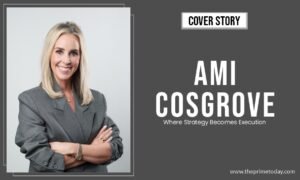
Ami Cosgrove: Where Strategy Becomes Execution
Every growing organisation reaches a point where ambition alone is no longer enough. Expanding into new markets, embracing digital transformation, responding to evolving customer expectations, and managing increasing organisational complexity all demand leadership that combines strategic vision with disciplined execution. The organisations that sustain long-term success are those that continually evolve their operating models, strengthen governance, empower their people, and build the capabilities needed for future growth.
Ami Cosgrove, Chief Operating Officer at Ektis, has spent nearly two decades leading enterprise transformation across digital, data, operations, and organisational strategy. Her career has been shaped by helping businesses navigate complex change, design scalable operating models, and align people, technology, governance, and commercial priorities to deliver lasting impact. Today, she brings that breadth of experience into executive leadership, where strategy is translated into tangible organisational capability, enabling businesses to grow with resilience, confidence, and purpose.
What sets her approach apart is the belief that leadership is not measured by the number of initiatives launched, but by whether those initiatives become part of the organisation’s everyday way of working. Whether she is establishing a data function, stabilising finance and recruitment operations, embedding AI responsibly, or developing performance and learning frameworks, her work is guided by a clear purpose: building organisations that are disciplined, trusted, and deeply human.
The Strength Behind Sustainable Growth
Enterprise transformation is about far more than implementing new technologies or introducing ambitious strategies. It requires organisations to align people, processes, governance, data, and leadership behind a shared vision for growth.
The strongest organisations are those that continually evolve, balancing innovation with disciplined execution while building the resilience to adapt to changing markets.
Throughout her career, Ami has helped organisations navigate complex transformation by bringing together strategic thinking with practical delivery. Her experience across digital, data, and enterprise change has shaped a leadership approach that focuses on creating sustainable capability rather than short-term success.
Whether leading transformation programmes or strengthening organisational performance, she believes lasting impact comes from building businesses that are adaptable, accountable, and prepared for the future.
From Advising Transformation to Building the Organisation
Ami spent almost seventeen years at PwC, leading large-scale transformation programmes across digital, data, and business change. Working alongside organisations navigating growth and disruption gave her a deep understanding of how strategy, technology, people, and governance must work together to create meaningful business outcomes. Over time, however, she wanted to move beyond advising transformation to becoming directly accountable for delivering it.
Joining Ektis as Chief Operating Officer provided that opportunity. Rather than supporting organisational change from the outside, she became responsible for helping build and scale the business itself. Her role has involved strengthening the organisation across multiple dimensions, including finance, technology, governance, risk, operational processes, and leadership capability, while creating the structures needed to support sustainable growth. Bringing these interconnected functions together has reinforced her belief that successful organisations are built through alignment, where people, systems, and strategy evolve together rather than in isolation.
Her experience has reinforced that sustainable transformation depends on alignment rather than individual functions working in isolation. When strategy, people, technology, governance, and culture move in the same direction, organisations are far better positioned to adapt, innovate, and grow with confidence.
Governance That Enables Innovation
Governance is often viewed as a mechanism that slows organisations down, but Ami sees it differently. She believes governance creates confidence by providing clarity around decision making, accountability, and risk, allowing people to innovate safely and quickly.
The most innovative organisations she has worked with are often some of the most disciplined. Strong governance does not need to feel restrictive. Her philosophy is to make it easy for people to do the right thing. When governance is designed well, it becomes almost invisible, supporting progress rather than getting in its way.
The Real Test of Rapid Growth
Periods of rapid growth often reveal where organisations need to evolve. As businesses expand, leadership structures, decision-making processes, technology platforms, and operational frameworks must mature alongside them. Ami believes sustainable growth depends on anticipating those needs before they become constraints.
Her experience has shown that scaling successfully is not simply about increasing capacity; it is about building organisational capability. Investing early in leadership development, strengthening cross-functional collaboration, and creating systems that allow people to perform consistently enables businesses to remain agile while maintaining high standards. For Ami, growth is most successful when the organisation becomes stronger as it becomes larger.
One principle has remained consistent throughout her career: if the culture is wrong, technology will not save the organisation. That belief continues to shape the way she approaches operational leadership and long-term growth.
What High-Performing Teams Have in Common
Ami believes that high performing teams are not created through annual values campaigns or motivational slogans. They are shaped by the everyday behaviour of leaders and the standards they consistently uphold.
In her experience, people pay close attention to what leaders reward, what they tolerate, and how they respond when pressure rises. She believes it is entirely possible to maintain high standards while leading with empathy, and that the strongest leaders are those who manage to do both at the same time.
Creating an environment where people feel safe to challenge ideas and learn from mistakes is equally important. She sees continuous improvement as a product of curiosity rather than fear, and believes that teams perform at their best when they are encouraged to question, adapt, and grow together.
Driving Transformation Through Technology
As Chief Operating Officer, Ami sees herself at the point where strategy becomes execution, making the role uniquely positioned to lead digital transformation and AI adoption.
Her approach is grounded in practicality. Technology should solve real business problems rather than exist because it is fashionable. She views artificial intelligence as a significant opportunity to remove repetitive work and give people more time for judgement, creativity, and meaningful relationships.
She is equally clear that AI cannot deliver value without trusted data and strong governance. In her view, weak foundations simply lead to faster mistakes. The organisations that will lead in the coming years will be those that combine human judgement with machine intelligence responsibly.
A Broader View of Success
Financial results remain important, but Ami considers them lagging indicators rather than the full picture of operational success. She pays close attention to employee engagement, retention, recruitment quality, delivery performance, operational efficiency, customer satisfaction, and risk indicators. One measure she believes is often overlooked is trust.
When people trust leadership, understand the organisation’s direction, and collaborate across functions, strong performance tends to follow naturally. Trust, in her view, is one of the most reliable indicators of a healthy organisation.
Resilience Through Consistency
Early in her career, Ami believed that great leaders were those who always had the answers. Experience has changed that perspective. She now believes that the best leaders ask better questions. Completing the London Marathon reinforced that lesson in a personal way. Preparation and hard work matter, but even with both, the journey can still be difficult.
Leadership, she believes, follows a similar pattern. Resilience comes from consistency rather than perfection, and people rarely remember a project plan in detail. What they remember is how a leader made them feel when uncertainty arrived.
The Hallmarks of Effective Leadership
An exceptional Chief Operating Officer combines strategic thinking with relentless execution, but Ami believes the defining characteristic is something deeper.
The strongest COOs build organisations that do not depend on them. If every important decision still requires the COO to be in the room, the organisation has not truly become scalable. Creating capable leaders, clear accountability, and systems that function independently is what separates operational management from operational leadership.
Advice for the Next Generation of Leaders
Curiosity sits at the centre of Ami’s advice to aspiring leaders. She encourages them to seek breadth as well as depth and to remain open to opportunities across industries, countries, and disciplines.
Many of the most valuable lessons in her own career came from stepping into unfamiliar environments. She believes that consistent delivery, humility, and a commitment to continuous learning remain timeless leadership qualities. One phrase continues to guide her approach: being useful never goes out of style.
Planning for Tomorrow
Ami believes effective leadership begins with a clear understanding of where an organisation wants to be in the future and the capabilities required to get there. Whether shaping operating models, strengthening leadership capability, or embedding digital and data-driven ways of working, she focuses on creating organisations that are prepared for tomorrow’s opportunities rather than simply responding to today’s challenges.
Her approach has evolved throughout her career. Experience has reinforced that sustainable growth is never the result of one leader alone. It comes from building capable teams, establishing clear accountability, and creating an environment where people are empowered to make decisions with confidence. When organisations invest in these foundations, transformation becomes continuous rather than reactive.
A Legacy of Stronger Organisations
When Ami reflects on the legacy she hopes to leave, it is not defined by a single programme, technology implementation, or operational achievement. She hopes to be remembered for leaving organisations stronger than she found them by helping build cultures where governance enabled innovation, people were trusted to do great work, and future leaders were given opportunities to thrive.
The legacy she values most is seeing people she has worked with go on to achieve more than she ever has. In her view, leadership is ultimately about creating opportunities that continue long after the leader has left the room.