
A Different Path to Student Success 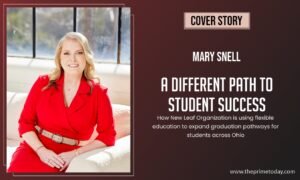
How New Leaf Organization is using flexible education to expand graduation pathways for students across Ohio
Education has long been considered the foundation for opportunity and future success—but when students disengage from school, it raises an urgent question: what must change to bring them back?
Mary Snell, Co-founder and Chief Executive Officer of New Leaf Organization, has dedicated her career to confronting that very question. Through New Leaf Organization’s work empowering Buckeye Community Schools across Ohio, Mary Snell and her team have built a model that removes barriers and restores opportunity for students who might otherwise fall through the cracks. By combining flexibility, accountability, and a deep belief in each student’s potential, New Leaf demonstrates how mission-driven leadership can reshape educational pathways and expand opportunity for students.
At the center of this work is a leadership philosophy grounded in belief—belief in students, belief in second chances, and belief that education can evolve when schools are willing to change.
Today, Buckeye Community Schools serve students across several Ohio communities, including Fremont, Lima, London, Mansfield, Marion, Springfield, and Tiffin.
Witnessing the Power of True Belief
The beginning of Mary Snell’s two-decade leadership journey happened when her entry into education at the London Academy ‘really turned out to be a jumpstart into leadership.’ In her own words, she was given so much responsibility that she quickly saw how much thoughtful organization and steady direction could shape a student’s experience. “I witnessed the power of being truly seen and how belief, empathy, and encouragement can change a young person’s trajectory.”
The relationships Mary Snell built with students during that time affirmed that she was exactly where she was meant to be. Learning the skill to see the story behind each student has guided every decision she has made since, Mary Snell explains. She adds, “It has influenced how we develop our teams, design our programs, and build schools where every student can succeed on their own terms.”
The Spark That Ignited Mary Snell’s Spirit
With over 20 years of experience in launching and managing seven successful dropout prevention and credit recovery community schools in Ohio, the initial spark that ignited Mary Snell’s passion for helping at-risk students earn their high school diplomas was the question of “Why would anyone drop out of their school?”
In answer, Mary Snell explains that what she has learned over the years is that students often carry challenges you’ll never fully grasp unless you take the time to sit with them and listen. On the surface, their struggles may look like apathy or disengagement, but meaningful conversation reveals much deeper stories. Many students have experiences with instability or systems that simply didn’t make space for who they are.
Hearing firsthand why traditional education failed to meet some students’ needs completely changed Mary Snell’s perspective and ignited a deep commitment to creating learning environments that remove obstacles rather than create them. She set out to build spaces rooted in empathy, flexibility, and opportunity—places where students’ lived experiences are acknowledged and their potential is cultivated.
A Perspective Deeply Grounded in People
Coming into education from a nontraditional path gave Mary Snell a perspective deeply grounded in people, not just systems. If you don’t intentionally build an environment where students and staff feel valued and understood, no curriculum will truly work, she insists.
Her real-world experiences taught her to see individuals holistically. Students arrive at school as sons and daughters, employees, parents, caregivers, and young people carrying stories that shape how they show up each day.
Academics matter deeply, but they cannot be separated from social-emotional well-being. She adds, “That’s why our model integrates mental health support, housing, and resource assistance.”
At the core, Mary Snell and her team’s approach is about meeting students where they are and building upward from there. When students feel supported and respected, they begin to rethink what’s possible for themselves, Mary Snell reflects.
Rewriting the Future
Over the years, Buckeye Community Schools, empowered by New Leaf Organization, has helped more than 5,500 students earn their high school diplomas.
Yet one of the first students Mary Snell worked with remains etched in her memory even decades later. Reflecting on that experience, she recalls, “The student was a young woman returning to school after becoming a mother. She wasn’t just trying to earn a diploma; she was trying to rewrite the future for herself and her child at the same time. Her desire for greatness inspired me to continue this path and help other students realize their potential.”
The evolution of supportive, individualized learning plans today has its roots in the innovative strategies Mary Snell introduced while designing the original computer system to track student progress. As she explains, “The system grew out of a gap I kept running into. At the time, most tools available assumed students moved through school in predictable ways, but that assumption did not reflect the reality of the students or the structure of our curriculum.”
Helping Students Turn a New Leaf
Recognizing that students often progress through their education at different paces and under different circumstances, Mary Snell designed the initial computer system to track student progress more effectively.
Instead of expecting students to follow a rigid structure, the platform allows educators to see how each student is progressing and where additional support may be needed.
Over time, that initial system evolved into a central part of how New Leaf operates today. It helps staff identify early warning signs and adjust learning plans as circumstances change, and remain both informed and accountable for each student’s progress. For Mary Snell, the real value of the platform lies not in the technology itself, but in the visibility it creates. “When you can see students clearly, you’re far less likely to lose them.”
Beyond systems and data, Mary Snell has cultivated a positive, high-achieving school culture that motivates both staff and students, particularly within challenging environments such as dropout prevention and credit recovery programs.
Mary Snell shares, “To remain motivated, we must think outside of the box and step into unorthodox ways to teach and learn. I believe flexibility is the foundation of equity.” This means literally meeting students where they are, whether that involves instruction at their workplaces or extending school hours to fit their schedules. Every student deserves to be offered an option that fits their needs.
Growing Leaders from Within
Alongside their work with students, New Leaf places strong emphasis on investing in its staff. Through ethics training and community engagement initiatives, team members develop a deeper understanding of the purpose behind the work and the impact it has on students and communities. Supporting staff development creates opportunities for strong, mission-driven leaders to emerge from within the organization.
Equally important are the relationships built throughout the school community. When students and staff feel genuinely supported and valued, it creates an environment where people are more willing to persevere through challenges. Knowing that New Leaf values and invests in its staff often provides the encouragement needed to keep striving toward success.
Designing Education Around Students
To adapt to the changing needs of today’s students, New Leaf offers tailored programs designed for those whose circumstances or learning styles were not well served by traditional models—creating a different path for students to move forward and succeed. Mary Snell explains that many traditional schools measure progress through seat time and standardized benchmarks—approaches that can sometimes overlook the realities many students face outside the classroom.
This understanding shaped the design of New Leaf’s model from the beginning, she explains. “Our student-centered model aligns education with real life through flexible scheduling, personalized learning plans, workplace-based instruction, and industry-recognized credentials. Community partnership is a cornerstone of this success. We collaborate with community employers to discover the job needs for their area, then develop academic and career opportunities for students to gain real-life employable skills.”
Academically, students advance through a demonstrated mastery model, requiring at least 75 percent proficiency to ensure deep understanding. This model is supported by rigorous, state-aligned assessments that prepare them for success beyond graduation.
Prioritizing Postsecondary Readiness
Furthermore, New Leaf offers multiple graduation pathways such as traditional diplomas, college credit plus, and career technical credentials. When asked what inspired them to prioritize postsecondary readiness in every student’s plan, Mary Snell shares that their goal is to ensure students are truly prepared for life beyond the classroom. When education fails to equip students for real-world success, it falls short of its purpose. “That belief drives our hands-on offerings, including automotive programs that lead to practical skills and career pathways. We also operate school-based greenhouses and grow towers, where students gain experience in entrepreneurship, healthy living, and community engagement by hosting monthly markets and providing fresh produce to communities.”
Leading with Conviction
Mary Snell’s journey into education did not follow a conventional path, yet her leadership has helped guide New Leaf Organization to measurable results, including earning an exemplary designation in Ohio. Reflecting on the lessons that shaped her approach, she explains:
“I was raised with a strong work ethic and a deep belief that every person brings value to the table. Those lessons helped me recognize that, regardless of my nontraditional background in education, the transformation I envisioned was both necessary and achievable. I have learned to remain open-minded and not let fear or opposition deter me from building something bold. My ideas were questioned at every step, but the measurable impact on students and New Leaf’s continued growth ultimately spoke for itself.”
Balancing Systems and Students
Next, keeping the focus on the human element of disenfranchised learners while balancing expertise in student enrollment, data management, and school operations is not a simple task. Mary Snell agrees. Balancing those responsibilities starts with remembering that systems are tools and not the mission. At New Leaf, data is used to illuminate students’ stories, not reduce them to numbers.
Mary Snell explains, “That balance is also possible because I don’t do this work alone. I’m surrounded by a team that brings deep expertise alongside shared values. We challenge one another to stay aligned with our purpose, ensuring that efficiency never outweighs empathy. Ultimately, keeping students at the heart of the work is a daily choice.”
Reaching as Many Students as Possible
Looking ahead, Mary Snell says that her personal motivation drives her dedication to expanding opportunities through New Leaf, and she envisions its role as an asset to Ohio communities. In her own words, she is determined to achieve the goal of reaching as many students as possible. “Helping build strong communities across Ohio has been deeply meaningful, and I know there is still important work ahead. I want to share our blueprint and demonstrate how this model can be successfully implemented elsewhere.”
Her vision is to build a scalable, replicable model that demonstrates how education can heal, empower, and prepare students to thrive on their own terms. When asked what advice she would offer to aspiring leaders in education reform, Mary Snell reflects:
“Let your decisions be guided by the students you serve. Offer your perspective, challenge assumptions, and don’t shrink from change simply because it’s uncomfortable. When your work is grounded in purpose, persistence matters more than approval. Stay anchored in what drives you and trust that real impact reveals itself over time.”