
India’s World-Renowned Quantum Researcher – Sanjukta Roy: Cultivating Excellence through the Power of Scientific Temperament and Human Connection
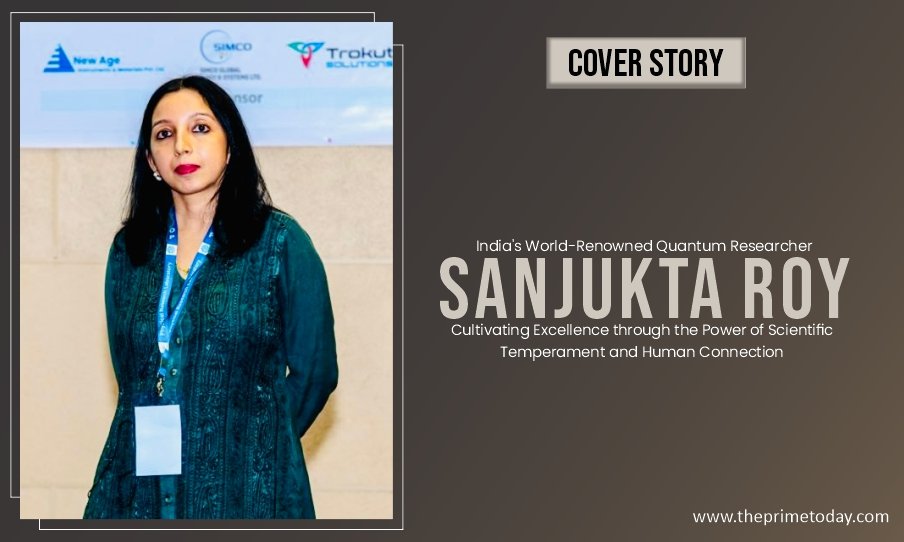
Is everything possible? If you ask this question to the majority of people, they might not answer it positively. But not Sanjukta Roy. She is an Associate Professor II at one of the most prestigious Raman Research Institute, Bangalore. Sanjukta, with her scientific temperament, is pursuing some of the most fundamental questions of Quantum research and finding out answers leading to the practical implementation of Quantum mechanics.’ Thus, she is not only proving every day that ‘nothing is impossible,’ but she is also making India proud due to her many groundbreaking discoveries and scientific achievements.
A Scientifically Learned Leader
Sanjukta Roy did her MSc in Physics from JNU, Delhi, and PhD from the Tata Institute of Fundamental Research, Mumbai. During her PhD, she realized the first Bose-Einstein Condensate (BEC) in India in 2007, along with her colleague Saptarishi Chaudhuri and her PhD supervisor Prof. C. S. Unnikrishnan. This achievement was highlighted in the media, and Sanjukta Roy also received a letter of appreciation from the Prime Minister of India for indigenously realizing the first Bose-Einstein condensate in India.
Thereafter, Sanjukta Roy did her Post-Doctoral Research in the Lab of Nobel Laureate (Physics, 1997) Claude Cohen-Tannoudji in Paris at Laboratoire Kastler Brossel, Ecole Normale Supérieure, where she worked on a metastable Helium BEC experiment. Sanjukta recalls, “There, I could work near pioneers in my field of research, which deeply motivated me to take up important yet challenging areas of research in my career.” She did her second Post-Doc at the European Laboratory for Non-Linear Spectroscopy in Florence, Italy, where Sanjukta Roy worked on the Potassium BEC experiment, specifically on few-body physics and Anderson localization in disordered potentials which led to publications in leading physics journals such as Physical Review Letters and Nature Physics. After joining the Raman Research Institute, Sanjukta has built an experiment on ultra-cold Rydberg atoms and realized Rydberg excitation in ultra-cold atoms for the first time in India. She works on Quantum Computation, Quantum Sensing, and Quantum Simulation of Many-body Physics with ultra-cold Rydberg atoms.
A Mindset of Focused Discovery
A term coined by India’s first Prime Minister, Jawaharlal Nehru, who also enshrined it in Article 51A of the Indian Constitution, ‘Scientific Temperament’ has been accepted worldwide as a universal and one of the most essential phenomena of modern human life. It is a mindset where only logical, rational, and evidence-based thinking holds true. This optimistic mental attitude is forever open-ended. A scientifically tempered person, like Sanjukta Roy, is always motivated by the innate curiosity of finding out answers to the most fundamental questions like ‘what is the universe?’ and ‘How energy and matter at atomic and subatomic scales behave?’, and ‘how everything works the way it is working?’
When finding answers to these questions, classical physics fails. That is why we need Quantum mechanics. Today, a highly motivated Sanjukta Roy is finding answers to these questions by exploring the Quantum realm. She credits her parents for inculcating this powerful motivation to pursue scientific research in her. “My mom and dad placed great importance on my education and encouraged me to pursue higher education, providing full support. This played an important role, which enabled me to pursue academics and research as my career. From my childhood, I was very fascinated with Scientists and their vital role in the progress of humankind. This also motivated me to pursue a career in scientific research,” she shares.
A Spark of Inspiration in Paris
For Sanjukta Roy, the dream of becoming a scientist began as a childhood fascination with those who move humanity forward through discovery. Supported by a family that valued education above all else, she pursued a life of research with deep enthusiasm. However, the moment that ignited her passion for leadership, transforming her from a dedicated researcher into a passionate leader, occurred far from her home. While conducting post-doctoral research in Paris, she attended a scientific workshop at the Collège de France honoring Nobel Laureate Prof. Serge Haroche, on the occasion of his 65th birthday. Sanjukta Roy recalls that eminent Scientists all over the world, whom Prof. Serge Haroche had mentored or collaborated with, gathered together to honour him. “This deeply motivated me to take on a leadership role and mentor future leaders,” says she, seeing that the true impact of a scientist is measured not just by their own findings, but by the leaders they help create. This experience planted a seed of purpose within her. She realized that she wanted to do more than solve equations; she wanted to lead by example and guide the next generation of thinkers.
Leading Through Action and Trust
Sanjukta Roy believes that true leadership is never about giving orders from a distance. Instead, she chooses to show the way by being in the trenches with her team. In her own words, “I am not afraid to take up new challenges and explore new directions. I believe in showing the way and leading by example instead of giving orders.” She is quite approachable by her team members, and she always encourages open communication in the team. By staying approachable and encouraging open communication, she has built a team culture where trust is the primary foundation.
Moreover, Sanjukta Roy always motivates her team to succeed in tough situations and build trust among them. She also carries a strong sense of accountability for every decision her team makes. She adds, “I am fully accountable and always take full responsibility for my decisions and my team’s performance, while giving my team members well-deserved recognition for the team’s success.” This balance of humility and responsibility creates an environment where everyone feels safe to innovate and push boundaries.
Breaking New Ground in Quantum Technology
Challenges test the mettle of every leader. Sanjukta’s case is no different. Early in her leadership role, she faced several challenges in building up her Experimental system to explore Quantum technology with ultra-cold Rydberg atoms. On several occasions, technical hurdles prevented the system from working as expected. However, her students and Sanjukta Roy were always motivated and tried to overcome the hurdles with patience and enthusiasm. Their perseverance and refusal to give up led to the successful realization of Rydberg excitation in ultra-cold atoms for the first time in India, opening important avenues for exploring Quantum Technology using the versatile platform of ultra-cold Rydberg atoms in our country. This experience taught her that strength in leadership often comes from acknowledging struggles openly while staying anchored to a shared goal. By sharing her own stories of past failures, she helps her team build the resilience needed to face the unknown.
The Evolution of Empathy and Influence
Over the last ten years, Sanjukta Roy has seen her approach to leadership undergo a profound change. In her early days as a researcher, she focused primarily on tasks and the technical accuracy of her experiments. However, as she spent more time guiding others, she realized that the most productive work happens in a flexible and collaborative environment. Her philosophy shifted from merely checking boxes to fostering an atmosphere of empathy and inclusivity. She now places a much higher value on mentoring her students and empowering them to take ownership of their own discoveries.
She understands that building a team is not about finding identical minds but about identifying the unique strengths of every individual. Sanjukta Roy makes a conscious effort to spot the hidden talents in her team members and offers them full support to reach their full potential. By connecting each person to their specific purpose within the project, she creates a sense of belonging. She ensures that trust is maintained by providing equal opportunities for growth and by recognizing the personal milestones of every student and colleague. “A leader is successful only when every member of the team feels they have a path to grow. My role is to recognize their unique talents and provide the support they need to shine in their own way.”
Finding Balance Through Peace and Discipline
Maintaining effectiveness in a high-pressure field like quantum research requires a dedicated personal routine. Sanjukta Roy starts every morning with yoga and meditation to ground her thoughts. Living and working at the Raman Research Institute provides her with a serene backdrop for reflection. She often takes long walks around the campus, which is filled with vibrant greenery and colorful flowers. This peaceful atmosphere helps her clear her mind and prepares her for the complex scientific questions of the day.
Beyond her spiritual practices, she is a firm believer in meticulous planning. She manages her time with great care, ensuring that every hour is used effectively to balance her own research with her duties as a mentor. This discipline allows her to stay steady when facing the uncertainty of experimental physics. When her team hits a wall, she is not afraid to show her human side. She listens to their concerns and shares her own past struggles to show them that failure is simply a part of the learning process. “I share my own stories of overcoming hurdles because I want my team to know that resilience is built through struggle. We stay anchored in our goals by acknowledging where we are and then moving forward together,” says Sanjukta Roy while pushing the boundaries of what is possible with Rydberg atoms, and she remains a guiding light for those around her. She is constantly looking for ways to improve her own leadership and to make the lab a place where innovation feels natural and supported.
The Legacy of the Laboratoire Kastler Brossel
Sanjukta’s perspective on leadership was forever altered during her time at the Laboratoire Kastler Brossel in Paris. It was there that she observed the profound influence of her mentor, Prof. Claude Cohen-Tannoudji. She watched a man who had not only made pioneering contributions to physics but had also cultivated a garden of brilliant minds. Seeing that his former student, Prof. Serge Haroche, had also reached the pinnacle of a Nobel Prize made her realize that the greatest achievement of a scientist is often the success of those they teach. This observation transformed her understanding of her own career. She saw that her role was not just to produce data, but to act as a foundation for future pioneers.
This realization brought a new depth to her daily work in the lab. Mentorship became the heartbeat of her professional life. She stopped seeing her team as a group of people hired to complete a series of tasks and started seeing them as future leaders in their own right. This shift in mindset meant that every conversation and every experiment became an opportunity to offer support and guidance. She understood that if she could help her team members grow, the research would naturally follow. For Sanjukta, being a leader meant carrying the torch of those who taught her and ensuring its light reached even further through her students. “The true measure of a leader in research is not found in the papers they publish alone, but in the eminent scientists they help to shape. My goal is to build a community where the next generation can stand on the shoulders of those who came before.”
Integrity as a Guided Compass
In the complex world of high-level research, Sanjukta Roy relies on a strict ethical code to navigate every challenge. She believes that a leader must be a pillar of honesty and fairness to earn the genuine trust of a team. Whether she is dealing with the distribution of credit for a discovery or managing the pressure of a difficult project, she applies the same moral principles to every choice. This commitment to doing the right thing means that she rarely feels the weight of a difficult decision. Because her actions are always rooted in respect and integrity, the path forward is usually clear and unmistakable.
She has learned that when a leader upholds their integrity consistently, it creates a sense of security for everyone involved. Her students know exactly what she stands for, which removes the fear of favoritism or hidden agendas. This moral clarity has become her greatest strength when guiding her lab through the highs and lows of experimental physics. By treating every team member with the same level of respect and holding herself to the highest standards, she ensures that the culture of her laboratory remains as precise and disciplined as the quantum systems they study. Sanjukta says, “When you follow a code of conduct based on fairness and respect, the right decision is never hard to find. Integrity is the silent force that keeps a team together during the most difficult experiments.”
The Power of Selective Excellence
Looking back on her path, Sanjukta Roy recognizes that the true strength of a laboratory is found in the people who walk through its doors. One lesson she holds close is the importance of being highly selective when choosing team members. She has learned that the effectiveness of any research project depends entirely on the competence and dedication of the individuals involved. A team is not just a collection of skills; it is a shared commitment to a goal. By surrounding herself with those who share her passion for discovery, she ensures that the foundation of her work remains solid and capable of supporting the weight of complex scientific challenges.
The Wisdom of a Singular Focus
If she could speak to her younger self, Sanjukta Roy would offer a single, powerful piece of advice: do one thing at a time with your full heart. Early in her career, the temptation to juggle multiple projects was strong. However, experience has taught her that the fastest way to complete many things successfully is to dedicate a concentrated effort to a single task. She has found that this focused approach significantly increases productivity and enhances the quality of her findings. By eliminating distractions, she allows her mind to explore subjects more thoroughly, which often leads to the most innovative solutions in the world of quantum physics. “A focused mind is a powerful tool. When we stop trying to do everything at once and give our full attention to a single purpose, we reduce our stress and unlock the ability to see deeper into the mysteries of science.”
A Future Built on Stillness and Strength
As 2026 continues to ride on the passing moments, Sanjukta continues to lead her team at the Raman Research Institute with a calm and steady hand. She remains a believer in the idea that scientific leadership is an ongoing journey of learning and refinement. By combining her love for mentorship with a disciplined focus on her Quantum research, she is helping to define a new era of scientific discovery in India. Her story is a reminder that in the fast-paced world of technology, the most profound progress often comes from the quietest moments of concentration and the careful nurturing of the human spirit.