
Professor Patrick Treacy and Biological Honesty in Regenerative Medicine
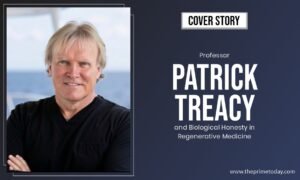
A career shaped by biochemistry, complication management, regenerative science and a refusal to let medical claims outrun the evidence
PROFILE | PROFESSOR DR PATRICK TREACY
Looking Beneath the Surface
Aesthetic medicine has spent much of the past three decades learning how to alter what we see. Professor Patrick Treacy has increasingly focused on the more difficult question: what is happening beneath the surface?
A wrinkle, scar or area of injured tissue is not merely a visible imperfection. It is the outward expression of cellular communication, inflammation, vascular supply, extracellular matrix organisation and repair. That conviction has connected the different parts of Treacy’s career: his early study of biochemistry, postgraduate qualification in dermatology, work in aesthetic and regenerative medicine, management of serious complications, international teaching and humanitarian practice.
It has also led him to a principle he calls Biological Honesty: the strength of a medical claim should never exceed the strength of the biological evidence supporting it.
The idea is particularly relevant as longevity and regenerative medicine expand into peptides, extracellular vesicles, stem-cell products, supplements and increasingly elaborate biomarker panels. Treacy is not opposed to innovation; much of his career has been built upon it. His position is that innovation becomes medicine only when mechanism, product quality, dosage, clinical evidence and meaningful patient outcomes can be connected.
Science Before Aesthetics
Treacy studied biochemistry at Queen’s University Belfast before medicine at the Royal College of Surgeons in Ireland. That foundation shaped the way he later approached the developing field of medical aesthetics. For him, skin was never simply a surface and treatment could never be judged solely by the immediate before-and-after photograph.
Ageing, pigmentation, inflammation, scarring and impaired wound healing are visible consequences of processes occurring at cellular and molecular level. An intervention may change appearance while doing little to restore tissue quality. Conversely, a biologically sound treatment may produce gradual changes that are less dramatic in a photograph but more meaningful to the health and organisation of the tissue.
This distinction became central to Treacy’s thinking: stimulation is not necessarily regeneration. Tissue can be stimulated and still heal through fibrosis or disordered repair. As he puts it, ‘Scar is not a failure of stimulation. It is a failure of organisation.’ Genuine regeneration must therefore be judged not only by activity, but by whether normal structure and function are restored.
When Complications Changed the Question
Some of the most consequential work of Treacy’s career emerged not from routine aesthetic treatment, but from cases in which tissue viability was in danger.
Vascular occlusion following dermal filler injection can progress from pain and discolouration to ischaemia, necrosis and, in rare cases, visual loss. At a time when conservative quantities of hyaluronidase were commonly advocated, Treacy developed and taught high-dose, repeated hyaluronidase rescue approaches for severe hyaluronic-acid filler vascular occlusion. The reasoning was biological and urgent: once perfusion is threatened, treatment should be governed by the anatomy and severity of the vascular emergency, not by the modest dosing conventions of routine aesthetic practice.
His wider complication work examined how established emergency treatment could be supported by attention to oxygenation, inflammation, cellular signalling and wound repair. It also reinforced a lesson that has remained with him: elegant theories are of little value when they fail at the bedside. A protocol must ultimately be measured by whether it protects sight, preserves tissue and improves a patient’s outcome.
These experiences changed the meaning of regenerative medicine for him. It was no longer chiefly about making ageing skin appear younger. It was about whether damaged tissue could survive, organise its repair and recover function.
From Platelets to Cellular Signals
Treacy began using platelet-rich plasma in the early years of regenerative aesthetics, before PRP became commonplace in cosmetic medicine. His later work explored platelet-derived signalling, photobiomodulation and the influence of the tissue microenvironment on healing.
That interest naturally extended to peptides, secretomes, extracellular vesicles and stem-cell signalling. Yet the rapid commercial growth of regenerative medicine has made him more discriminating, not less adventurous. A product does not become regenerative merely because it uses the language of cellular biology.
Peptides illustrate both the promise and the discipline he wants the field to retain. A defined peptide sequence can, in principle, be characterised: its identity, purity, receptor interaction, concentration and dose-response relationship can be investigated. Extracellular vesicle and so-called exosome products may also carry biologically active signals, but their cargo can vary with the source cells, culture conditions, processing, storage and isolation methods. Calling a preparation an exosome does not by itself establish what message it contains, how consistently it delivers that message or what clinical outcome follows.
Treacy therefore separates three categories that commercial medicine often collapses into one: biological plausibility, an interesting experimental signal and demonstrated improvement in meaningful human outcomes. The first may justify research. The second may justify cautious optimism. Only the third justifies a confident clinical claim.
A Wider Medical Education
Treacy’s medical education also unfolded far beyond the aesthetic clinic. His work took him across Ireland, Britain, the United States, Australia, New Zealand, Africa and the Middle East. It included service with the Royal Flying Doctor Service in Australia, medicine in remote communities and work in settings where advanced infrastructure could not be assumed. His humanitarian projects later brought him to communities affected by poverty, disease, disaster and conflict, including work in Africa and Haiti.
Those experiences provided an important counterweight to the commercial world of aesthetics. In one setting, medicine may involve millimetres of facial anatomy; in another, the central question may be whether a patient has access to basic treatment at all. The common obligation is restoration: protecting life, function and dignity with the knowledge and resources available.
This broader perspective has informed more than 150 medical papers and presentations and the training of thousands of doctors and nurses internationally. It has also shaped his books, which move between medicine, scientific history, humanitarian experience and the human stories encountered across a long clinical career.
Awards and international recognition have followed, including three AMEC Trophy honours and multiple MyFaceMyBody awards. Treacy speaks of such recognition with gratitude, but does not treat it as the measure of a medical life. ‘A doctor’s legacy is not found in the awards on the wall. It is found in whether their knowledge improves another human life.’
The Patient Before the Technology
Treacy has treated people from widely different backgrounds, from patients in vulnerable communities to internationally recognised public figures. Among the best-known chapters of his career was his association with Michael Jackson during the singer’s time in Ireland. Yet celebrity, he argues, should never alter the clinical equation. Biology does not recognise fame. Anatomy, consent, confidentiality, complication management and professional responsibility apply equally to every patient.
The same principle informs his concern about some contemporary longevity practice. A patient may now be offered extensive biomarker testing followed by dozens of supplements, peptides and interventions. The complexity can appear scientific, but changing many variables simultaneously makes causality difficult to establish and adverse effects harder to attribute.
The purpose of medicine is not to normalise every laboratory value in isolation. A biomarker may correlate with ageing without being its cause, and changing it does not necessarily improve health or extend life. The better question is whether an intervention improves the biological system that produced the abnormality and whether the patient becomes more functional, resilient or well as a result.
Biological Honesty
Biological Honesty connects the apparently different strands of Treacy’s career. Biochemistry taught him to think in mechanisms. Dermatology taught him to read what internal biology expresses through the skin. Aesthetic medicine demonstrated how intervention can alter tissue. Complication management showed how quickly assumptions become dangerous when biology behaves differently from expectation. Regenerative science opened the possibility of influencing repair rather than disguising damage. Humanitarian medicine supplied the essential reminder that scientific progress matters only when it serves people.
For that reason, Treacy rejects simplistic promises to defeat ageing. Ageing is not a single pathway waiting for one molecule to switch it off. It is the cumulative result of interacting processes involving genomic and epigenetic change, mitochondrial function, proteostasis, inflammation, cellular senescence, immune function, metabolism, intercellular communication and the tissue microenvironment.
The realistic ambition is not immortality. It is to preserve health, function, independence and dignity for as much of the lifespan as possible. Achieving that will require bold science, but it will also require restraint: transparent product characterisation, reproducible methods, proportionate claims, measurable outcomes and the willingness to abandon an attractive idea when the evidence does not support it.
‘Regenerative medicine must be guided by Biological Honesty: the commitment to align intervention with coherent science, measurable outcomes and patient dignity.’
The Next Chapter
After more than three decades in medicine, Treacy remains fascinated by emerging science. What has changed is the threshold he believes it must cross. A peptide may have an intriguing mechanism. An extracellular vesicle may carry an active signal. A supplement may alter a laboratory value. A biomarker may be associated with ageing. None of these observations alone proves that an intervention improves human longevity.
That distinction will become more important as artificial intelligence, cellular therapies, gene regulation and longevity science converge. The technologies will become more powerful, and the commercial stories surrounding them will become more persuasive. Medicine will need physicians willing both to explore the frontier and to question it.
For Patrick Treacy, those positions are not contradictory. They are the essence of responsible innovation. The task is not simply to move medicine into the future as quickly as possible, but to ensure that scientific truth and the welfare of the patient arrive there with it.
Innovation should remain restless. Integrity must remain non-negotiable.