
The Responsible Educator: Suchit Ahuja’s Applied Framework for Frugal Digital Innovation, Constraint-Based Systems Thinking, and Sociotechnical AI Governance
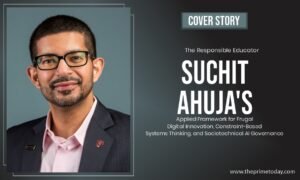
Modern business technology programs face intense pressure to produce graduates who can manage high-volume technical data without losing sight of human and societal outcomes. Few academics embody the answer to that challenge as completely as Suchit Ahuja, who is driving this educational evolution at the John Molson School of Business, Concordia University in Montreal. As Co-Director of the Applied AI Institute and an Associate Professor of Business Technology Management, he combines academic service with data-backed curricula. He also served as the founding Director of the Master of Science Program in Business Analytics and Technology Management, where he shaped a curriculum that enables future business professionals to grasp cutting-edge technological advances while maintaining deep ethical awareness. His administrative guidance bridges the vast historical divide that has long existed between raw data execution and strategic corporate management — and, in doing so, equips his students with the exact analytical tools required to lead modern enterprise networks.
This dedication to balanced, rigorous instruction positions him among the prominent education leaders to follow in 2026. Academic institutions look to his pedagogical methods to transform traditional digital technology, innovation, and transformation courses into active hubs for sociotechnical research, and his classroom excellence has earned him elite institutional honors, including the ‘2021 Dean’s Excellence in Teaching Award’ and the ‘2023 Excellence in Academic Service Award’ at the John Molson School of Business, alongside the prestigious ‘2022 President’s Excellence in Teaching Award’ at Concordia University. By combining real-world case studies with deep industry logic, he teaches his students to investigate technical problems through a highly responsible, human-centered lens.
The Applied AI Frontier: Integrating Engineering, Business, and Social Science through Systems Thinking
Suchit recently stepped into the Co-Director role at the Applied AI Institute, a position that deliberately bridges Engineering, Business, and Social Science. He believes this cross-disciplinary ‘triangulation’ is the only effective way to lead AI research and education today, because AI is no longer merely an engineering or technology field. It is everywhere. It affects our daily lives. It has become a complex sociotechnical, socioeconomic, and increasingly societal discipline. Research, teaching, pedagogy, and experiential learning, he argues, must therefore center on complex systems and systems thinking around the contemporary problems that business, society, and government are facing. The siloed approach no longer works. “We need to get into intersections and overlaps among different disciplines to explore and exploit the most valuable aspects of the AI frontier landscape,” he says.
His research often explores the organizational and societal consequences of AI, and he is deliberately shifting the educational focus from ‘what AI can do’ to ‘what AI should do’ in a responsible business context. Like most technology, AI can be used for good and bad — but with AI, both sides become exponentially consequential, because for the first time, “we have a technology that can think and generate ideas, narratives, and logic autonomously.” That is why he places such weight on establishing governance and the rules of engagement correctly, so that the principle of ‘do no harm’ can be upheld. This is where responsible AI principles, ethical AI guidelines, and accountability for AI-based decision-making come in. Businesses, he cautions, need to be aware of the best practices and guiding principles within such frameworks to deal with issues like algorithmic bias, poor vetting of open training data, embedding human prejudice into code, and the further marginalization of communities and individuals already at a disadvantage due to the nature and evolution of AI technology.
Most AI education, Suchit observes, is capability-first — here’s what the model does, here’s how to deploy it — with the ‘should’ arriving later as a separate ethics week that everyone quietly treats as soft. He considers that separation the real failure. At the Applied AI Institute, his team is working to make the normative question inseparable from the technical one: the moment a student establishes that a system can do something, the very next questions are under what conditions it should, who absorbs the downside, and who gets to decide. In a business context, that means moving ‘responsible AI’ away from compliance checklists and toward judgment — the harder skill of reasoning through cases where the technically optimal answer and the defensible one genuinely diverge.
The Lean Framework: Applying Frugal Innovation and Small Language Models to Close the Digital Divide
Suchit has done extensive work on frugal innovation in emerging markets, which raises a natural question: how can these ‘lean’ principles be applied to AI adoption in higher education to prevent a widening digital divide between well-funded and marginalized institutions? In his view, AI is the great equalizer. Most institutions will have access to some form of AI at a somewhat affordable cost; it is what they do with it, and how they leverage it for strategic and tactical advantage, that will set them apart in the competitive landscape. Nonetheless, he acknowledges that the AI divide is very real — and that the sector must do everything in its power to make AI as inclusive and accessible as possible.
Within higher education, lean principles will play a major role in how institutions integrate, adopt, and utilize AI across their academic and administrative operations. But the institution with the deepest pockets and the most expensive AI tools will not necessarily win. The winners, Suchit predicts, will be those who know how to operate within constraints, integrate AI strategically, and invest in the tools and technologies that bring maximum ROI. “Those who tend to operate as if we are still living in the 1980s will likely fail to move forward with AI,” he warns. Marginalized institutions, for example, may rely on Small Language Models (SLMs) instead of LLMs, and Edge AI instead of expensive equipment, to fulfill their AI needs. For Suchit, the constrained context is a source of design intelligence, not a lesser version of the rich one — marginalized institutions are closest to the problems of access and relevance, and they often produce the most transferable solutions. “We train students in constraint-based innovation and digital transformation across all layers of the AI stack – infrastructure, chips, model, data, application, and interface.”
The Orchestration Blueprint: Evolving Business Technology Curricula to Prioritize Strategic Judgment
As an Associate Professor at one of Canada’s top business schools, Suchit is often asked how the Business Technology Management (BTM) curriculum should evolve to ensure graduates aren’t just AI users, but strategic AI orchestrators. His answer is direct: teach students not to treat AI as a tool, but as a game-changing strategic differentiator that can be deployed for competitive advantage within business and society. In practice, that means exposing students to the research, practice, and policy sides of AI throughout their training, across the breadth of the school’s programs. The faculty constantly update and refresh the curriculum across the undergraduate, MSc, EMBA, and PhD programs to integrate more AI learning opportunities, and push students into experiential learning activities and real-world immersion projects that take them outside their comfort zones and train them to work with industry partners while still in school. This prepares them well for their careers and embeds skills like analysis, communication, project management, and navigating complex business environments.
“We’re shifting assessment away from ‘can you produce an output with the tool’ toward ‘can you decide whether this is the right tool, judge whether the output can be trusted, and own the consequences when it’s wrong’ — because orchestration is fundamentally about judgment, not operation,” Suchit explains. It also means teaching AI as a systems and portfolio question rather than a single-tool skill: real value comes from how models, data, processes, and people are orchestrated together.
The Integrated Classroom: Translating Complex Sociotechnical Concepts into Practical Learning Outcomes
Translating these complex concepts into practical learning outcomes is where Suchit’s classroom craft becomes visible. His starting point is that AI requires responsible leadership that understands technology as simultaneously ‘economic, technical, social, and political’ — and economics drives everything else. Fundamentally, he notes, AI promises to bring efficiency and optimization, and to create new value for businesses. Yet within the AI landscape, economics is intertwined with technical, social, political, and environmental consequences, both intended and unintended.
He therefore works with students on complex case-based learning that simulates managerial decision-making on these issues and regularly invites guest speakers from industry into the classroom to share their expertise. Most of his courses deploy experiential learning techniques, team-based projects, and real-world engagement with nearly every type of organization — micro, small, and medium enterprises, large multinationals, NGOs, and public policy advisory bodies. He also makes a point of bringing contemporary AI issues into the classroom. In one of his MSc courses, he and his students were working on a case about TikTok deploying AI for video suggestions; they ended up watching the entire Senate hearing of TikTok’s CEO to fully immerse themselves in the context of the case. The exercise gave students a valuable learning advantage and brought the political and social perspectives squarely into the discussion. Other sessions have explored themes around social enterprises, marginalized populations, emerging markets, healthcare platforms, and rural education. At the end of the day, he wants students to hold competency across every aspect of AI — because a technical design choice is a distributional choice, and a governance arrangement is a political one.
The Mitacs Partnership: Bridging the Academic Research Valley of Death through Real-World Industry Skin in the Game
The partnership between Concordia’s Applied AI Institute and Mitacs stands as a significant milestone for 2026, designed to bridge the notorious ‘valley of death’ between academic AI research and real-world workforce readiness. What distinguishes it, Suchit explains, is that the way the partnership is built actually resists the valley-of-death problem rather than just gesturing at it. There are two complementary pieces. The first is the training series — an online program the Applied AI Institute runs with Mitacs, moving from AI fundamentals and applied problem-solving through project management and into responsible and sustainable AI. Suchit and his teams deliberately don’t stop at ‘here’s how the tool works’; they end where the hard questions live.
But a workshop alone doesn’t cross the valley. The bridge is what sits underneath it: the Mitacs Umbrella program, where graduate students and recent graduates are embedded on real projects with a Canadian-incorporated industry partner that must put up half the funding before the work starts. That partner contribution does quiet but important work — it means the problem is real enough that someone is willing to pay for it, which is exactly the discipline academic research often lacks. The student isn’t translating findings over a wall; they’re inside a live constraint, on a funded footing, solving a problem that matters to an organization operating in the world. That is where workforce readiness actually forms. The valley of death is widest when research is admired in a lab and never survives contact with reality. Concordia and Mitacs are narrowing it by making sure students meet that reality early, with a partner who has skin in the game and a frame that keeps the ‘should’ question in the room the whole way across.
The Governance Imperative: Overcoming the Corporate Deployment Blind Spots and Championing Technical Equity
In Suchit’s view, the biggest mistake corporate leaders make when integrating AI into their business models today is treating AI as a tool to deploy rather than a decision to govern. Leaders ask ‘what can this do for us?’ and rush to ship, skipping the prior question of what it should do, for whom, and at what cost. That is how organizations end up with systems that are efficient and indefensible at the same time. At Concordia’s Applied AI Institute, he and his colleagues train the next generation to reverse the order: every time a student establishes that a system can do something, the next questions are who absorbs the downside and who decides. By embedding students in real industry projects through Mitacs, under a frame that is explicitly about responsible, acceptable AI, judgment — not just technical fluency — becomes the reflex. The goal is graduates who can build the system and tell you whether it should exist.
Through his work with the Quebec Black Entrepreneurship Knowledge Hub, Suchit also champions diversity — and to him, gender and racial equity in AI is not just a social imperative but a requirement for technical accuracy and business success. A model is only as good as the world represented in its data; when whole populations are thin or absent, the system isn’t neutral — it’s confidently wrong about exactly the people it underrepresents. Facial analysis that fails on darker-skinned women, hiring models that automate yesterday’s exclusions: those aren’t merely unfair systems, they’re inaccurate ones, and an inaccurate product in a diverse market is a business liability, not a social footnote. The blind spot in the data is usually the blind spot in the room, which is why representation in who builds AI is a technical safeguard, not a courtesy. Equity, as he puts it, is what accuracy looks like when you take the whole population seriously.
The National Stack Standard: The Sovereign Role of Independent Academic Institutions in 2026 AI Regulation
On the international standards evolving in 2026 to keep pace with AI, Suchit — who has served on the Standards Council of Canada — is characteristically blunt: Canada now has an “AI for All” national strategy, and the international standards racing to govern AI only deliver sovereignty if the layers beneath them trust each other by design. Canada now has an identity standard, a real-time rail, and open banking, but these were built on different timelines under different owners. That, he argues, is a pile, not a stack — and standards laid over a pile deliver sovereignty in name only. “As the Digital Governance Council puts it, if we rent the layers, we rent our defense. Universities are the one actor not selling a layer.”
The job for him and his peers, Suchit adds, is to do the independent work of turning voluntary codes into operating standards with real conformity assessment, to train the people who will staff both the regulators and the firms, and to insist that the stack is built with the communities it affects, not deployed at them. Canada, he believes, is building slowly enough to still get this right. That’s the choice — and it’s Canada’s to make now.
The 2030 Applied Legacy: Frugal Public-Interest Innovations and Training Cross-Border Human Orchestrators
Looking back from 2030, Suchit says he’d want his legacy to be a simple phrase made real: responsibly applied. Not a center that published about responsible AI, but one that proved it works in the world. Concretely, that means a few things he hopes will have compounded by then. That the Institute is recognized globally as a leading center for responsible, acceptable AI — not as a slogan, but because the systems it helped build were measurably more trustworthy. That the Concordia–India AI Impact Initiative matured into the clearest demonstration of what he has argued for years: that frugal, public-interest AI built across two very different contexts travels further than anything designed in one. That its industry partnerships became genuine bridges across the valley of death, not logos on a webpage.
And underneath all of it lies the legacy that will actually outlast him: students who graduate from his programs able to build a system and tell you whether it should exist — now sitting in the rooms where those decisions get made. Stability and growth matter, but they’re the means. The real legacy is whether ‘responsibly applied’ came to mean responsible by design, and whether the people he and his team trained carry that reflex everywhere they go.